See Katharine, Manser Renee, Park Elyse R, Steinfort Daniel, King Bridget, Piccolo Francesco, Manners David
Dept of Respiratory Medicine, Northern Hospital, Epping, Victoria, Australia.
Dept of Respiratory and Sleep Medicine, Royal Melbourne Hospital, Parkville, Victoria, Australia.
ERJ Open Res. 2020 Mar 16;6(1). doi: 10.1183/23120541.00158-2019. eCollection 2020 Jan.
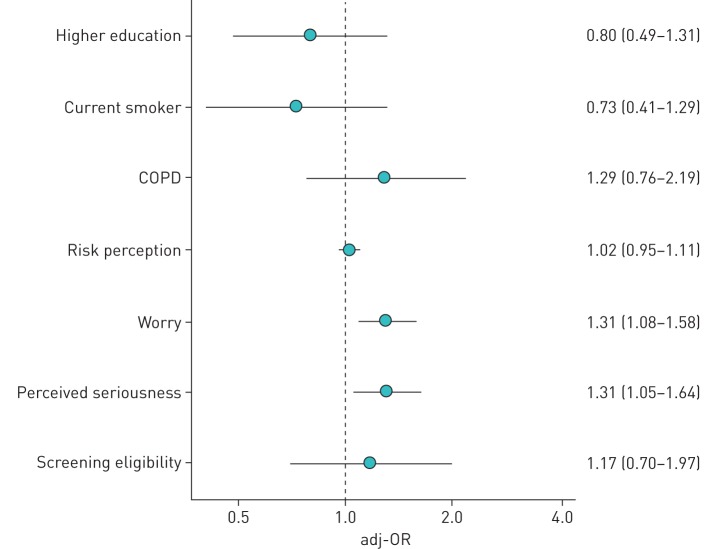
Lung cancer screening is effective at reducing lung cancer deaths when individuals at greatest risk are screened. Recruitment initiatives target all current and former smokers, of whom only some are eligible for screening, potentially leading to discordance between screening preference and eligibility in ineligible individuals. The objective of the present study was to identify factors associated with preference for screening among ever-smokers. Ever-smokers aged 55-80 years attending outpatient clinics at three Australian hospitals were invited. The survey recorded: 1) demographics; 2) objective lung cancer risk and screening eligibility using the Prostate Lung Colon Ovarian 2012 risk model; and 3) perceived lung cancer risk, worry about and seriousness of lung cancer using a validated questionnaire. Multivariable ordinal logistic regression identified predictors of screening preference. The survey was completed by 283 individuals (response rate 27%). Preference for screening was high (72%) with no significant difference between low-dose computed tomography screening-eligible and -ineligible individuals (77% 68%, p=0.11). Worry about lung cancer (adjusted-proportional odds ratio (adj-OR) 1.31, 95% CI 1.08-1.58; p=0.007) and perceived seriousness of lung cancer (adj-OR 1.31, 95% CI 1.05-1.64; p=0.02) were associated with higher preference for lung cancer screening while screening eligibility was not. The concept of "early detection" was the most important driver to have screening while practical obstacles like difficulty travelling to the scan or taking time off work were the least important barriers to screening. Most current or former smokers prefer to undergo screening. Worry about lung cancer and perceived seriousness of the diagnosis are more important drivers for screening preference than eligibility status.
当对风险最高的个体进行肺癌筛查时,肺癌筛查在降低肺癌死亡方面是有效的。招募计划针对所有当前和曾经的吸烟者,其中只有一些人符合筛查条件,这可能导致不符合条件的个体在筛查偏好和资格之间出现不一致。本研究的目的是确定与曾经吸烟者的筛查偏好相关的因素。邀请了在澳大利亚三家医院门诊就诊的55 - 80岁的曾经吸烟者。该调查记录了:1)人口统计学特征;2)使用前列腺、肺、结肠、卵巢癌风险评估模型(Prostate Lung Colon Ovarian 2012 risk model)评估的客观肺癌风险和筛查资格;3)使用经过验证的问卷评估的感知肺癌风险、对肺癌的担忧程度和肺癌的严重性。多变量有序逻辑回归确定了筛查偏好的预测因素。283人完成了调查(回复率27%)。筛查偏好较高(72%),低剂量计算机断层扫描筛查符合条件和不符合条件的个体之间无显著差异(77%对68%,p = 0.11)。对肺癌的担忧(调整后的比例优势比(adj - OR)1.31,95%置信区间1.08 - 1.58;p = 0.007)和感知到的肺癌严重性(adj - OR 1.31,95%置信区间1.05 - 1.64;p = 0.02)与更高的肺癌筛查偏好相关,而筛查资格则不然。“早期发现”的概念是进行筛查的最重要驱动因素,而诸如前往扫描困难或请假等实际障碍是筛查的最不重要障碍。大多数当前或曾经的吸烟者更喜欢接受筛查。与资格状态相比,对肺癌的担忧和对诊断严重性的感知是筛查偏好更重要的驱动因素。