Rizk Yasmin Silva, Santos-Pereira Sandy, Gervazoni Luiza, Hardoim Daiana de Jesus, Cardoso Flávia de Oliveira, de Souza Celeste da Silva Freitas, Pelajo-Machado Marcelo, Carollo Carlos Alexandre, de Arruda Carla Cardozo Pinto, Almeida-Amaral Elmo Eduardo, Zaverucha-do-Valle Tânia, Calabrese Kátia da Silva
Laboratório de Imunomodulação e Protozoologia, Instituto Oswaldo Cruz, Fundação Oswaldo Cruz, Rio de Janeiro, Brazil.
Laboratório de Bioquímica de Tripanosomatídeos, Instituto Oswaldo Cruz, Fundação Oswaldo Cruz, Rio de Janeiro, Brazil.
Front Cell Infect Microbiol. 2021 Feb 25;11:615814. doi: 10.3389/fcimb.2021.615814. eCollection 2021.
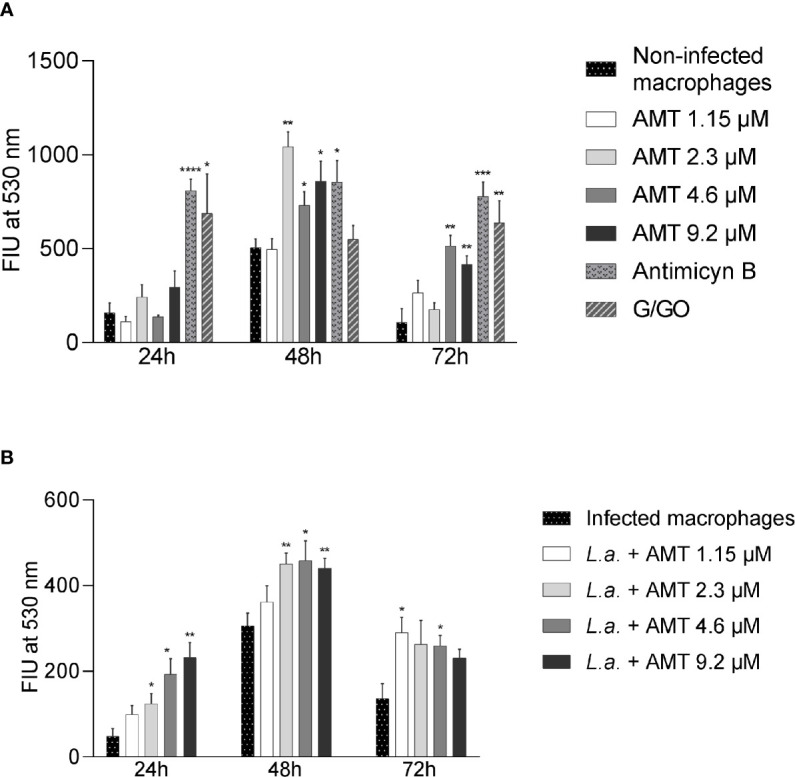
Treatment of leishmaniasis is a challenging subject. Although available, chemotherapy is limited, presenting toxicity and adverse effects. New drugs with antileishmanial activity are being investigated, such as antiparasitic compounds derived from plants. In this work, we investigated the antileishmanial activity of the biflavonoid amentoflavone on the protozoan . Although the antileishmanial activity of amentoflavone has already been reported , the mechanisms involved in the parasite death, as well as its action , remain unknown. Amentoflavone demonstrated activity on intracellular amastigotes in macrophages obtained from BALB/c mice (IC 2.3 ± 0.93 μM). No cytotoxicity was observed and the selectivity index was estimated as greater than 10. Using BALB/c mice infected with we verified the effect of an intralesional treatment with amentoflavone (0.05 mg/kg/dose, in a total of 5 doses every 4 days). Parasite quantification demonstrated that amentoflavone reduced the parasite load in treated footpads (46.3% reduction by limiting dilution assay and 56.5% reduction by Real Time Polymerase Chain Reaction). Amentoflavone decreased the nitric oxide production in peritoneal macrophages obtained from treated animals. The treatment also increased the expression of ferritin and decreased iNOS expression at the site of infection. Furthemore, it increased the production of ROS in peritoneal macrophages infected . The increase of ROS , associated with the reduction of NO and iNOS expression , points to the antioxidant/prooxidant potential of amentoflavone, which may play an important role in the balance between inflammatory and anti-inflammatory patterns at the infection site. Taken together these results suggest that amentoflavone has the potential to be used in the treatment of cutaneous leishmaniasis, working as an ally in the control and development of the lesion.
利什曼病的治疗是一个具有挑战性的课题。尽管有化疗方法可用,但化疗存在局限性,会产生毒性和不良反应。目前正在研究具有抗利什曼原虫活性的新药,例如源自植物的抗寄生虫化合物。在这项研究中,我们研究了双黄酮穗花杉双黄酮对该原生动物的抗利什曼原虫活性。尽管穗花杉双黄酮的抗利什曼原虫活性已有报道,但其导致寄生虫死亡的机制及其作用方式仍不清楚。穗花杉双黄酮对从BALB/c小鼠获得的巨噬细胞内的无鞭毛体显示出活性(IC 2.3±0.93μM)。未观察到细胞毒性,选择性指数估计大于10。使用感染了[此处原文缺失感染物相关信息]的BALB/c小鼠,我们验证了病灶内注射穗花杉双黄酮(0.05mg/kg/剂量,每4天共注射5剂)的效果。寄生虫定量分析表明,穗花杉双黄酮降低了治疗后足垫中的寄生虫载量(通过有限稀释法降低了46.3%,通过实时聚合酶链反应降低了56.5%)。穗花杉双黄酮降低了从治疗动物获得的腹膜巨噬细胞中一氧化氮的产生。该治疗还增加了感染部位铁蛋白的表达并降低了诱导型一氧化氮合酶的表达。此外,它增加了感染的腹膜巨噬细胞中活性氧的产生。活性氧的增加,与一氧化氮和诱导型一氧化氮合酶表达的降低相关,表明穗花杉双黄酮具有抗氧化/促氧化潜力,这可能在感染部位的炎症和抗炎模式平衡中发挥重要作用。综合这些结果表明,穗花杉双黄酮有潜力用于治疗皮肤利什曼病,在病变的控制和发展中发挥辅助作用。