Gil Hélio M, Price Thomas W, Chelani Kanik, Bouillard Jean-Sebastien G, Calaminus Simon D J, Stasiuk Graeme J
Department of Imaging Chemistry and Biology, School of Biomedical Engineering and Imaging Sciences, King's College London, 4th Floor Lambeth Wing, St Thomas' Hospital, London SE1 7EH, London, UK.
Department of Biomedical Sciences, Faculty of Health Sciences, University of Hull, Cottingham Road, HU6 7RX Hull, UK.
iScience. 2021 Feb 15;24(3):102189. doi: 10.1016/j.isci.2021.102189. eCollection 2021 Mar 19.
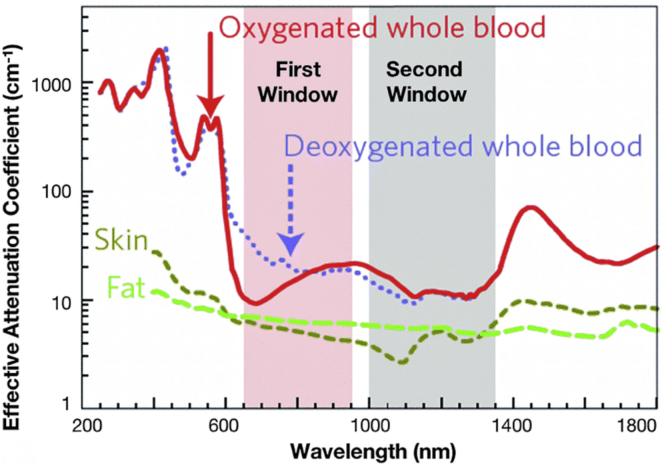
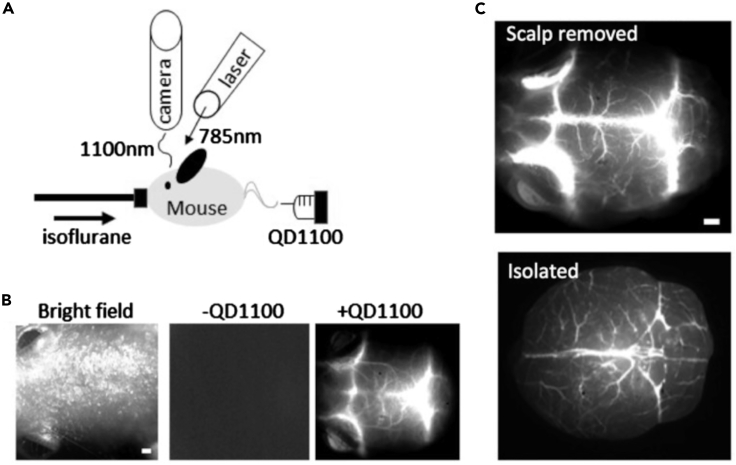
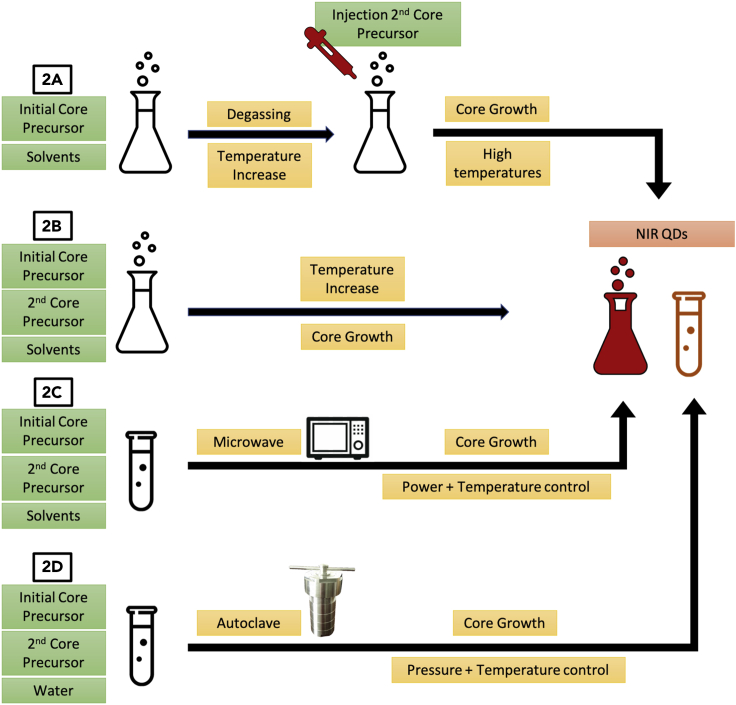
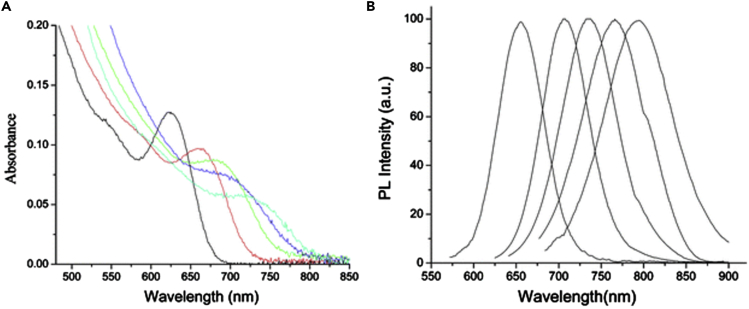
Fluorescence imaging has gathered interest over the recent years for its real-time response and high sensitivity. Developing probes for this modality has proven to be a challenge. Quantum dots (QDs) are colloidal nanoparticles that possess unique optical and electronic properties due to quantum confinement effects, whose excellent optical properties make them ideal for fluorescence imaging of biological systems. By selectively controlling the synthetic methodologies it is possible to obtain QDs that emit in the first (650-950 nm) and second (1000-1400 nm) near infra-red (NIR) windows, allowing for superior imaging properties. Despite the excellent optical properties and biocompatibility shown by some NIR QDs, there are still some challenges to overcome to enable there use in clinical applications. In this review, we discuss the latest advances in the application of NIR QDs in preclinical settings, together with the synthetic approaches and material developments that make NIR QDs promising for future biomedical applications.
近年来,荧光成像因其实时响应和高灵敏度而备受关注。事实证明,开发用于这种成像方式的探针是一项挑战。量子点(QDs)是胶体纳米颗粒,由于量子限制效应而具有独特的光学和电子特性,其优异的光学特性使其成为生物系统荧光成像的理想选择。通过选择性地控制合成方法,可以获得在第一近红外(NIR)窗口(650 - 950 nm)和第二近红外窗口(1000 - 1400 nm)发射的量子点,从而实现卓越的成像性能。尽管一些近红外量子点表现出优异的光学特性和生物相容性,但要使其能够用于临床应用仍有一些挑战需要克服。在这篇综述中,我们讨论了近红外量子点在临床前应用中的最新进展,以及使近红外量子点在未来生物医学应用中具有前景的合成方法和材料开发。