Du Shangguang, Huang Xueyong, Cai Yali, Hao Yingbin, Qiu Shengrong, Liu Lihua, Cui Meng, Luo Liping
School of Life Sciences, Nanchang University, Nanchang, China.
School of Life Sciences, Nanchang Normal University, Nanchang, China.
Front Plant Sci. 2021 Feb 26;12:631421. doi: 10.3389/fpls.2021.631421. eCollection 2021.
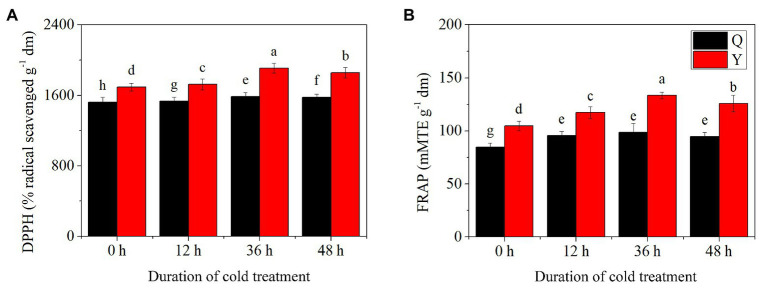
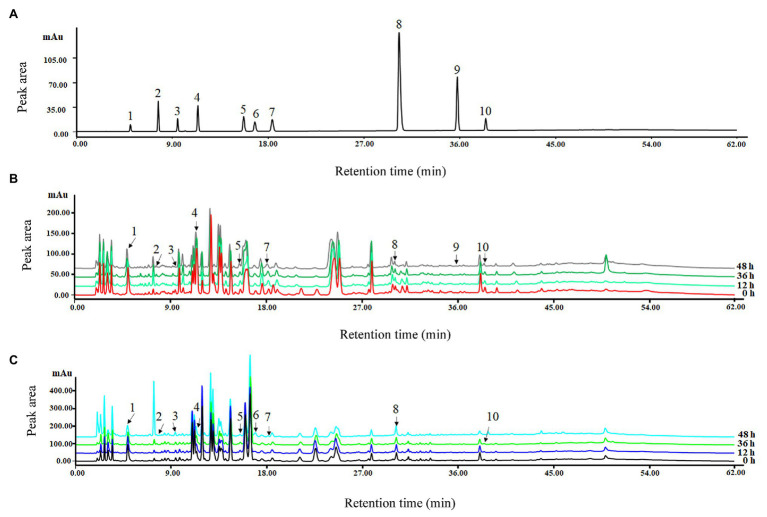
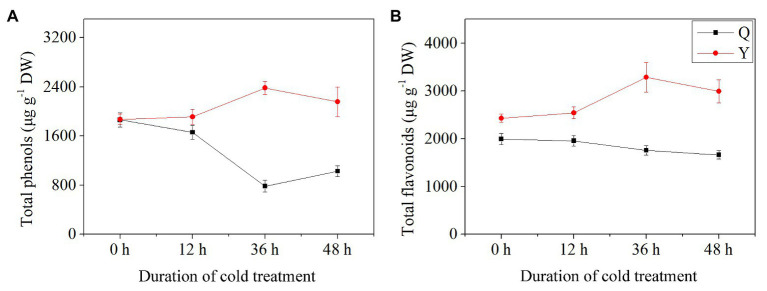
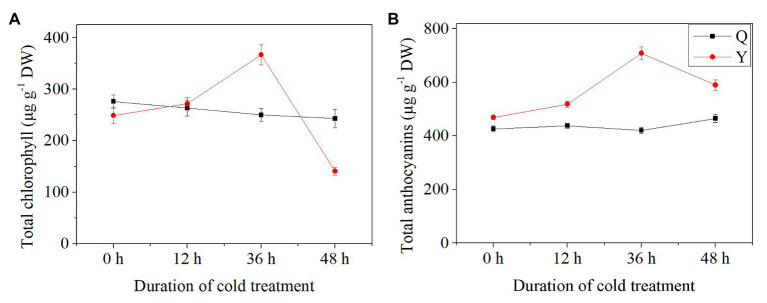
Variations in antioxidant compounds were examined in seedlings of two rice cultivars (Qiutianxiaoting and 93-11) exposed to low temperature (4°C) for 0, 12, 36, and 48 h. Antioxidant activity was identified by 2,2-diphenyl-1-picrylhydrazyl (DPPH) and ferric reducing antioxidant power (FRAP) assays. The concentrations of total phenols, flavonoids, chlorophyll, and anthocyanins (ACNs) were determined by spectrophotometry. In addition, high-performance liquid chromatography (HPLC) was used to reveal the changes in phenolic compound concentrations in rice seedlings under chilling treatment. Results showed that antioxidant concentrations and antioxidant activity after chilling treatment were higher in 93-11 compared to Qiutianxiaoting, reaching the highest level at 36 h chilling treatment in 93-11. Phenolic compounds in Qiutianxiaoting decreased between 12 and 36 h but then increased at 48 h, whereas the corresponding levels in 93-11 increased as chilling time increased. Moreover, 10 phenolic compounds were detected and quantified by HPLC, of which gallic acid and caffeic acid tended to only exist in 93-11, whereas rutin was observed only in Qiutianxiaoting. The results of this study could be leveraged to optimize the antioxidant potential of rice in the context of healthy food choices.
在两个水稻品种(秋天下亭和93 - 11)的幼苗中检测了抗氧化化合物的变化,这些幼苗在4°C低温下分别处理0、12、36和48小时。通过2,2 - 二苯基 - 1 - 苦基肼(DPPH)和铁还原抗氧化能力(FRAP)测定法鉴定抗氧化活性。通过分光光度法测定总酚、黄酮类化合物、叶绿素和花青素(ACN)的浓度。此外,使用高效液相色谱法(HPLC)揭示低温处理下水稻幼苗中酚类化合物浓度的变化。结果表明,与秋天下亭相比,93 - 11在低温处理后的抗氧化剂浓度和抗氧化活性更高,在93 - 11中,低温处理36小时时达到最高水平。秋天下亭中的酚类化合物在12至36小时之间减少,但在48小时时增加,而93 - 11中的相应水平随着低温处理时间的增加而增加。此外,通过HPLC检测并定量了10种酚类化合物,其中没食子酸和咖啡酸倾向于仅存在于93 - 11中,而芦丁仅在秋天下亭中被观察到。本研究结果可用于在健康食品选择的背景下优化水稻的抗氧化潜力。