Paediatric Infectious Disease Research Group, Institute for Infection and Immunity, St. George's University of London, London, United Kingdom.
Department of Biology, University of Lyon, Université Claude Bernard Lyon, ENS de Lyon, CNRS, UMR, Lyon, France.
PLoS One. 2021 Mar 15;16(3):e0248218. doi: 10.1371/journal.pone.0248218. eCollection 2021.
Increasingly, vaccine efficacy studies are being recommended in low-and-middle-income countries (LMIC), yet often facilities are unavailable to take and store infant blood samples correctly. Dried blood spots (DBS), are useful for collecting blood from infants for diagnostic purposes, especially in low-income settings, as the amount of blood required is miniscule and no refrigeration is required. Little is known about their utility for antibody studies in children. This systematic review aims to investigate the correlation of antibody concentrations against infectious diseases in DBS in comparison to serum or plasma samples that might inform their use in vaccine clinical trials.
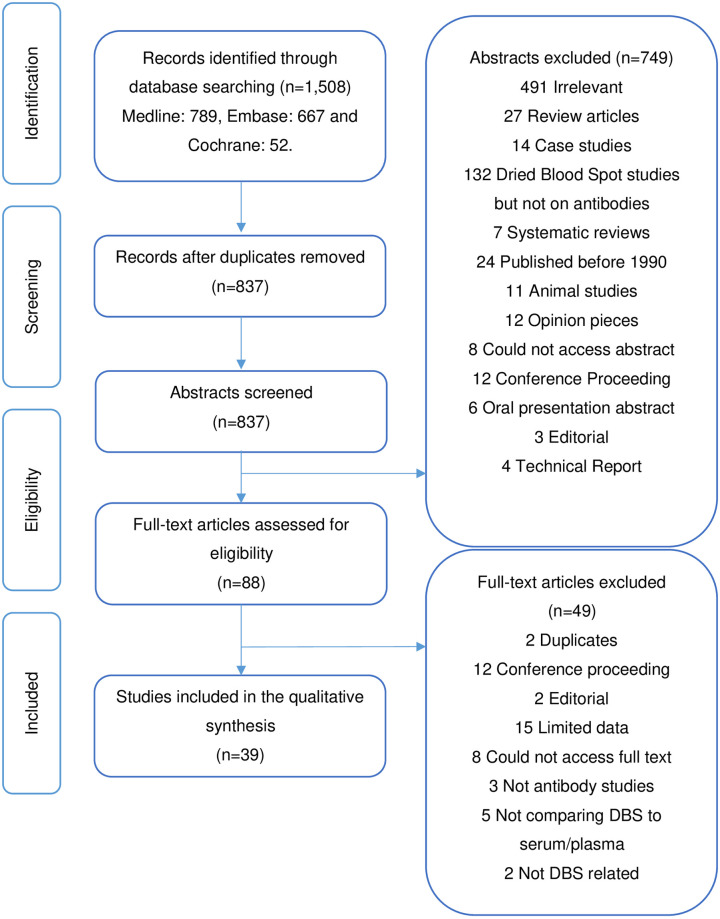
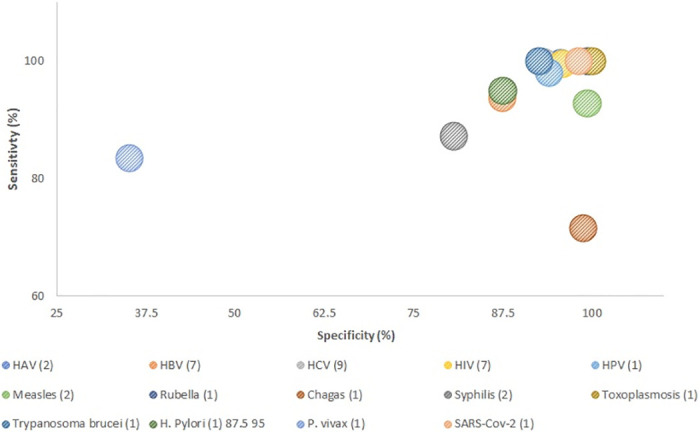
We searched MEDLINE, Embase and the Cochrane library for relevant studies between January 1990 to October 2020 with no language restriction, using PRISMA guidelines, investigating the correlation between antibody concentrations in DBS and serum or plasma samples, and the effect of storage temperature on DBS diagnostic performance. We included 40 studies in this systematic review. The antibody concentration in DBS and serum/plasma samples reported a good pooled correlation, (r2 = 0.86 (ranged 0.43 to 1.00)). Ten studies described a decline of antibody after 28 days at room temperature compared to optimal storage at -20°C, where antibodies were stable for up to 200 days. There were only five studies of anti-bacterial antibodies.
There is a good correlation between antibody concentrations in DBS and serum/plasma samples, supporting the wider use of DBS in vaccine and sero-epidemiological studies, but there is limited data on anti-bacterial antibodies. The correct storage of DBS is critical and may be a consideration for longer term storage.
越来越多的疫苗效力研究正在中低收入国家(LMIC)中被推荐,然而,许多设施无法正确地采集和储存婴儿血液样本。干血斑(DBS)可用于收集婴儿的血液样本进行诊断,特别是在低收入环境中,因为所需的血量非常少,且不需要冷藏。关于其在儿童抗体研究中的应用,人们知之甚少。本系统评价旨在调查 DBS 中针对传染病的抗体浓度与血清或血浆样本之间的相关性,这可能为其在疫苗临床试验中的应用提供信息。
我们使用 PRISMA 指南,在 1990 年 1 月至 2020 年 10 月期间,在 MEDLINE、Embase 和 Cochrane 图书馆中进行了无语言限制的相关研究检索,调查了 DBS 中抗体浓度与血清或血浆样本之间的相关性,以及储存温度对 DBS 诊断性能的影响。我们将 40 项研究纳入本系统评价。DBS 和血清/血浆样本中的抗体浓度报告了良好的总体相关性(r2=0.86(范围 0.43 至 1.00))。有 10 项研究描述了在室温下储存 28 天后,与在 -20°C 下最佳储存相比,抗体水平下降,而抗体在 200 天内保持稳定。仅有 5 项研究涉及抗细菌抗体。
DBS 中抗体浓度与血清/血浆样本之间具有良好的相关性,支持在疫苗和血清流行病学研究中更广泛地使用 DBS,但关于抗细菌抗体的数据有限。DBS 的正确储存至关重要,可能需要考虑更长时间的储存。