Institute for Sociology, Centre for Social Sciences, Budapest, Hungary.
Institute of Economics, Centre for Economic and Regional Studies, Budapest, Hungary.
PLoS One. 2021 Mar 15;16(3):e0248638. doi: 10.1371/journal.pone.0248638. eCollection 2021.
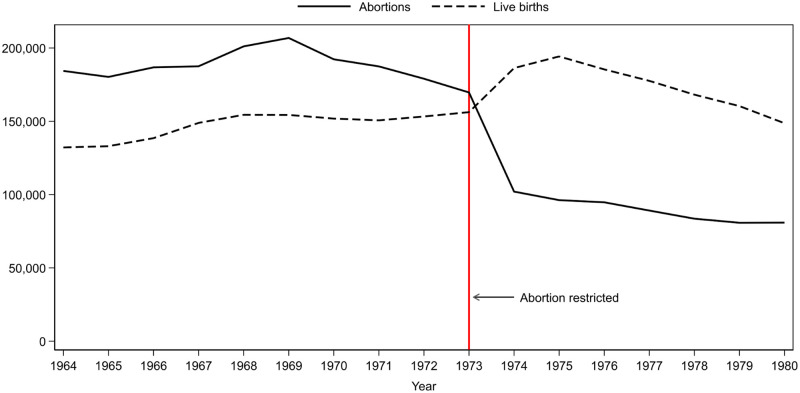
We examine the long-term consequences of restricted access to abortion following a change in the Hungarian abortion law in 1974. Due to a change that restricted access to legal abortions, the number of induced abortions decreased from 169,650 to 102,022 between 1973 and 1974, whereas the number of live births increased from 156,224 to 186,288. We analyze the effects on the adult outcomes of the affected cohort of newborns (educational attainment, labor market participation, teen fertility). We use matched large-scale, individual-level administrative datasets of the Hungarian Central Statistical Office (population census 2011; live birth register), and we estimate the effects by comparing children born within a short timespan around the time the law change came into effect. We apply a difference-in-differences approach, building on the special rules of the new law that, despite the severe restriction, still made abortion permissible for selected groups of women. We control for the compositional change in the population of parents, rule out the effect of (unobserved) time trends and other potential behavioral responses to the law change, and draw causal inferences. We find that restricted access to abortion had, on average, a negative impact on the socioeconomic outcomes of the affected cohort of children. Children born after the law change have had worse educational outcomes, a greater likelihood of being unemployed at age 37, and a higher probability of being a teen parent.
我们研究了 1974 年匈牙利堕胎法变更后限制堕胎机会对长期后果的影响。由于一项限制合法堕胎机会的变更,1973 年至 1974 年间,人工流产数量从 169650 例降至 102022 例,而活产数量从 156224 例增至 186288 例。我们分析了受影响新生儿队列(教育程度、劳动力市场参与度、青少年生育率)的成人结果的影响。我们使用了匈牙利中央统计局的大规模、个人层面的行政数据集(2011 年人口普查;活产登记)进行分析,并通过比较该法律变更生效前后短期内出生的儿童来估计影响。我们采用了差异中的差异方法,该方法基于新法律的特殊规定,尽管限制严格,但仍允许某些特定群体的妇女进行堕胎。我们控制了父母群体的组成变化,排除了(未观察到的)时间趋势和其他可能对法律变更产生的行为反应的影响,并得出了因果推论。我们发现,限制堕胎机会平均对受影响儿童队列的社会经济结果产生了负面影响。法律变更后出生的儿童的教育成果较差,37 岁时失业的可能性更大,成为青少年父母的概率也更高。