Center for Neuroscience, University of Pittsburgh, Pittsburgh, PA, USA.
Department of Psychiatry, University of Pittsburgh, Pittsburgh, PA, USA.
Transl Psychiatry. 2021 Mar 15;11(1):171. doi: 10.1038/s41398-021-01290-1.
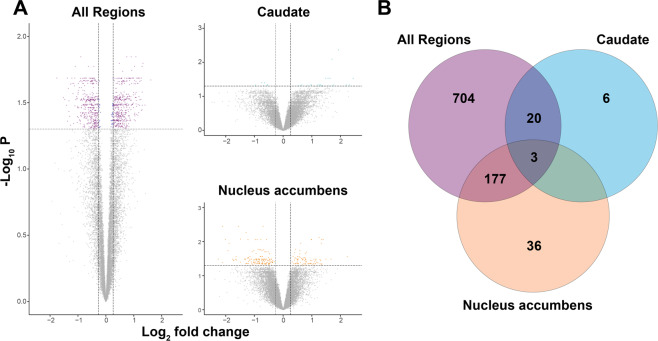
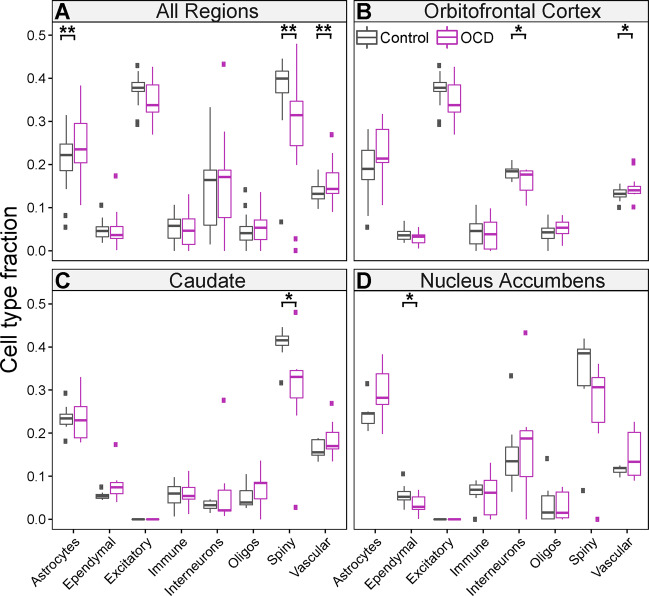
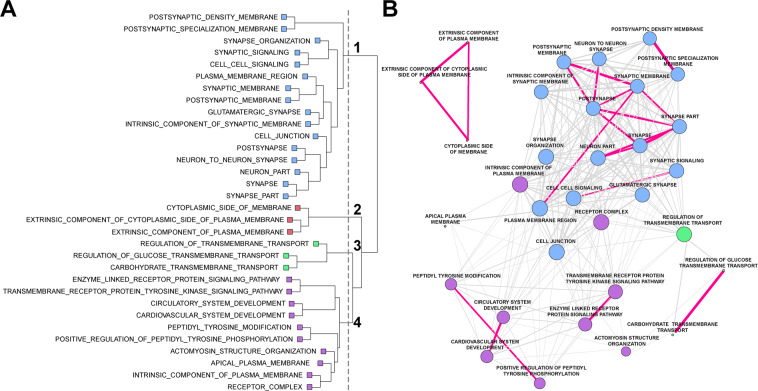
Obsessive-compulsive disorder (OCD) is a chronic and severe psychiatric disorder for which effective treatment options are limited. Structural and functional neuroimaging studies have consistently implicated the orbitofrontal cortex (OFC) and striatum in the pathophysiology of the disorder. Recent genetic evidence points to involvement of components of the excitatory synapse in the etiology of OCD. However, the transcriptional alterations that could link genetic risk to known structural and functional abnormalities remain mostly unknown. To assess potential transcriptional changes in the OFC and two striatal regions (caudate nucleus and nucleus accumbens) of OCD subjects relative to unaffected comparison subjects, we sequenced messenger RNA transcripts from these brain regions. In a joint analysis of all three regions, 904 transcripts were differentially expressed between 7 OCD versus 8 unaffected comparison subjects. Region-specific analyses highlighted a smaller number of differences, which concentrated in caudate and nucleus accumbens. Pathway analyses of the 904 differentially expressed transcripts showed enrichment for genes involved in synaptic signaling, with these synapse-associated genes displaying lower expression in OCD subjects relative to unaffected comparison subjects. Finally, we estimated that cell type fractions of medium spiny neurons were lower whereas vascular cells and astrocyte fractions were higher in tissue of OCD subjects. Together, these data provide the first unbiased examination of differentially expressed transcripts in both OFC and striatum of OCD subjects. These transcripts encoded synaptic proteins more often than expected by chance, and thus implicate the synapse as a vulnerable molecular compartment for OCD.
强迫症(OCD)是一种慢性且严重的精神疾病,目前有效的治疗方法有限。结构和功能神经影像学研究一致表明眶额皮层(OFC)和纹状体在该疾病的病理生理学中起作用。最近的遗传证据表明,兴奋性突触的成分可能与 OCD 的病因有关。然而,将遗传风险与已知的结构和功能异常联系起来的转录变化在很大程度上仍然未知。为了评估 OCD 患者的眶额皮层(OFC)和两个纹状体区域(尾状核和伏隔核)中与未受影响的对照受试者相比的潜在转录变化,我们对这些大脑区域的信使 RNA 转录本进行了测序。在对所有三个区域的联合分析中,7 名 OCD 患者与 8 名未受影响的对照受试者之间有 904 个转录本存在差异表达。区域特异性分析突出了较少的差异,这些差异主要集中在尾状核和伏隔核。904 个差异表达的转录本的途径分析显示,参与突触信号转导的基因富集,与未受影响的对照受试者相比,这些突触相关基因在 OCD 患者中的表达较低。最后,我们估计 OCD 患者组织中的中等棘突神经元细胞分数较低,而血管细胞和星形胶质细胞分数较高。总之,这些数据提供了 OCD 患者的 OFC 和纹状体中差异表达转录本的首次无偏检查。这些转录本编码的突触蛋白比预期的机会更多,因此表明突触是 OCD 的脆弱分子区室。