State Key Laboratory of Bioactive Substance and Function of Natural Medicines, Institute of Materia Medica, Chinese Academy of Medical Sciences and Peking Union Medical College, Beijing, China.
State Key Laboratory of Medical Molecular Biology, Department of Molecular Biology and Biochemistry, Institute of Basic Medical Sciences, Biomedical Primate Research Center, Neuroscience Center Chinese Academy of Medical Sciences, School of Basic Medicine Peking Union Medical College, Beijing, China.
Cell Death Dis. 2021 Mar 15;12(3):277. doi: 10.1038/s41419-021-03543-9.
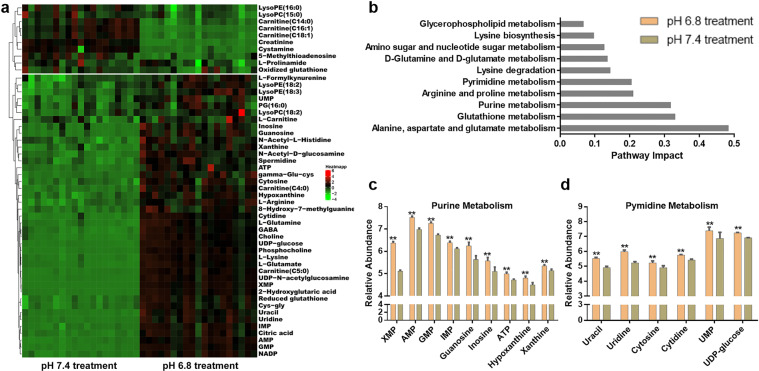
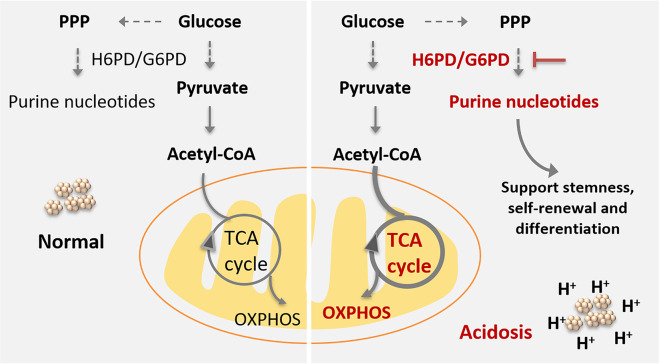
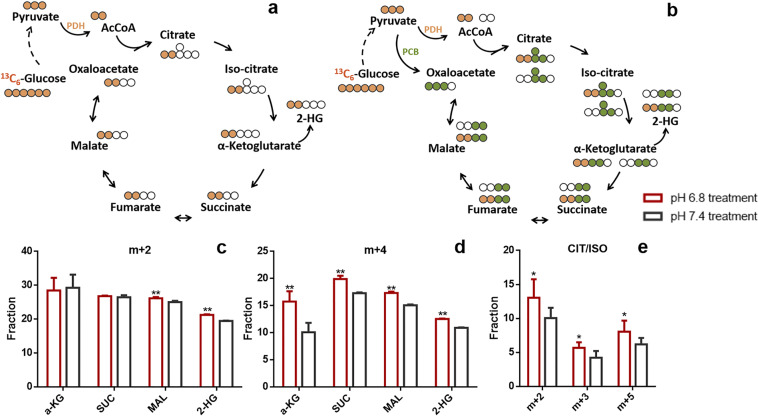
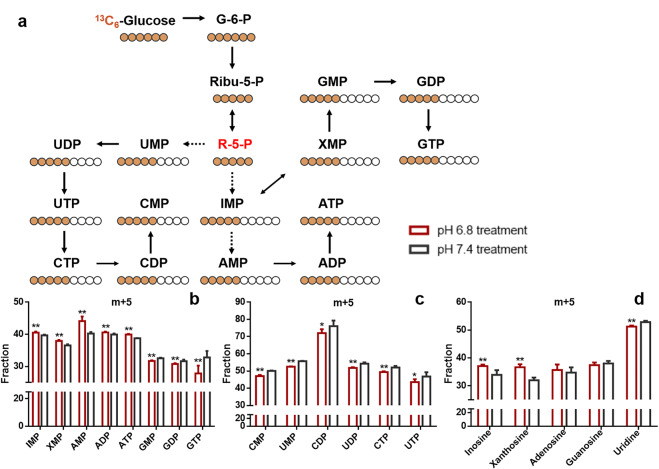
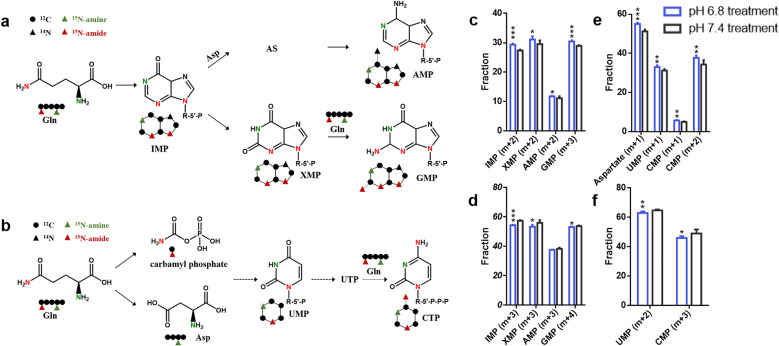
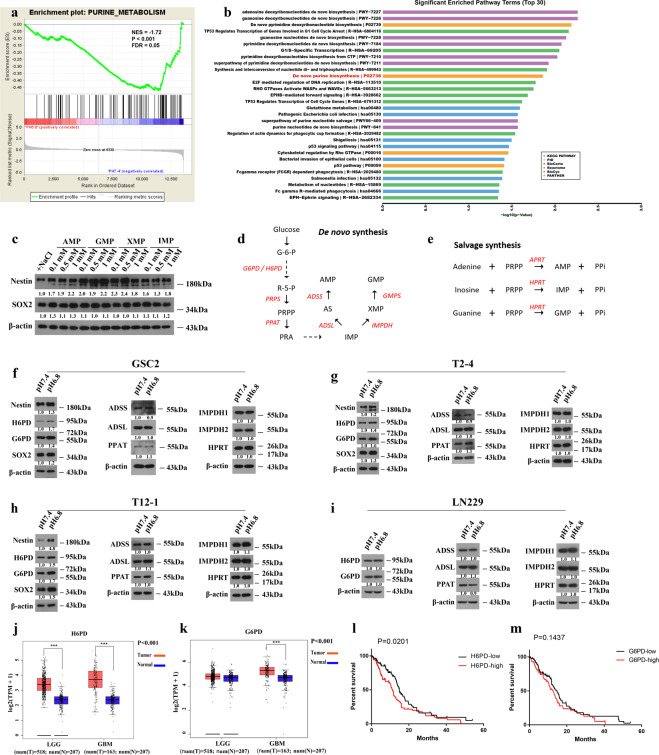
Glioma stem cells (GSCs) contribute to therapy resistance and poor outcomes for glioma patients. A significant feature of GSCs is their ability to grow in an acidic microenvironment. However, the mechanism underlying the rewiring of their metabolism in low pH remains elusive. Here, using metabolomics and metabolic flux approaches, we cultured GSCs at pH 6.8 and pH 7.4 and found that cells cultured in low pH exhibited increased de novo purine nucleotide biosynthesis activity. The overexpression of glucose-6-phosphate dehydrogenase, encoded by G6PD or H6PD, supports the metabolic dependency of GSCs on nucleotides when cultured under acidic conditions, by enhancing the pentose phosphate pathway (PPP). The high level of reduced glutathione (GSH) under acidic conditions also causes demand for the PPP to provide NADPH. Taken together, upregulation of G6PD/H6PD in the PPP plays an important role in acidic-driven purine metabolic reprogramming and confers a predilection toward glioma progression. Our findings indicate that targeting G6PD/H6PD, which are closely related to glioma patient survival, may serve as a promising therapeutic target for improved glioblastoma therapeutics. An integrated metabolomics and metabolic flux analysis, as well as considering microenvironment and cancer stem cells, provide a precise insight into understanding cancer metabolic reprogramming.
神经胶质瘤干细胞(GSCs)导致神经胶质瘤患者对治疗产生抗性和预后不良。GSCs 的一个重要特征是它们能够在酸性微环境中生长。然而,其在低 pH 值下代谢重编程的机制仍不清楚。在这里,我们使用代谢组学和代谢通量方法,将 GSCs 在 pH 值 6.8 和 pH 值 7.4 下培养,发现 pH 值较低时培养的细胞表现出增加的从头嘌呤核苷酸生物合成活性。葡萄糖-6-磷酸脱氢酶(由 G6PD 或 H6PD 编码)的过表达支持 GSCs 在酸性条件下培养时对核苷酸的代谢依赖性,通过增强戊糖磷酸途径(PPP)来实现。在酸性条件下,还原型谷胱甘肽(GSH)的高水平也导致对 PPP 提供 NADPH 的需求。综上所述,PPP 中 G6PD/H6PD 的上调在酸性驱动的嘌呤代谢重编程中起着重要作用,并赋予了胶质瘤进展的倾向。我们的研究结果表明,靶向与神经胶质瘤患者生存密切相关的 G6PD/H6PD,可能成为改善胶质母细胞瘤治疗的有前途的治疗靶点。综合代谢组学和代谢通量分析,以及考虑微环境和癌症干细胞,为深入了解癌症代谢重编程提供了精确的见解。