Esper Christine Doss, Scorr Laura, Papazian Sosi, Bartholomew Daniel, Esper Gregory Jacob, Factor Stewart Alan
Department of Neurology, Emory University, Atlanta, GA, USA.
J Mov Disord. 2021 May;14(2):119-125. doi: 10.14802/jmd.20099. Epub 2021 Mar 18.
Telemedicine has rapidly gained momentum in movement disorder neurology during the coronavirus disease (COVID-19) pandemic to preserve clinical care while mitigating the risks of in-person visits. We present data from the rapid implementation of virtual visits in a large, academic, movement disorder practice during the COVID-19 pandemic.
We describe the strategic shift to virtual visits and retrospectively examine elements that impacted the ability to switch to telemedicine visits using historical prepandemic in-person data as a comparator, including demographics, distance driven, and diagnosis distribution, with an additional focus on patients with deep brain stimulators.
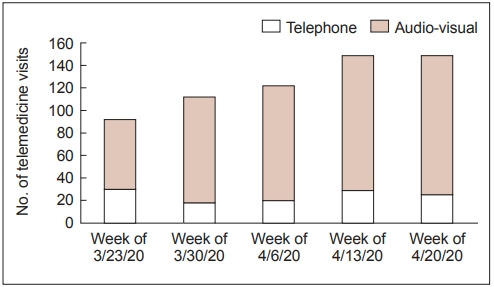
A total of 686 telemedicine visits were performed over a five-week period (60% of those previously scheduled for in-office visits). The average age of participants was 65 years, 45% were female, and 73% were Caucasian. Men were more likely to make the transition (p = 0.02). Telemedicine patients lived farther from the clinic than those seen in person (66.47 km vs. 42.16 km, p < 0.001), age was not associated with making the switch, and patient satisfaction did not change. There was a significant shift in the distribution of movement disorder diagnoses seen by telemedicine compared to prepandemic in-person visits (p < 0.001). Patients with deep brain stimulators were more likely to use telemedicine (11.5% vs. 7%, p < 0.001).
Telemedicine is feasible, viable and relevant in the care of movement disorder patients, although health care disparities appear evident for women and minorities. Patients with deep brain stimulators preferred telemedicine in our study. Further study is warranted to explore these findings.
在冠状病毒病(COVID-19)大流行期间,远程医疗在运动障碍神经病学领域迅速发展,以在降低面对面就诊风险的同时维持临床护理。我们展示了在COVID-19大流行期间,一家大型学术性运动障碍诊疗机构快速实施虚拟就诊的数据。
我们描述了向虚拟就诊的战略转变,并回顾性地研究了影响转向远程医疗就诊能力的因素,以大流行前的面对面就诊历史数据作为对照,包括人口统计学特征、出行距离和诊断分布,特别关注植入脑深部刺激器的患者。
在五周内共进行了686次远程医疗就诊(占之前预约门诊就诊次数的60%)。参与者的平均年龄为65岁,45%为女性,73%为白种人。男性更有可能进行这种转变(p = 0.02)。远程医疗患者居住的地方比面对面就诊的患者离诊所更远(66.47公里对42.16公里,p < 0.001),年龄与转变无关,患者满意度也没有变化。与大流行前的面对面就诊相比,远程医疗所见运动障碍诊断的分布有显著变化(p < 0.001)。植入脑深部刺激器的患者更有可能使用远程医疗(11.5%对7%,p < 0.001)。
远程医疗在运动障碍患者的护理中是可行、 viable且相关的,尽管女性和少数族裔的医疗保健差距似乎很明显。在我们的研究中,植入脑深部刺激器的患者更喜欢远程医疗。有必要进一步研究以探索这些发现。