Department of Medical Epidemiology and Biostatistics, Karolinska Institutet, Stockholm, Sweden; Sachs' Children and Youth Hospital, Stockholm, Sweden.
Department of Medical Epidemiology and Biostatistics, Karolinska Institutet, Stockholm, Sweden.
Chest. 2021 Aug;160(2):422-431. doi: 10.1016/j.chest.2021.03.006. Epub 2021 Mar 13.
Studies have reported an increased risk for asthma following lower respiratory tract infections, but few studies have specifically assessed this risk in children diagnosed with pneumonia in infancy. Furthermore, it is not fully understood whether this association is indicative of a causal relationship or if certain children have a predisposition for both diseases.
Are children diagnosed with pneumonia in infancy at increased risk for asthma, and what is the role of familial confounding and pneumococcal conjugate vaccine immunization on the association?
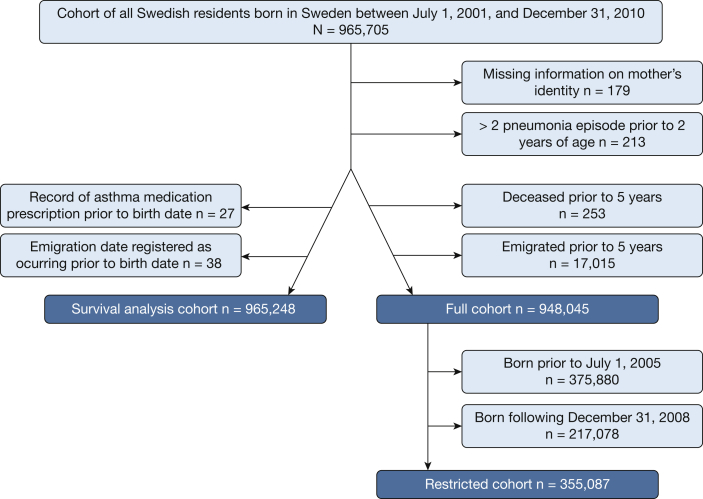
This study was a nationwide register-based cohort analysis of > 900,000 Swedish children to assess the association between pneumonia in infancy and prevalent asthma at 4 years. A secondary aim was to assess if the association has changed after the introduction of nationwide pneumococcal conjugate vaccine (PCV) immunization as this has led to a shift in pneumonia etiology. The study controlled for important confounders, including shared environmental and familial confounding, by using sibling analyses.
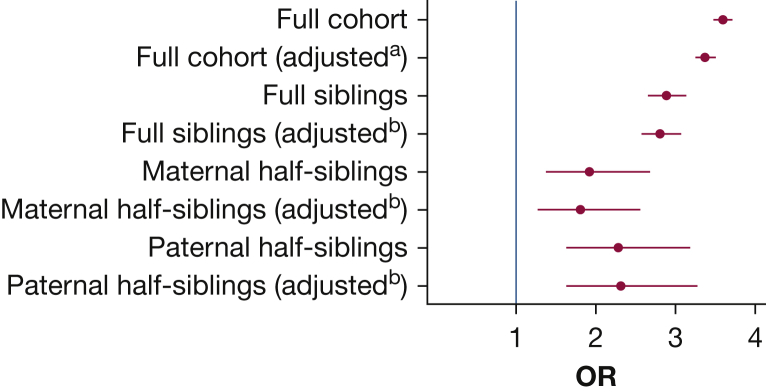
There was a strong association between pneumonia diagnosis in infancy and prevalent asthma at 4 years (adjusted OR, 3.38; 95% CI, 3.26-3.51), as well as in the full sibling analyses (adjusted OR, 2.81; 95% CI, 2.58-3.06). The risk for asthma following pneumonia diagnosis in infancy was slightly higher for those born in the PCV period compared with the pre-PCV period (adjusted OR, 3.80 [95% CI, 3.41-4.24] vs 3.28 [95% CI, 3.15-3.42]) when the proportion of viral pneumonia etiology was also higher (14.5% vs 10.7%, respectively) and the overall asthma prevalence was lower (5.3% vs 6.6%).
Children diagnosed with pneumonia in infancy have a highly increased risk for prevalent asthma at 4 years, which might have implications for future asthma preventive measures and needs to be considered when assessing the morbidity that can be attributed to pneumonia.
研究报告称,下呼吸道感染后哮喘的风险增加,但很少有研究专门评估婴儿期肺炎患儿的这种风险。此外,尚不完全清楚这种关联是否表明存在因果关系,或者某些儿童是否同时容易患这两种疾病。
婴儿期患肺炎的儿童患哮喘的风险是否增加,以及家族性混杂因素和肺炎球菌结合疫苗免疫接种在该关联中的作用是什么?
这是一项针对 90 多万名瑞典儿童的全国性基于登记的队列分析,旨在评估婴儿期肺炎与 4 岁时普遍哮喘之间的关联。次要目的是评估全国性肺炎球菌结合疫苗(PCV)免疫接种引入后该关联是否发生变化,因为这导致了肺炎病因的转变。该研究通过使用同胞分析来控制重要的混杂因素,包括共享环境和家族性混杂因素。
婴儿期肺炎诊断与 4 岁时普遍哮喘之间存在很强的关联(调整后的比值比,3.38;95%置信区间,3.26-3.51),以及在全同胞分析中(调整后的比值比,2.81;95%置信区间,2.58-3.06)。与 PCV 前时期相比,PCV 时期出生的婴儿在婴儿期肺炎诊断后发生哮喘的风险略高(调整后的比值比,3.80 [95%置信区间,3.41-4.24] 与 3.28 [95%置信区间,3.15-3.42]),而病毒肺炎病因的比例也更高(分别为 14.5%与 10.7%),总体哮喘患病率也更低(分别为 5.3%与 6.6%)。
婴儿期诊断为肺炎的儿童在 4 岁时患普遍哮喘的风险显著增加,这可能对未来的哮喘预防措施有影响,在评估可归因于肺炎的发病率时需要考虑到这一点。