Artificial Intelligence in Medicine (AIM) Program, Mass General Brigham, Harvard Medical School, Boston, MA, USA.
Department of Radiation Oncology, Dana Farber Cancer Institute and Brigham and Women's Hospital, Boston, MA, USA.
Sci Rep. 2021 Mar 9;11(1):5471. doi: 10.1038/s41598-021-84630-x.
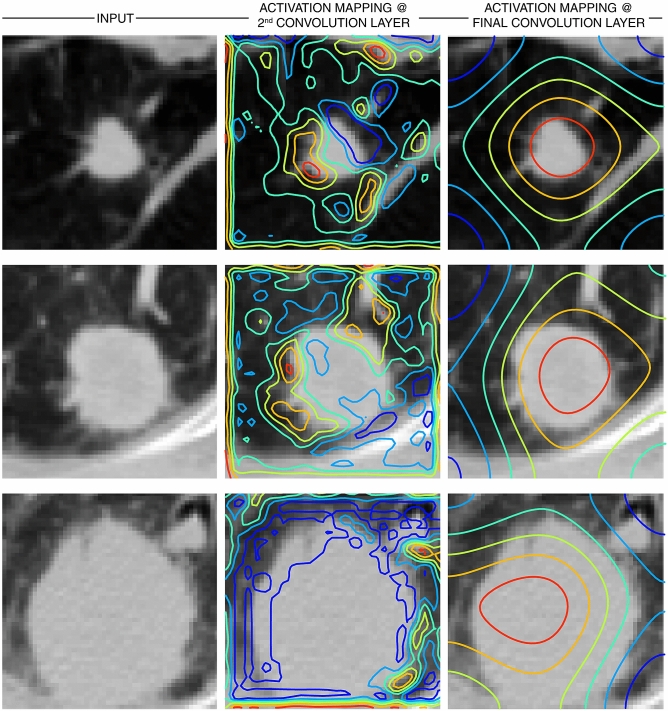
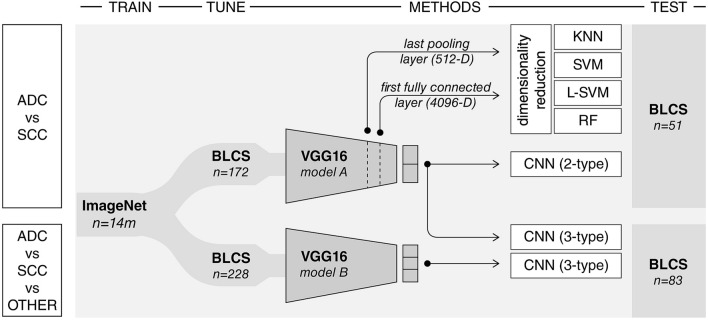
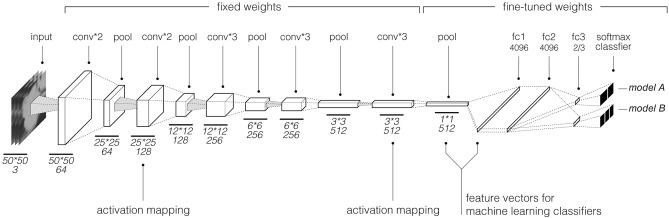
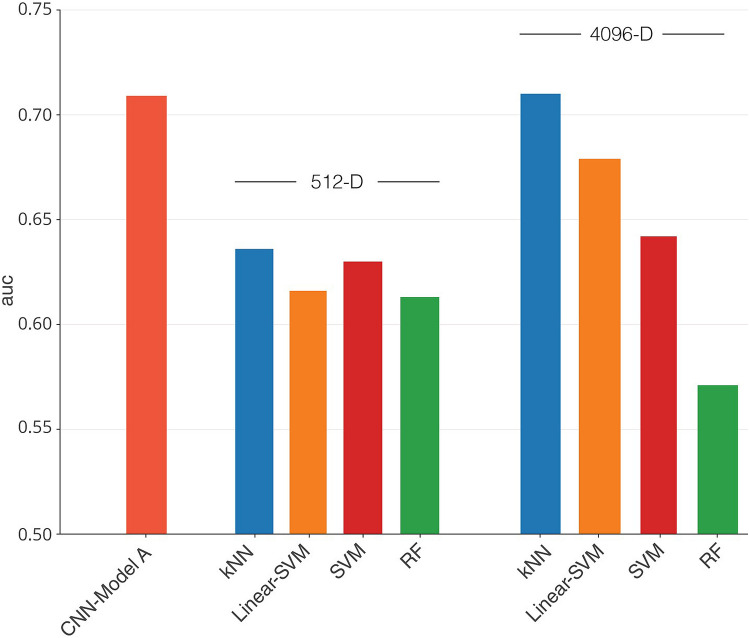
Tumor histology is an important predictor of therapeutic response and outcomes in lung cancer. Tissue sampling for pathologist review is the most reliable method for histology classification, however, recent advances in deep learning for medical image analysis allude to the utility of radiologic data in further describing disease characteristics and for risk stratification. In this study, we propose a radiomics approach to predicting non-small cell lung cancer (NSCLC) tumor histology from non-invasive standard-of-care computed tomography (CT) data. We trained and validated convolutional neural networks (CNNs) on a dataset comprising 311 early-stage NSCLC patients receiving surgical treatment at Massachusetts General Hospital (MGH), with a focus on the two most common histological types: adenocarcinoma (ADC) and Squamous Cell Carcinoma (SCC). The CNNs were able to predict tumor histology with an AUC of 0.71(p = 0.018). We also found that using machine learning classifiers such as k-nearest neighbors (kNN) and support vector machine (SVM) on CNN-derived quantitative radiomics features yielded comparable discriminative performance, with AUC of up to 0.71 (p = 0.017). Our best performing CNN functioned as a robust probabilistic classifier in heterogeneous test sets, with qualitatively interpretable visual explanations to its predictions. Deep learning based radiomics can identify histological phenotypes in lung cancer. It has the potential to augment existing approaches and serve as a corrective aid for diagnosticians.
肿瘤组织学是预测肺癌治疗反应和结果的重要指标。组织取样进行病理学家检查是组织学分类最可靠的方法,然而,医学影像分析深度学习的最新进展暗示了放射学数据在进一步描述疾病特征和风险分层方面的效用。在这项研究中,我们提出了一种从非侵入性标准护理计算机断层扫描(CT)数据预测非小细胞肺癌(NSCLC)肿瘤组织学的放射组学方法。我们在一个包含 311 名在马萨诸塞州综合医院(MGH)接受手术治疗的早期 NSCLC 患者的数据集上训练和验证了卷积神经网络(CNN),重点关注两种最常见的组织学类型:腺癌(ADC)和鳞状细胞癌(SCC)。CNN 能够以 AUC 为 0.71(p=0.018)预测肿瘤组织学。我们还发现,使用机器学习分类器(如 k-最近邻(kNN)和支持向量机(SVM))对 CNN 衍生的定量放射组学特征进行分类,也可以获得相当的判别性能,AUC 高达 0.71(p=0.017)。我们表现最好的 CNN 在异构测试集中充当了强大的概率分类器,并对其预测进行了定性可解释的可视化解释。基于深度学习的放射组学可以识别肺癌的组织表型。它有可能增强现有的方法,并作为诊断医生的纠正辅助工具。