Department of Surgery and Cancer, Imperial College London, London, W2 1NY, UK.
Institute of Global Health Innovation, Imperial College London, 10th Floor, Queen Elizabeth Queen Mother building, St Mary's Hospital Campus, Praed Street, London, W2 1NY, UK.
Sci Rep. 2021 Mar 16;11(1):5958. doi: 10.1038/s41598-021-85514-w.
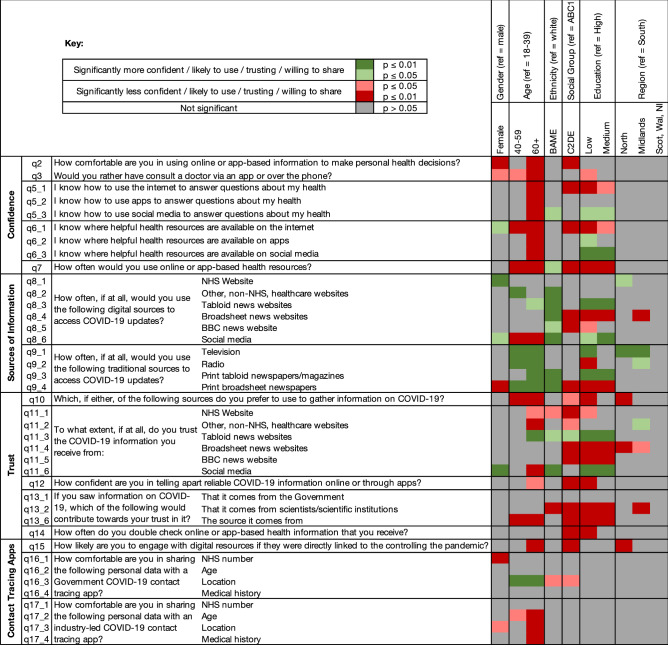
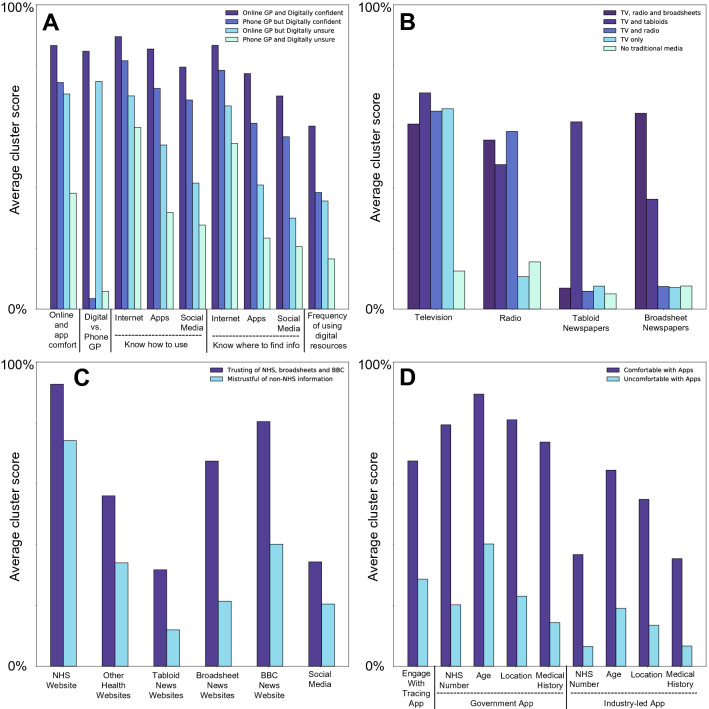
There is concern that digital public health initiatives used in the management of COVID-19 may marginalise certain population groups. There is an overlap between the demographics of groups at risk of digital exclusion (older, lower social grade, low educational attainment and ethnic minorities) and those who are vulnerable to poorer health outcomes from SARS-CoV-2. In this national survey study (n = 2040), we assessed how the UK population; particularly these overlapping groups, reported their preparedness for digital health strategies. We report, with respect to using digital information to make health decisions, that those over 60 are less comfortable (net comfort: 57%) than those between 18 and 39 (net comfort: 78%) and lower social grades are less comfortable (net comfort: 63%) than higher social grades (net comfort: 75%). With respect to a preference for digital over non-digital sources in seeking COVID-19 health information, those over 60 (net preference: 21%) are less inclined than those between 18 and 39 (net preference: 60%) and those of low educational attainment (net preference: 30%) are less inclined than those of high educational attainment (net preference: 52%). Lastly, with respect to distinguishing reliable digital COVID-19 information, lower social grades (net confidence: 55%) are less confident than higher social grades (net confidence: 68%) and those of low educational attainment (net confidence: 51%) are less confident than those of high educational attainment (net confidence: 71%). All reported differences are statistically significant (p < 0.01) following multivariate regression modelling. This study suggests that digital public health approaches to COVID-19 have the potential to marginalise groups who are concurrently at risk of digital exclusion and poor health outcomes from SARS-CoV-2.
人们担心用于管理 COVID-19 的数字公共卫生举措可能会使某些人群边缘化。面临数字排斥风险的群体(年龄较大、社会等级较低、教育程度较低和少数民族)与那些更容易因 SARS-CoV-2 而导致健康状况恶化的群体之间存在重叠。在这项全国性调查研究(n=2040)中,我们评估了英国人口;特别是这些重叠群体,他们对数字健康策略的准备情况。我们报告说,就使用数字信息做出健康决策而言,60 岁以上的人不如 18 至 39 岁的人(网络舒适度:78%)舒适,社会等级较低的人不如社会等级较高的人(网络舒适度:75%)舒适。就寻求 COVID-19 健康信息时对数字来源相对于非数字来源的偏好而言,60 岁以上的人(网络偏好:21%)不如 18 至 39 岁的人(网络偏好:60%)和教育程度较低的人(网络偏好:30%)不如教育程度较高的人(网络偏好:52%)。最后,就区分可靠的数字 COVID-19 信息而言,社会等级较低的人(网络信心:55%)不如社会等级较高的人(网络信心:68%)和教育程度较低的人(网络信心:51%)不如教育程度较高的人(网络信心:71%)。所有报告的差异在多变量回归模型后均具有统计学意义(p<0.01)。这项研究表明,针对 COVID-19 的数字公共卫生方法有可能使同时面临数字排斥风险和 SARS-CoV-2 不良健康后果的群体边缘化。