Lund Troy C, Doherty Terence M, Eisengart Julie B, Freese Rebecca L, Rudser Kyle D, Fung Ellen B, Miller Bradley S, White Klane K, Orchard Paul J, Whitley Chester B, Polgreen Lynda E
Department of Pediatrics University of Minnesota Minneapolis Minnesota USA.
Department of Pediatrics The Lundquist Institute at Harbor-UCLA Medical Center Torrance California USA.
JIMD Rep. 2020 Dec 8;58(1):89-99. doi: 10.1002/jmd2.12190. eCollection 2021 Mar.
Orthopedic disease progresses in mucopolysaccharidosis type I (MPS I), even with approved therapies and remains a major factor in persistent suffering and disability. Novel therapies and accurate predictors of response are needed. The primary objective of this study was to identify surrogate biomarkers of future change in orthopedic disease.
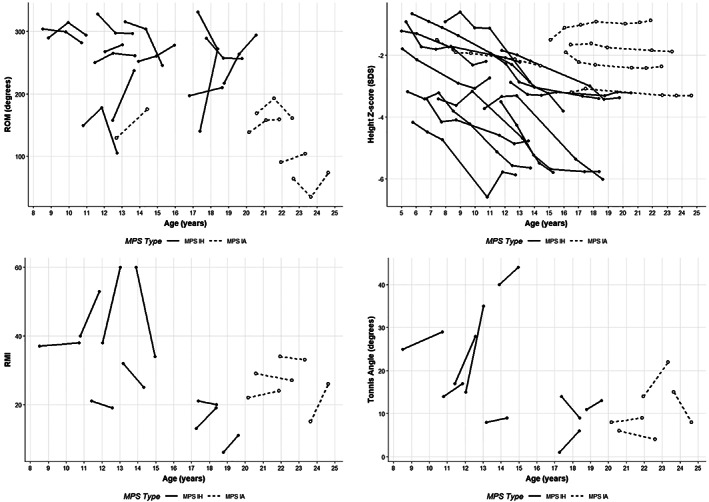
As part of a 9-year observational study of MPS I, range-of-motion (ROM), height, pelvic radiographs were measured annually. Biomarkers in year 1 were compared to healthy controls. Linear regression tested for associations of change in biomarkers over the first year with change in long-term outcomes.
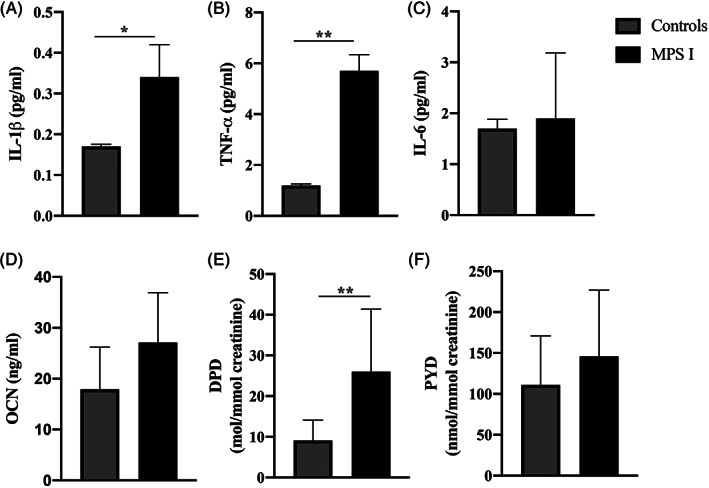
MPS I participants (N = 19) were age 5 to 16 years and on average 6.9 ± 2.9 years post treatment initiation. Healthy controls (N = 51) were age 9 to 17 years. Plasma IL-1β, TNF-α, osteocalcin, pyridinolines, and deoxypyridinolines were higher in MPS than controls. Within MPS, progression of hip dysplasia was present in 46% to 77%. A 1 pg/mL increase in IL-6 was associated with -22°/year change in ROM (-28 to -15; < .001), a 20 nmol/mmol creatinine/year increase in urine PYD was associated with a -0.024 Z-score/year change in height Z-score (-0.043 to -0.005; = .016), and a 20 nmol/mmol creatinine/year increase in urine PYD was associated with a -2.0%/year change in hip dysplasia measured by Reimers migration index (-3.8 to -0.1; = .037).
Inflammatory cytokines are high in MPS I. IL-6 and PYD were associated with progression in joint contracture, short stature, and hip dysplasia over time. Once validated, these biomarkers may prove useful for predicting response to treatment of skeletal disease in MPS I.
即便采用了获批的疗法,黏多糖贮积症I型(MPS I)中的骨科疾病仍会进展,并且依然是导致持续痛苦和残疾的主要因素。需要新的疗法以及对反应的准确预测指标。本研究的主要目的是确定骨科疾病未来变化的替代生物标志物。
作为一项对MPS I进行的为期9年的观察性研究的一部分,每年测量活动范围(ROM)、身高、骨盆X光片。将第1年的生物标志物与健康对照进行比较。线性回归测试了第一年生物标志物的变化与长期结果变化之间的关联。
MPS I参与者(N = 19)年龄在5至16岁之间,平均在开始治疗后6.9±2.9年。健康对照(N = 51)年龄在9至17岁之间。MPS患者血浆中的白细胞介素-1β、肿瘤坏死因子-α、骨钙素、吡啶啉和脱氧吡啶啉高于对照组。在MPS患者中,46%至77%存在髋关节发育不良进展。白细胞介素-6每增加1 pg/mL与ROM每年变化-22°(-28至-15;P <.001)相关,尿吡啶啉每年每增加20 nmol/mmol肌酐与身高Z评分每年变化-0.024 Z评分(-0.043至-0.005;P = 0.016)相关,尿吡啶啉每年每增加20 nmol/mmol肌酐与通过赖默斯移位指数测量的髋关节发育不良每年变化-2.0%(-3.8至-0.1;P = 0.037)相关。
MPS I中炎症细胞因子水平较高。白细胞介素-6和吡啶啉与关节挛缩、身材矮小和髋关节发育不良随时间的进展相关。一旦得到验证,这些生物标志物可能被证明对预测MPS I中骨骼疾病的治疗反应有用。