Chen Meng-Qi, Shi Wen-Rui, Wang Hao-Yu, Sun Ying-Xian
Department of Cardiology, The First Hospital of China Medical University, Shenyang, 110001, People's Republic of China.
Department of Cardiology, Coronary Heart Disease Center, Fuwai Hospital, National Center for Cardiovascular Diseases, Chinese Academy of Medical Sciences & Peking Union Medical College, Beijing, 100037, People's Republic of China.
Clin Epidemiol. 2021 Mar 10;13:197-206. doi: 10.2147/CLEP.S295989. eCollection 2021.
Hypertension and obesity are recognized as modifiable risk factors for stroke, but their combined effects are unknown. This study aimed to explore the combined effects of hypertension and general or central obesity on the risk of ischemic stroke in a middle-aged and elderly population.
The data of 11,731 participants (53.5 ± 10.5 years old) were analyzed from the Northeast China Rural Cardiovascular Health Study, 2012-2013. General obesity (GO) was defined by body mass index (BMI); central obesity (CO) was measured by waist circumference (WC), waist-to-height ratio (WHtR) and waist-to-hip ratio (WHpR).
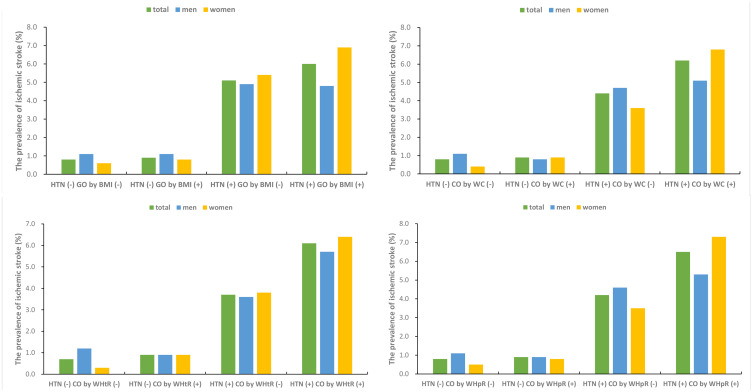
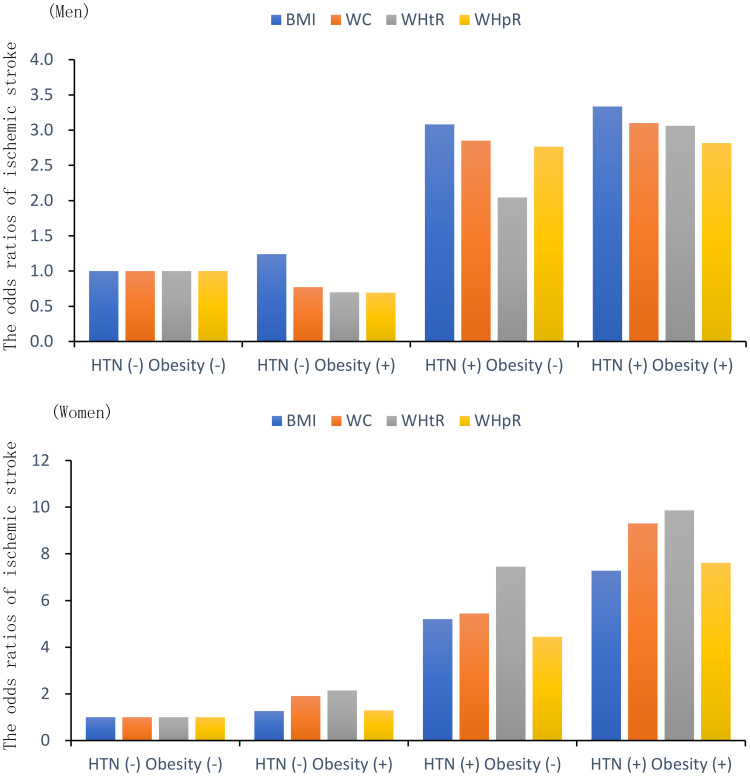
The overall prevalence of ischemic stroke was 3.1%. After adjusting for age and sex, the odds ratios for having ischemic stroke were 4.31 (3.14-5.91) among subjects with hypertension, 1.79 (1.40-2.30) with GO, 1.94 (1.54-2.43), 1.98 (1.54-2.53), and 1.65 (1.33-2.06) with CO measured by WC, WHtR and WHpR, respectively. After full adjustment for potential confounders, the combinations of hypertension and obesity indices (including BMI, WC, WHtR and WHpR) were associated with the highest risk of ischemic stroke, especially in women, which were respectively 7.3-fold, 9.3-fold, 9.9-fold and 7.6-fold higher than that of individuals without both conditions.
Our study results suggest that women with both hypertension and obesity, no matter defined by BMI, WC, WHtR or WHpR, were more likely to have ischemic stroke. A better understanding of the combined effects of these risk factors can help promote primary prevention in susceptible subgroups.
高血压和肥胖被认为是可改变的中风危险因素,但其联合作用尚不清楚。本研究旨在探讨高血压与全身或中心性肥胖对中老年人群缺血性中风风险的联合作用。
分析了2012 - 2013年中国东北农村心血管健康研究中11731名参与者(年龄53.5±10.5岁)的数据。全身肥胖(GO)通过体重指数(BMI)定义;中心性肥胖(CO)通过腰围(WC)、腰高比(WHtR)和腰臀比(WHpR)测量。
缺血性中风的总体患病率为3.1%。在调整年龄和性别后,高血压患者发生缺血性中风的比值比为4.31(3.14 - 5.91),全身肥胖者为1.79(1.40 - 2.30),通过腰围、腰高比和腰臀比测量的中心性肥胖者分别为1.94(1.54 - 2.43)、1.98(1.54 - 2.53)和1.65(1.33 - 2.06)。在对潜在混杂因素进行全面调整后,高血压与肥胖指标(包括BMI、WC、WHtR和WHpR)的组合与缺血性中风的最高风险相关,尤其是在女性中,分别比无这两种情况的个体高7.3倍、9.3倍、9.9倍和7.6倍。
我们的研究结果表明,无论通过BMI、WC、WHtR还是WHpR定义,患有高血压和肥胖的女性更易发生缺血性中风。更好地了解这些危险因素的联合作用有助于促进易感亚组的一级预防。