Klar Marie Kristin, Geyer Siegfried, Safieddine Batoul, Tetzlaff Fabian, Tetzlaff Juliane, Sperlich Stefanie
Hannover Medical School, Medical Sociology, Hannover, Germany.
SSM Popul Health. 2021 Feb 23;13:100758. doi: 10.1016/j.ssmph.2021.100758. eCollection 2021 Mar.
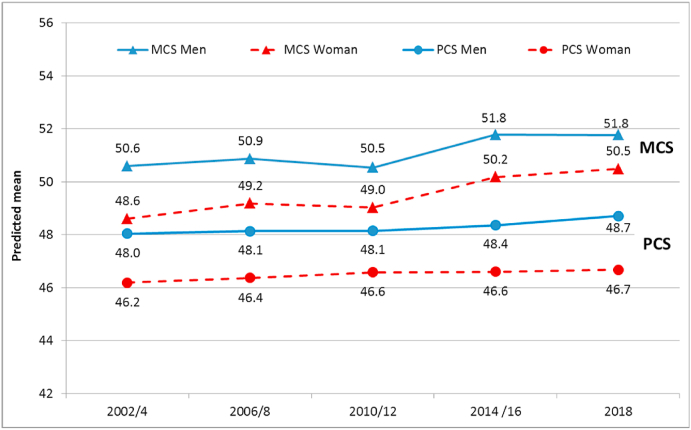
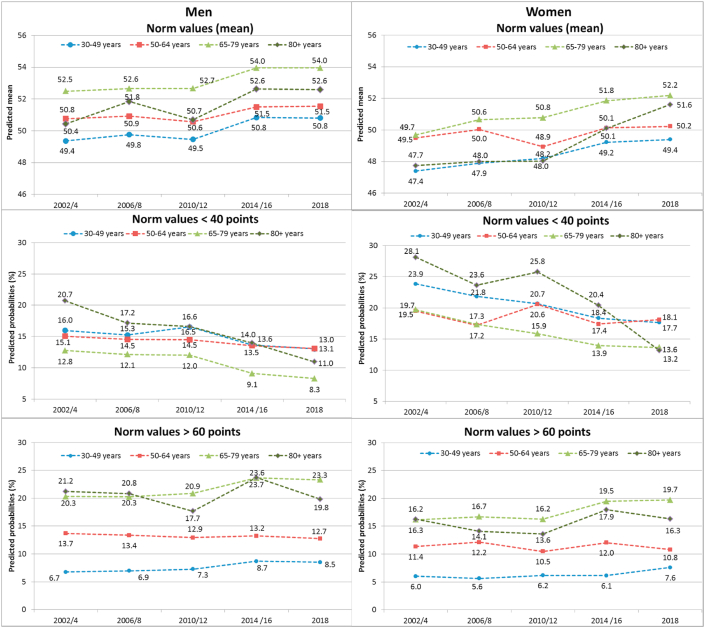
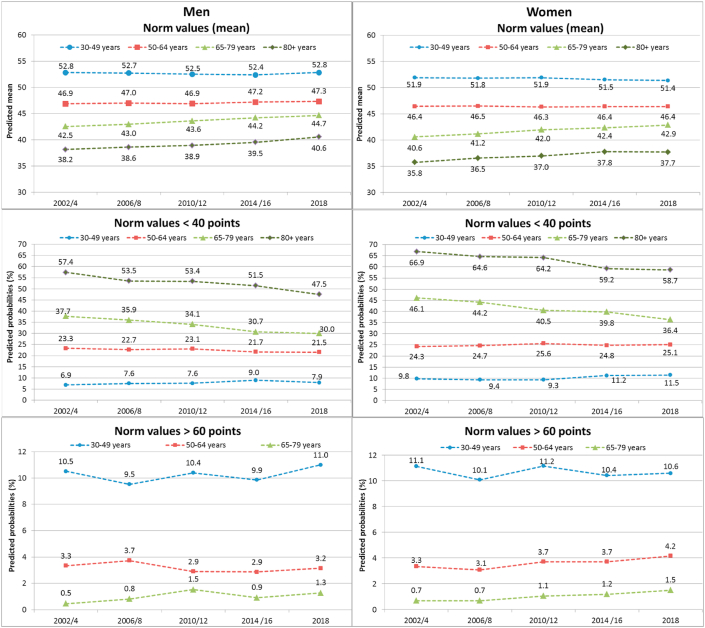
The question of whether rising life expectancy has led to additional life years spent in good health or poor health is of major public health relevance. We tested the theories of compression or expansion of morbidity for Germany with respect to the mental and physical component summary scales (MCS/PCS) of the health-related quality of life (HRQOL) questionnaire (SF-12). Data of 90,758 women and 81,400 men were obtained from the German Socio-Economic Panel between 2002 and 2018. Linear and logistic regression analyses were applied to estimate temporal changes in MCS and PCS in different life stages. The development of healthy life expectancy (H-LE) expressed by life years without severe functional limitations was calculated by applying the Sullivan method. Overall, a significant increase of MCS and PCS was found in both genders. The rise was mainly due to declining proportions of severe limitations (norm values < 40 points) while the proportions of norm values > 60 points did not change substantially. Improvements were most apparent for the 'young seniors' (65-79 years) and at 'old age' (80 years +). In contrast, no improvements in PCS were found for 'later working life' (50-64 years) and decreasing levels were observed for persons of 'middle working age' (30-49 years). During the study period, H-LE at age 50 increased in women/men by 2.93/2.90 years (MCS) and 1.92/2.53 years (PCS), respectively. Our results support the hypothesis of absolute compression of morbidity. However, since consistent improvements were not found for ages below 65 years, it remains open to debate whether the positive health trend will also persist in the future. Our findings suggest that health promotion efforts should be strengthened for people of middle and later working age to support healthy aging.
预期寿命的提高是否导致了健康状况良好或不佳的额外生命年,这一问题具有重大的公共卫生意义。我们针对德国,就健康相关生活质量(HRQOL)问卷(SF - 12)的心理和身体成分汇总量表(MCS/PCS),检验了发病压缩或扩展理论。从2002年至2018年的德国社会经济面板中获取了90758名女性和81400名男性的数据。应用线性和逻辑回归分析来估计不同生命阶段MCS和PCS的时间变化。通过应用沙利文方法计算无严重功能限制的生命年所表示的健康预期寿命(H - LE)。总体而言,发现男性和女性的MCS和PCS均有显著增加。这种增加主要是由于严重限制比例(标准值<40分)下降,而标准值>60分的比例没有实质性变化。改善在“年轻老年人”(65 - 79岁)和“老年”(80岁及以上)最为明显。相比之下,“工作后期”(50 - 64岁)的PCS没有改善,“中年工作年龄”(30 - 49岁)的人则出现下降。在研究期间,50岁时女性/男性的健康预期寿命(H - LE)在MCS方面分别增加了2.93/2.90年,在PCS方面分别增加了1.92/2.53年。我们的结果支持发病绝对压缩的假设。然而,由于65岁以下人群未发现持续改善,未来这种积极的健康趋势是否也会持续仍有待讨论。我们的研究结果表明,应加强针对中年和老年工作人群的健康促进努力,以支持健康老龄化。