Song Yang, Li Linhao, Zhao Weikang, Qian Yuna, Dong Lili, Fang Yunnan, Yang Li, Fan Yubo
Key Laboratory for Biomechanics and Mechanobiology of Ministry of Education, Beijing Advanced Innovation Center for Biomedical Engineering, School of Biological Science and Medical Engineering, Beihang University, Beijing, 100083, PR China.
Key Laboratory of Biorheological Science and Technology, Ministry of Education, Bioengineering College, Chongqing University, Chongqing, 400030, PR China.
Bioact Mater. 2021 Mar 1;6(9):2983-2998. doi: 10.1016/j.bioactmat.2021.02.020. eCollection 2021 Sep.
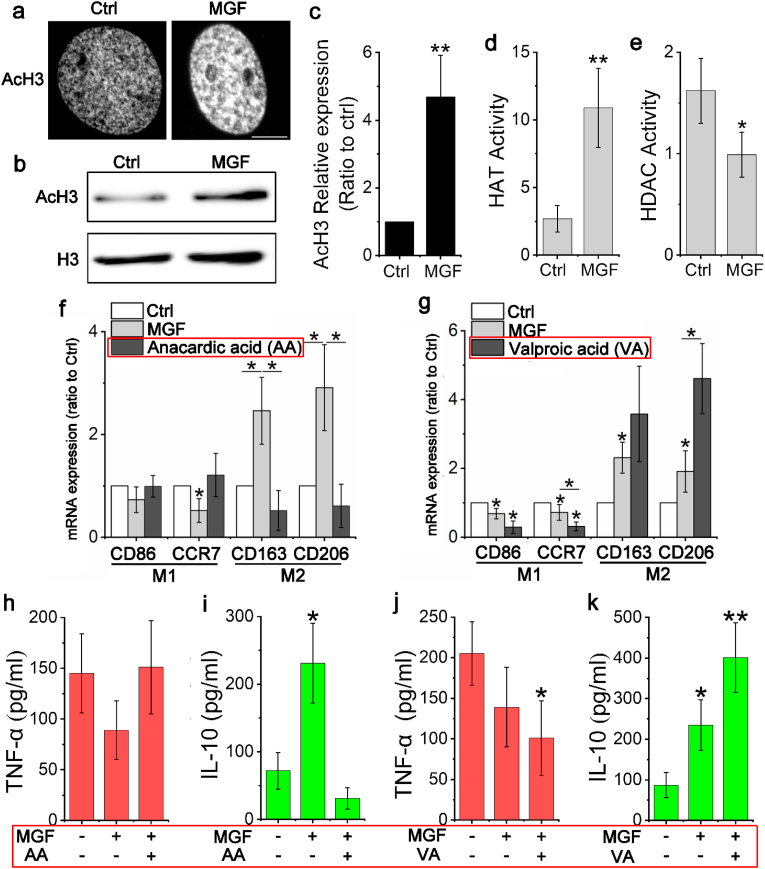
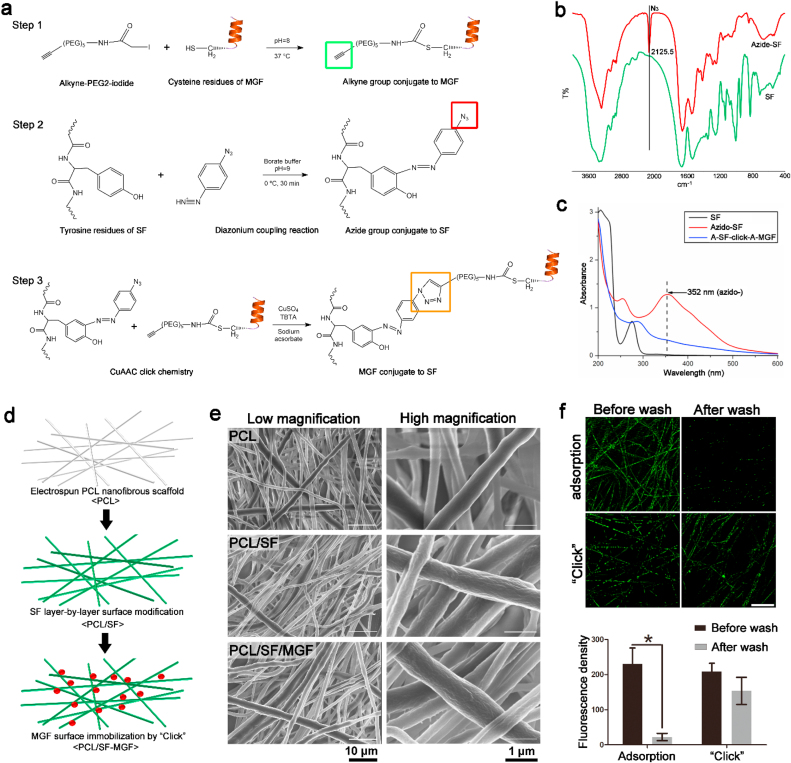
The implantation of synthetic polymeric scaffolds induced foreign-body reaction (FBR) seriously influence the wound healing and impair functionality recovery. A novel short peptide, mechano-growth factor (MGF), was introduced in this study to modify an electrospun polycaprolactone (PCL) fibrous scaffold to direct the macrophage phenotype transition and mitigate the FBR. studies discovered the cell signal transduction mechanism of MGF regulates the macrophage polarization via the expression of related genes and proteins. We found that macrophages response the MGF stimuli via endocytosis, then MGF promotes the histone acetylation and upregulates the STAT6 expression to direct an anti-inflammatory phenotype transition. Subsequently, an immunoregulatory electrospun PCL fibrous scaffold was modified by silk fibroin (SF) single-component layer-by-layer assembly, and the SF was decorated with MGF via click chemistry. Macrophages seeded on scaffold to identify the function of MGF modified scaffold in directing macrophage polarization . Parallelly, rat subcutaneous implantation model and rat tendon adhesion model were performed to detect the immunomodulatory ability of the MGF-modified scaffold . The results demonstrate that MGF-modified scaffold is beneficial to the transformation of macrophages to M2 phenotype . More importantly, MGF-functionalized scaffold can inhibit the FBR at the subcutaneous tissue and prevent tissue adhesion.
合成聚合物支架的植入引发的异物反应(FBR)严重影响伤口愈合并损害功能恢复。在本研究中引入了一种新型短肽——机械生长因子(MGF),以修饰静电纺丝聚己内酯(PCL)纤维支架,引导巨噬细胞表型转变并减轻异物反应。研究发现MGF的细胞信号转导机制通过相关基因和蛋白质的表达来调节巨噬细胞极化。我们发现巨噬细胞通过内吞作用对MGF刺激作出反应,然后MGF促进组蛋白乙酰化并上调STAT6表达,以引导抗炎表型转变。随后,通过丝素蛋白(SF)单一组分层状组装对免疫调节性静电纺丝PCL纤维支架进行修饰,并通过点击化学将MGF修饰在SF上。将巨噬细胞接种在支架上,以确定MGF修饰支架在引导巨噬细胞极化方面的功能。同时,进行大鼠皮下植入模型和大鼠肌腱粘连模型,以检测MGF修饰支架的免疫调节能力。结果表明,MGF修饰支架有利于巨噬细胞向M2表型转化。更重要的是,MGF功能化支架可抑制皮下组织的异物反应并防止组织粘连。