Vassey Matthew J, Figueredo Grazziela P, Scurr David J, Vasilevich Aliaksei S, Vermeulen Steven, Carlier Aurélie, Luckett Jeni, Beijer Nick R M, Williams Paul, Winkler David A, de Boer Jan, Ghaemmaghami Amir M, Alexander Morgan R
School of Life Sciences University of Nottingham Nottingham NG7 2RD UK.
School of Computer Science University of Nottingham Nottingham NG8 1BB UK.
Adv Sci (Weinh). 2020 Apr 28;7(11):1903392. doi: 10.1002/advs.201903392. eCollection 2020 Jun.
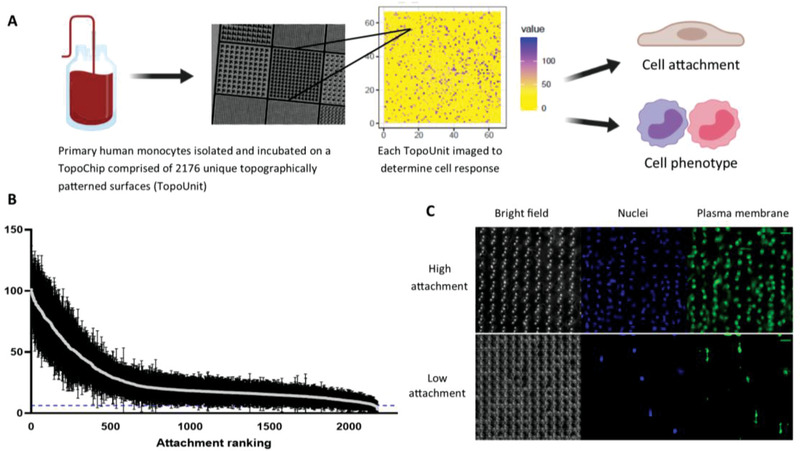
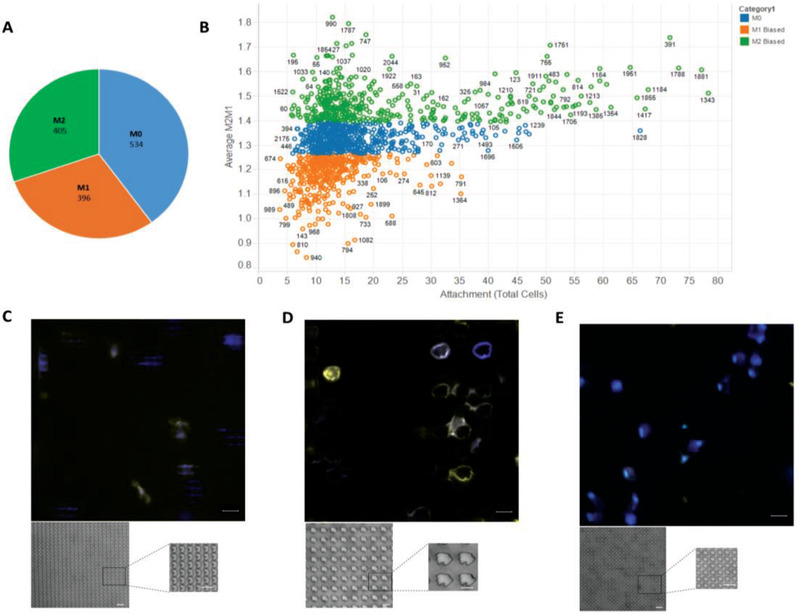
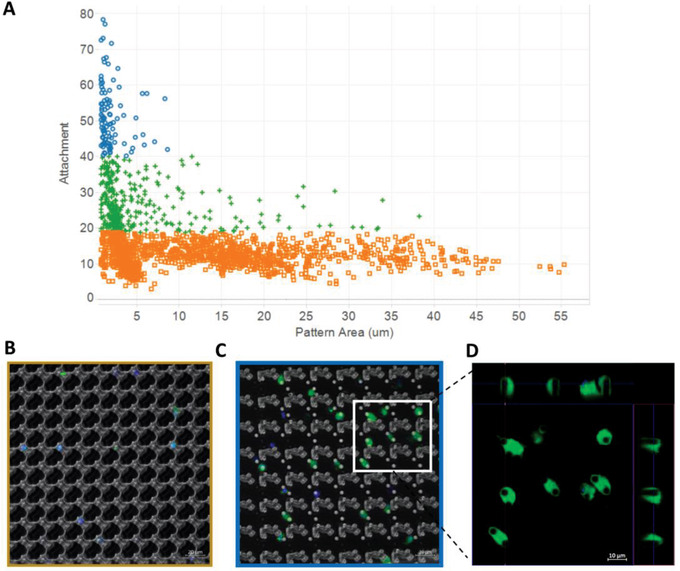
Macrophages play a central role in orchestrating immune responses to foreign materials, which are often responsible for the failure of implanted medical devices. Material topography is known to influence macrophage attachment and phenotype, providing opportunities for the rational design of "immune-instructive" topographies to modulate macrophage function and thus foreign body responses to biomaterials. However, no generalizable understanding of the inter-relationship between topography and cell response exists. A high throughput screening approach is therefore utilized to investigate the relationship between topography and human monocyte-derived macrophage attachment and phenotype, using a diverse library of 2176 micropatterns generated by an algorithm. This reveals that micropillars 5-10 µm in diameter play a dominant role in driving macrophage attachment compared to the many other topographies screened, an observation that aligns with studies of the interaction of macrophages with particles. Combining the pillar size with the micropillar density is found to be key in modulation of cell phenotype from pro to anti-inflammatory states. Machine learning is used to successfully build a model that correlates cell attachment and phenotype with a selection of descriptors, illustrating that materials can potentially be designed to modulate inflammatory responses for future applications in the fight against foreign body rejection of medical devices.
巨噬细胞在协调针对外来物质的免疫反应中起着核心作用,而外来物质往往是植入式医疗设备失效的原因。已知材料的拓扑结构会影响巨噬细胞的附着和表型,这为合理设计“免疫指导性”拓扑结构以调节巨噬细胞功能,进而调节对生物材料的异物反应提供了机会。然而,目前对于拓扑结构与细胞反应之间的相互关系尚无普遍适用的认识。因此,采用高通量筛选方法,利用算法生成的包含2176种微图案的多样文库,研究拓扑结构与人类单核细胞衍生巨噬细胞附着及表型之间的关系。研究发现,与筛选的许多其他拓扑结构相比,直径为5 - 10微米的微柱在驱动巨噬细胞附着方面起主导作用,这一观察结果与巨噬细胞与颗粒相互作用研究一致。研究还发现,将柱体尺寸与微柱密度相结合是将细胞表型从促炎状态调节为抗炎状态的关键。利用机器学习成功构建了一个将细胞附着和表型与一系列描述符相关联的模型,表明未来有可能设计材料来调节炎症反应,以用于对抗医疗设备的异物排斥。