Ageno Walter, Farjat Alfredo, Haas Sylvia, Weitz Jeffrey I, Goldhaber Samuel Z, Turpie Alexander G G, Goto Shinya, Angchaisuksiri Pantep, Dalsgaard Nielsen Joern, Kayani Gloria, Schellong Sebastian, Bounameaux Henri, Mantovani Lorenzo G, Prandoni Paolo, Kakkar Ajay K
Department of Medicine and Surgery University of Insubria Varese Italy.
Thrombosis Research Institute London UK.
Res Pract Thromb Haemost. 2021 Feb 20;5(2):326-341. doi: 10.1002/rth2.12482. eCollection 2021 Feb.
Venous thromboembolism (VTE) has a long-term risk of recurrence, dependent on the presence or absence of provoking risk factors at the time of the event.
To compare clinical characteristics, anticoagulant patterns, and 12-month outcomes in patients with transient provoking factors, active cancer, and unprovoked VTE.
The Global Anticoagulant Registry in the FIELD (GARFIELD)-VTE is a prospective, observational study that enrolled 10 207 patients with objectively diagnosed VTE from 415 sites in 28 countries.
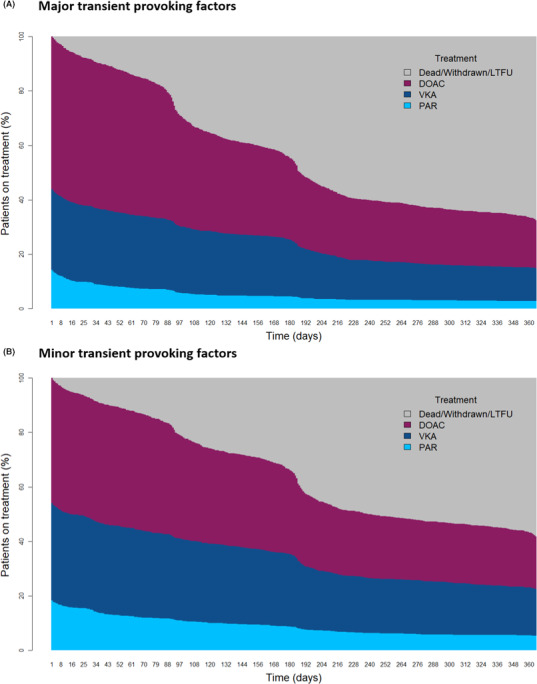
Patients with transient provoking factors were younger (53.0 years) and more frequently women (61.2%) than patients with unprovoked VTE (60.3 years; 43.0% women) or active cancer (63.6 years; 51.7% women). After 6 months, 59.1% of patients with transient provoking factors remained on anticoagulation, compared to 71.3% with unprovoked VTE and 47.3% with active cancer. At 12 months, this decreased to 36.7%, 51.5%, and 25.4%, respectively. The risk of mortality (hazard ratio [HR], 1.21; 95% confidence interval [CI], 0.90-1.62), recurrent VTE (HR, 0.84; 95% CI, 0.62-1.14), and major bleeding (HR, 1.26; 95% CI, 0.86-1.85) was comparable in patients with transient provoking factors and unprovoked VTE. Patients with minor and major transient provoking factors had a similar risk of recurrent VTE (HR, 0.99; 95% CI, 0.59-1.66), but those with major transient risk factors had a lower risk of death (HR, 0.61; 95% CI, 0.38-0.98).
At 1 year, nearly 40% of patients with transient provoking factors and slightly over half of patients with unprovoked VTE were on anticoagulant treatment. Event rates were comparable between the two groups. Risk of death was higher in patients with minor transient factors than in those with major transient factors.
静脉血栓栓塞症(VTE)具有复发的长期风险,这取决于事件发生时是否存在诱发风险因素。
比较有短暂诱发因素、活动性癌症和无诱因VTE患者的临床特征、抗凝模式及12个月的结局。
FIELD全球抗凝注册研究(GARFIELD)-VTE是一项前瞻性观察性研究,纳入了来自28个国家415个地点的10207例经客观诊断为VTE的患者。
有短暂诱发因素的患者比无诱因VTE患者(60.3岁;43.0%为女性)或活动性癌症患者(63.6岁;51.7%为女性)更年轻(53.0岁),且女性比例更高(61.2%)。6个月后,有短暂诱发因素的患者中59.1%仍在接受抗凝治疗,无诱因VTE患者为71.3%,活动性癌症患者为47.3%。在12个月时,这一比例分别降至36.7%、51.5%和25.4%。有短暂诱发因素的患者与无诱因VTE患者的死亡率(风险比[HR],1.21;95%置信区间[CI],0.90-1.62)、复发性VTE(HR,0.84;95%CI,0.62-1.14)和大出血(HR,1.26;95%CI,0.86-1.85)风险相当。有轻微和严重短暂诱发因素的患者复发性VTE风险相似(HR,0.99;95%CI,0.59-1.66),但有严重短暂风险因素的患者死亡风险较低(HR,0.61;95%CI,0.38-0.98)。
1年时,近40%有短暂诱发因素的患者和略超过一半无诱因VTE患者正在接受抗凝治疗。两组的事件发生率相当。有轻微短暂因素的患者死亡风险高于有严重短暂因素的患者。