Afanasenko Anastasiia, Barta Katalin
Stratingh Institute for Chemistry, University of Groningen, Nijenborgh 4, 9747 AG Groningen, the Netherlands.
Institute of Chemistry, University of Graz, Heinrichstrasse 28, 8010 Graz, Austria.
iScience. 2021 Feb 20;24(3):102211. doi: 10.1016/j.isci.2021.102211. eCollection 2021 Mar 19.
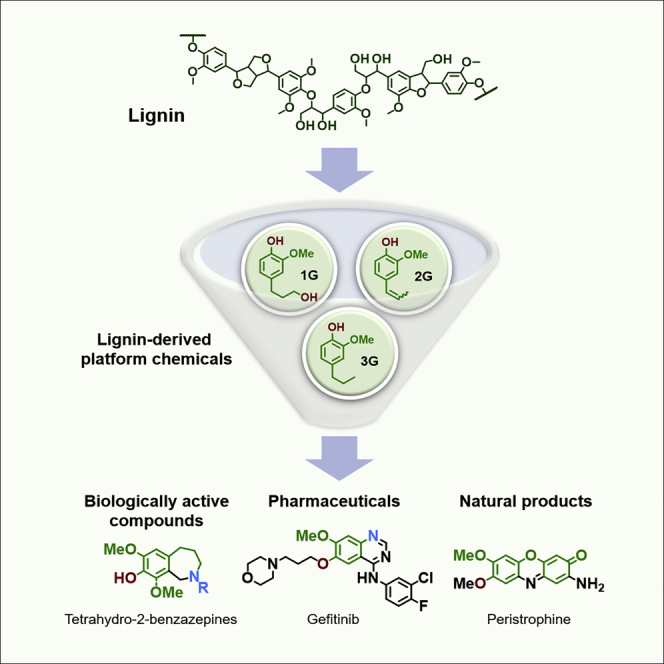
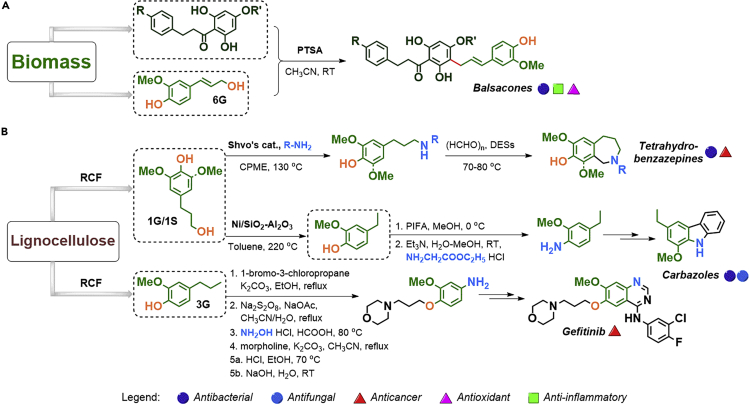
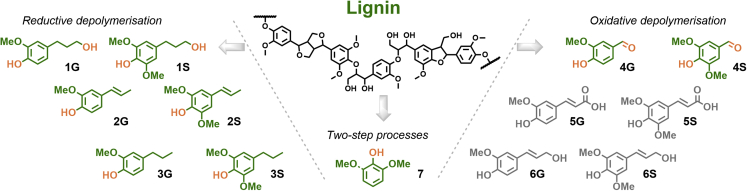
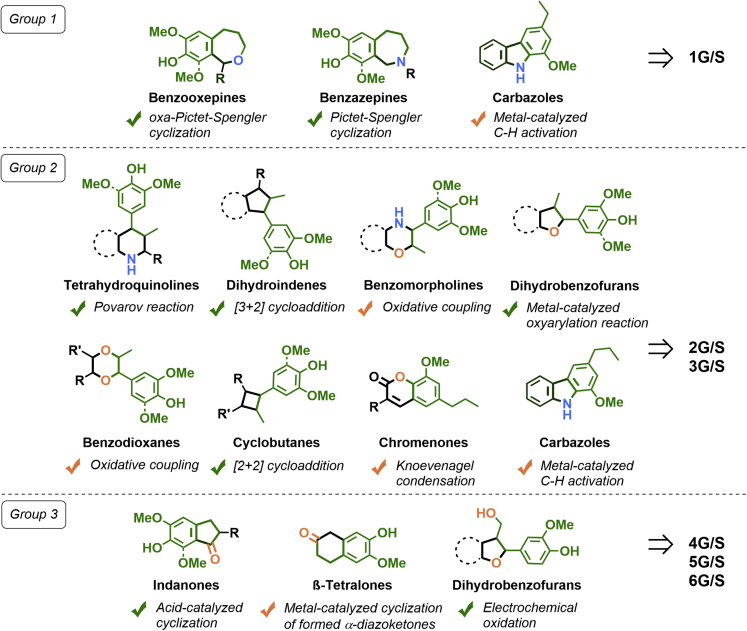
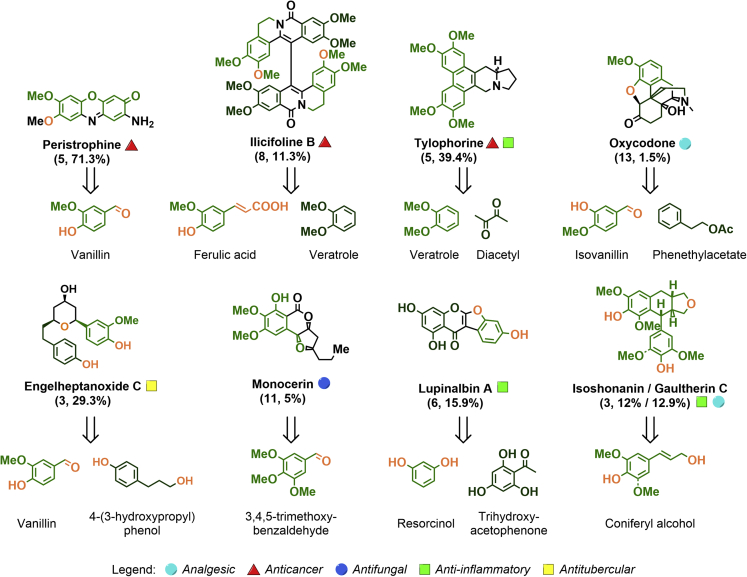
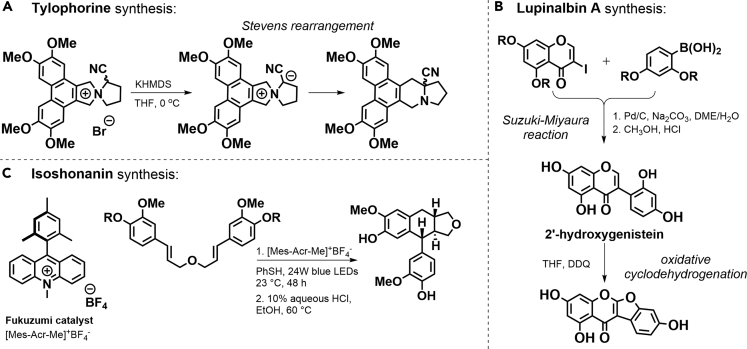
Lignin, the richest source of renewable aromatics on the planet, is an intriguing raw material for the construction of value-added aromatics. In the past decade, much progress has been made regarding the development of efficient lignin depolymerization methods, able to produce specific monophenol derivatives in high-enough selectivity and yields. This now serves as an excellent basis for developing powerful downstream conversion strategies toward a wide range of products, including fine chemical building blocks. The inherent structural features of lignin-derived platform chemicals undoubtedly inspire the development of novel, creative, atom-economic synthetic routes toward biologically active molecules or natural products. In this perspective we attempt to bridge the structural features of lignin-derived platform chemicals with existing synthetic strategies toward the construction of heterocycles and provide a summary of efforts for the production of natural products from aromatics that can be, in principle, obtained from lignin. Last, we comment on the latest efforts that present entire value-chains from wood to valuable pharmaceutically relevant compounds.
木质素是地球上最丰富的可再生芳烃来源,是一种用于构建增值芳烃的有趣原料。在过去十年中,在开发高效的木质素解聚方法方面取得了很大进展,这些方法能够以足够高的选择性和产率生产特定的单酚衍生物。这现在为开发强大的下游转化策略以生产包括精细化工原料在内的各种产品提供了极好的基础。木质素衍生的平台化学品的固有结构特征无疑激发了朝着生物活性分子或天然产物开发新颖、创新、原子经济的合成路线。从这个角度出发,我们试图将木质素衍生的平台化学品的结构特征与现有的构建杂环的合成策略联系起来,并总结从原则上可从木质素获得的芳烃生产天然产物的努力。最后,我们对目前从木材到有价值的药物相关化合物的整个价值链的最新努力进行评论。