Medical Research Council Human Genetics Unit, Institute of Genetics and Molecular Medicine, University of Edinburgh, Edinburgh, UK.
Scottish Universities Physics Alliance, School of Physics and Astronomy, University of Edinburgh, Edinburgh, UK.
J Cell Biol. 2021 May 3;220(5). doi: 10.1083/jcb.202010003.
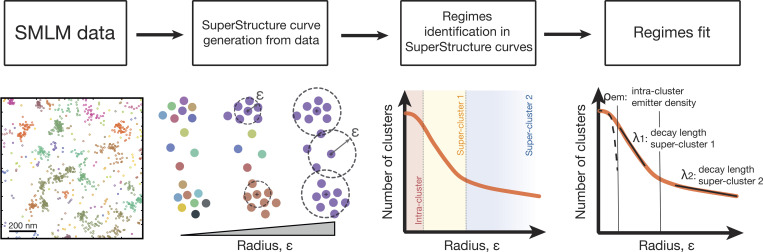
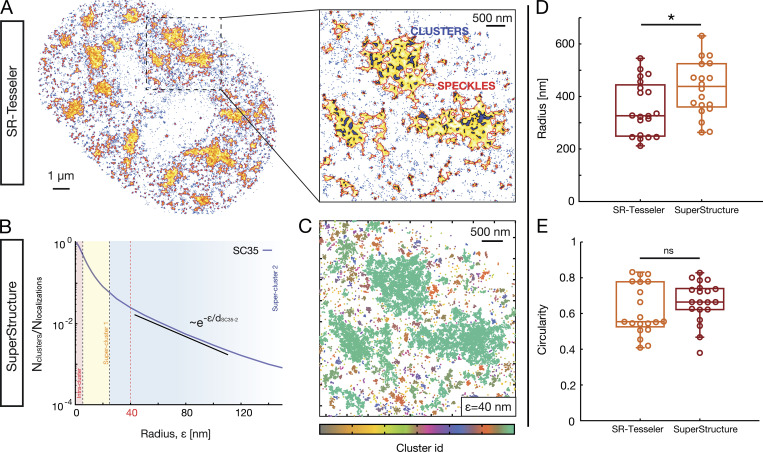
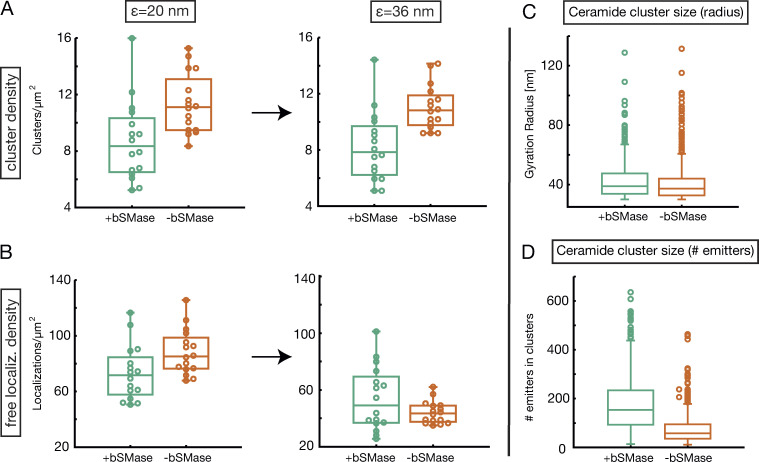
Understanding biological function requires the identification and characterization of complex patterns of molecules. Single-molecule localization microscopy (SMLM) can quantitatively measure molecular components and interactions at resolutions far beyond the diffraction limit, but this information is only useful if these patterns can be quantified and interpreted. We provide a new approach for the analysis of SMLM data that develops the concept of structures and super-structures formed by interconnected elements, such as smaller protein clusters. Using a formal framework and a parameter-free algorithm, (super-)structures formed from smaller components are found to be abundant in classes of nuclear proteins, such as heterogeneous nuclear ribonucleoprotein particles (hnRNPs), but are absent from ceramides located in the plasma membrane. We suggest that mesoscopic structures formed by interconnected protein clusters are common within the nucleus and have an important role in the organization and function of the genome. Our algorithm, SuperStructure, can be used to analyze and explore complex SMLM data and extract functionally relevant information.
理解生物功能需要识别和描述复杂的分子模式。单分子定位显微镜(SMLM)可以在远远超过衍射极限的分辨率下定量测量分子成分和相互作用,但只有当这些模式可以被定量和解释时,这些信息才有用。我们提供了一种用于分析 SMLM 数据的新方法,该方法发展了由相互连接的元素(如较小的蛋白质簇)形成的结构和超结构的概念。使用正式框架和无参数算法,发现由较小成分形成的(超)结构在核蛋白(如异质核核糖核蛋白颗粒(hnRNPs))等类别中非常丰富,但在位于质膜中的神经酰胺中不存在。我们认为,由相互连接的蛋白质簇形成的介观结构在核内很常见,在基因组的组织和功能中具有重要作用。我们的算法 SuperStructure 可用于分析和探索复杂的 SMLM 数据并提取功能相关信息。