Department of Speech, Hearing and Phonetic Sciences.
Department of Psychology.
J Exp Psychol Gen. 2021 Sep;150(9):1854-1869. doi: 10.1037/xge0001019. Epub 2021 Mar 18.
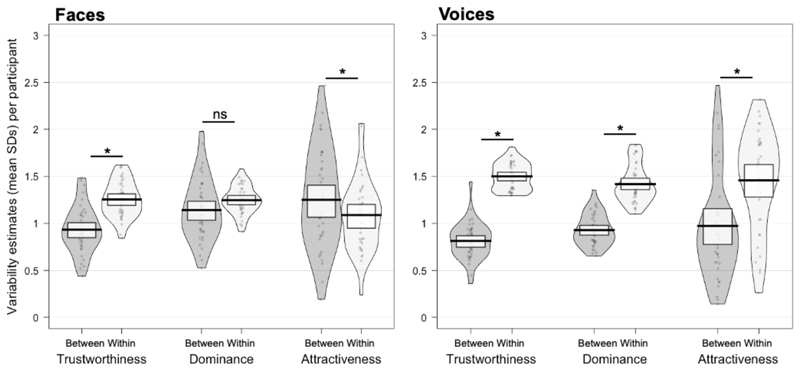
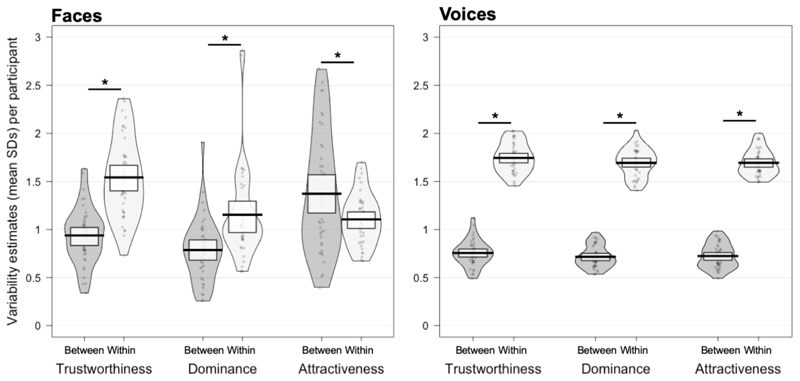
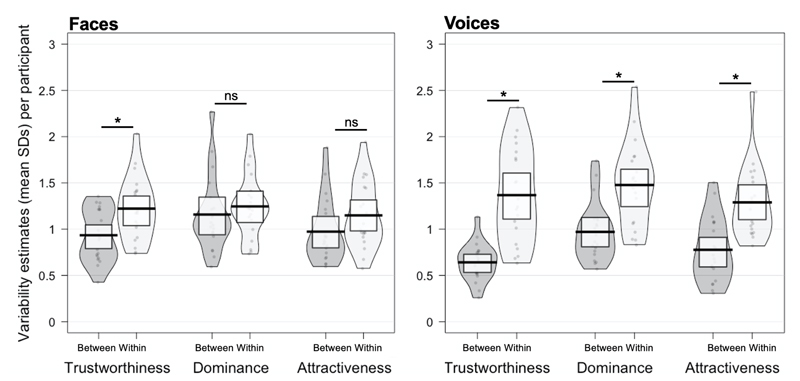
Human faces and voices are rich sources of information that can vary in many different ways. Most of the literature on face/voice perception has focused on understanding how people look and sound different to each other (between-person variability). However, recent studies highlight the ways in which the same person can look and sound different on different occasions (within-person variability). Across three experiments, we examined how within- and between-person variability relate to one another for social trait impressions by collecting trait ratings attributed to multiple face images and voice recordings of the same people. We find that within-person variability in social trait evaluations is at least as great as between-person variability. Using different stimulus sets across experiments, trait impressions of voices are consistently more variable within people than between people-a pattern that is only evident occasionally when judging faces. Our findings highlight the importance of understanding within-person variability, showing how judgments of the same person can vary widely on different encounters and quantify how this pattern differs for voice and face perception. The work consequently has implications for theoretical models proposing that voices can be considered "auditory faces" and imposes limitations to the "kernel of truth" hypothesis of trait evaluations. (PsycInfo Database Record (c) 2021 APA, all rights reserved).
人脸和声音是丰富的信息来源,可以在许多方面发生变化。大多数关于面孔/声音感知的文献都集中在理解人们彼此之间的外观和声音有何不同(个体间变异性)。然而,最近的研究强调了同一个人在不同场合下看起来和听起来不同的方式(个体内变异性)。在三个实验中,我们通过收集归因于同一个人多个面孔图像和语音记录的特征评分,研究了社会特征印象的个体内和个体间变异性之间的相互关系。我们发现,社会特征评价的个体内变异性至少与个体间变异性一样大。使用不同的实验刺激集,声音特征印象在个体内的变化比在个体间更为多变——这种模式在判断面孔时偶尔才会出现。我们的研究结果强调了理解个体内变异性的重要性,展示了同一个人的判断如何在不同的情况下发生很大变化,并量化了这种模式在声音和面孔感知方面的差异。因此,这项工作对提出声音可以被视为“听觉面孔”的理论模型具有启示意义,并对特征评价的“核心真相”假设施加了限制。