Montazeri Mahdieh, ZahediNasab Roxana, Farahani Ali, Mohseni Hadis, Ghasemian Fahimeh
Medical Informatics Research Center, Institute for Futures Studies in Health, Kerman University of Medical Sciences, Kerman, Iran.
Computer Engineering Department, Faculty of Engineering, Shahid Bahonar University of Kerman, Kerman, Iran.
JMIR Med Inform. 2021 Apr 23;9(4):e25181. doi: 10.2196/25181.
Accurate and timely diagnosis and effective prognosis of the disease is important to provide the best possible care for patients with COVID-19 and reduce the burden on the health care system. Machine learning methods can play a vital role in the diagnosis of COVID-19 by processing chest x-ray images.
The aim of this study is to summarize information on the use of intelligent models for the diagnosis and prognosis of COVID-19 to help with early and timely diagnosis, minimize prolonged diagnosis, and improve overall health care.
A systematic search of databases, including PubMed, Web of Science, IEEE, ProQuest, Scopus, bioRxiv, and medRxiv, was performed for COVID-19-related studies published up to May 24, 2020. This study was performed in accordance with the PRISMA (Preferred Reporting Items for Systematic Reviews and Meta-analyses) guidelines. All original research articles describing the application of image processing for the prediction and diagnosis of COVID-19 were considered in the analysis. Two reviewers independently assessed the published papers to determine eligibility for inclusion in the analysis. Risk of bias was evaluated using the Prediction Model Risk of Bias Assessment Tool.
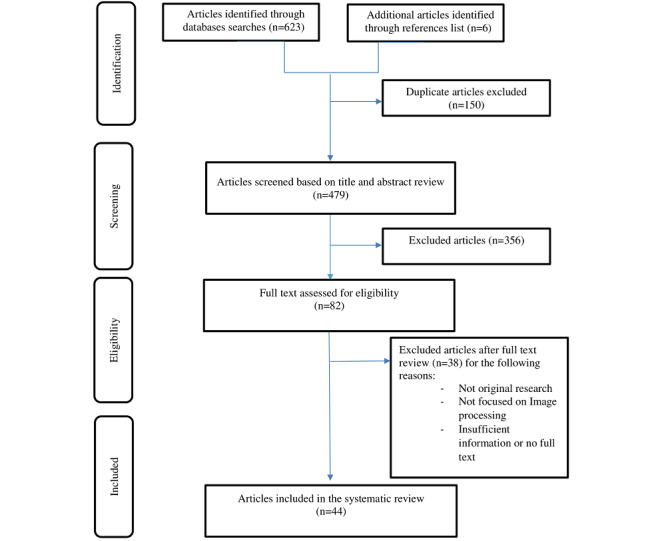
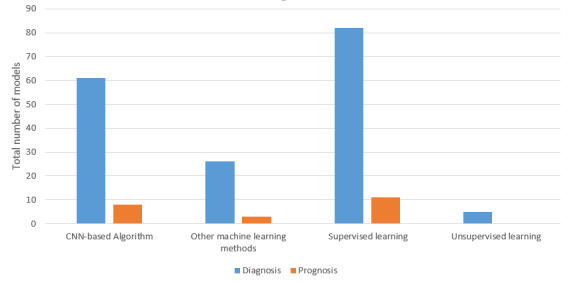
Of the 629 articles retrieved, 44 articles were included. We identified 4 prognosis models for calculating prediction of disease severity and estimation of confinement time for individual patients, and 40 diagnostic models for detecting COVID-19 from normal or other pneumonias. Most included studies used deep learning methods based on convolutional neural networks, which have been widely used as a classification algorithm. The most frequently reported predictors of prognosis in patients with COVID-19 included age, computed tomography data, gender, comorbidities, symptoms, and laboratory findings. Deep convolutional neural networks obtained better results compared with non-neural network-based methods. Moreover, all of the models were found to be at high risk of bias due to the lack of information about the study population, intended groups, and inappropriate reporting.
Machine learning models used for the diagnosis and prognosis of COVID-19 showed excellent discriminative performance. However, these models were at high risk of bias, because of various reasons such as inadequate information about study participants, randomization process, and the lack of external validation, which may have resulted in the optimistic reporting of these models. Hence, our findings do not recommend any of the current models to be used in practice for the diagnosis and prognosis of COVID-19.
准确及时地诊断疾病并进行有效的预后评估对于为新型冠状病毒肺炎(COVID-19)患者提供尽可能最佳的治疗以及减轻医疗系统负担至关重要。机器学习方法可通过处理胸部X光图像在COVID-19的诊断中发挥关键作用。
本研究旨在总结关于使用智能模型进行COVID-19诊断和预后评估的信息,以帮助早期及时诊断,尽量减少诊断时间延长,并改善整体医疗保健。
对包括PubMed、科学网、电气和电子工程师协会(IEEE)、ProQuest、Scopus、生物预印本(bioRxiv)和医学预印本(medRxiv)在内的数据库进行系统检索,以查找截至2020年5月24日发表的与COVID-19相关的研究。本研究按照系统评价和荟萃分析的首选报告项目(PRISMA)指南进行。分析中纳入了所有描述图像处理在COVID-19预测和诊断中的应用的原始研究文章。两名评审员独立评估已发表的论文,以确定是否符合纳入分析的条件。使用预测模型偏倚风险评估工具评估偏倚风险。
在检索到的629篇文章中,纳入了44篇。我们确定了4个用于计算个体患者疾病严重程度预测和隔离时间估计的预后模型,以及40个用于从正常情况或其他肺炎中检测COVID-19的诊断模型。大多数纳入研究使用基于卷积神经网络的深度学习方法,该方法已被广泛用作分类算法。COVID-19患者中最常报告的预后预测因素包括年龄、计算机断层扫描数据、性别、合并症、症状和实验室检查结果。与基于非神经网络的方法相比,深度卷积神经网络取得了更好的结果。此外,由于缺乏关于研究人群、目标群体的信息以及报告不当,发现所有模型都存在较高的偏倚风险。
用于COVID-19诊断和预后评估的机器学习模型显示出优异的判别性能。然而,由于诸如关于研究参与者的信息不足、随机化过程以及缺乏外部验证等各种原因,这些模型存在较高的偏倚风险,这可能导致对这些模型的乐观报告。因此,我们的研究结果不建议在实践中使用当前任何模型进行COVID-19的诊断和预后评估。