Research and Evaluation Division, Public Health Wales, Cardiff, United Kingdom.
Kings Fund, London, United Kingdom.
J Med Internet Res. 2021 Apr 7;23(4):e21726. doi: 10.2196/21726.
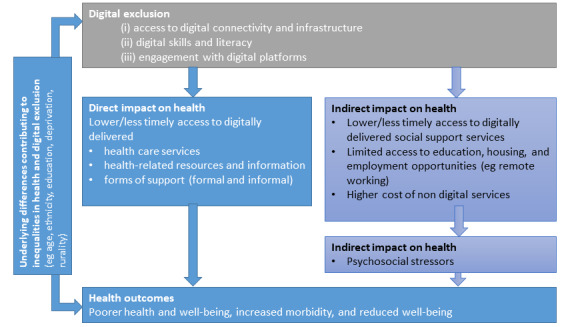
Digital technologies have been transforming methods of health care delivery and have been embraced within the health, social, and public response to the COVID-19 pandemic. However, this has directed attention to the "inverse information law" (also called "digital inverse care law") and digital inequalities, as people who are most in need of support (in particular, older people and those experiencing social deprivation) are often least likely to engage with digital platforms. The response to the COVID-19 pandemic represents a sustained shift to the adoption of digital approaches to working and engaging with populations, which will continue beyond the COVID-19 pandemic. Therefore, it is important to understand the underlying factors contributing to digital inequalities and act immediately to avoid digital inequality contributing to health inequalities in the future. The response to COVID-19 represents a sustained shift to adopting digital approaches to working and engaging with populations which will continue beyond this pandemic. Therefore it is important that we understand the underlying factors contributing to digital inequalities, and act now to protect against digital inequality contributing to health inequalities in the future.
数字技术改变了医疗保健的提供方式,并在应对 COVID-19 大流行的卫生、社会和公共反应中得到了采用。然而,这引起了对“逆向信息法”(也称为“数字逆向护理法”)和数字不平等的关注,因为最需要支持的人(特别是老年人和遭受社会剥夺的人)往往最不可能使用数字平台。对 COVID-19 大流行的反应代表了向采用数字方法来开展工作和与人群互动的持续转变,这种转变将在 COVID-19 大流行之后继续下去。因此,了解导致数字不平等的潜在因素并立即采取行动以避免数字不平等导致未来健康不平等至关重要。对 COVID-19 的反应代表了向采用数字方法来开展工作和与人群互动的持续转变,这种转变将在这场大流行之后继续下去。因此,我们必须了解导致数字不平等的潜在因素,并立即采取行动,防止数字不平等导致未来的健康不平等。