Information Sciences Institute, University of Southern California, Los Angeles, CA, United States.
Department of Computer Science, University of Southern California, Los Angeles, CA, United States.
J Med Internet Res. 2021 Apr 12;23(4):e25379. doi: 10.2196/25379.
Gender imbalances in academia have been evident historically and persist today. For the past 60 years, we have witnessed the increase of participation of women in biomedical disciplines, showing that the gender gap is shrinking. However, preliminary evidence suggests that women, including female researchers, are disproportionately affected by the COVID-19 pandemic in terms of unequal distribution of childcare, elderly care, and other kinds of domestic and emotional labor. Sudden lockdowns and abrupt shifts in daily routines have had disproportionate consequences on their productivity, which is reflected by a sudden drop in research output in biomedical research, consequently affecting the number of female authors of scientific publications.
The objective of this study is to test the hypothesis that the COVID-19 pandemic has had a disproportionate adverse effect on the productivity of female researchers in the biomedical field in terms of authorship of scientific publications.
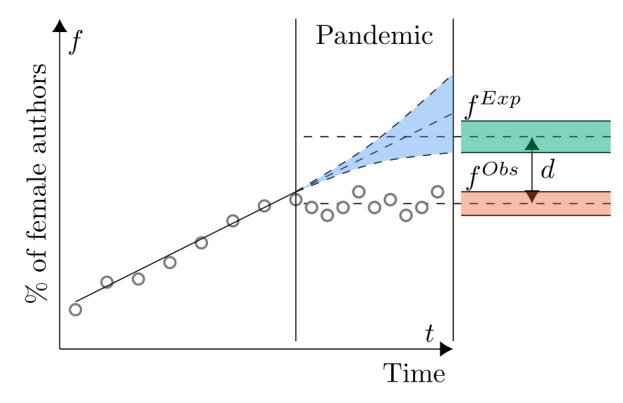
This is a retrospective observational bibliometric study. We investigated the proportion of male and female researchers who published scientific papers during the COVID-19 pandemic, using bibliometric data from biomedical preprint servers and selected Springer-Nature journals. We used the ordinary least squares regression model to estimate the expected proportions over time by correcting for temporal trends. We also used a set of statistical methods, such as the Kolmogorov-Smirnov test and regression discontinuity design, to test the validity of the results.
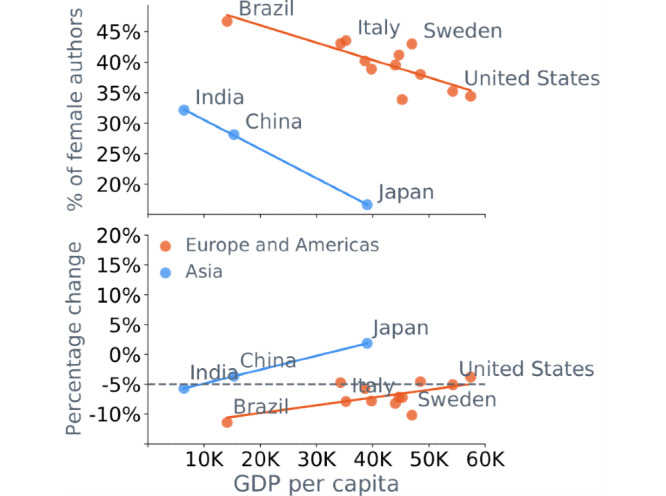
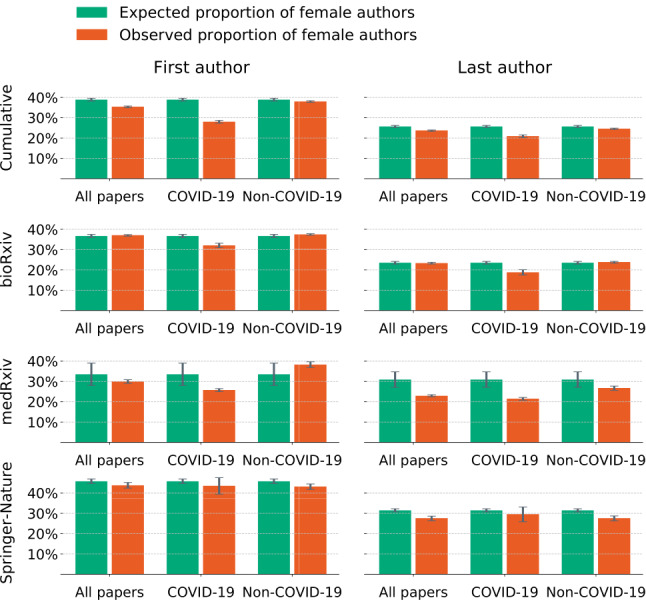
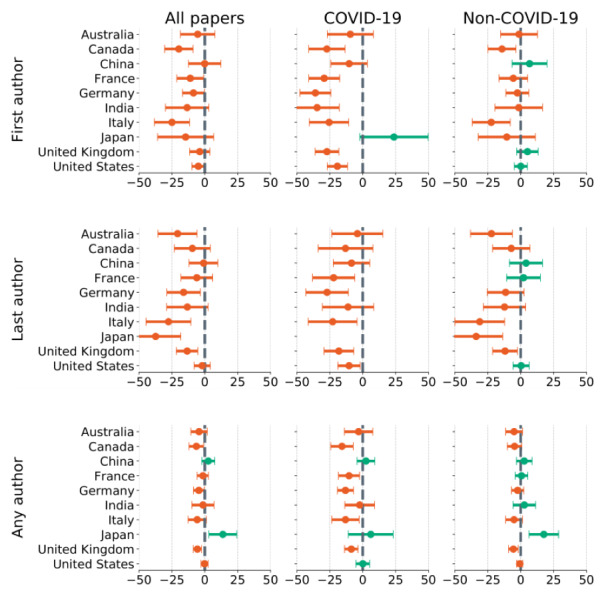
A total of 78,950 papers from the bioRxiv and medRxiv repositories and from 62 selected Springer-Nature journals by 346,354 unique authors were analyzed. The acquired data set consisted of papers that were published between January 1, 2019, and August 2, 2020. The proportion of female first authors publishing in the biomedical field during the pandemic dropped by 9.1%, on average, across disciplines (expected arithmetic mean y=0.39; observed arithmetic mean y=0.35; standard error of the estimate, S=0.007; standard error of the observation, σ=0.004). The impact was particularly pronounced for papers related to COVID-19 research, where the proportion of female scientists in the first author position dropped by 28% (y=0.39; y=0.28; S=0.007; σ=0.007). When looking at the last authors, the proportion of women dropped by 7.9%, on average (y=0.25; y=0.23; S=0.005; σ=0.003), while the proportion of women writing about COVID-19 as the last author decreased by 18.8% (y=0.25; y=0.21; S=0.005; σ=0.007). Further, by geocoding authors' affiliations, we showed that the gender disparities became even more apparent when disaggregated by country, up to 35% in some cases.
Our findings document a decrease in the number of publications by female authors in the biomedical field during the global pandemic. This effect was particularly pronounced for papers related to COVID-19, indicating that women are producing fewer publications related to COVID-19 research. This sudden increase in the gender gap was persistent across the 10 countries with the highest number of researchers. These results should be used to inform the scientific community of this worrying trend in COVID-19 research and the disproportionate effect that the pandemic has had on female academics.
学术界的性别失衡现象历史悠久,至今仍然存在。在过去的 60 年里,我们见证了女性参与生物医学学科的比例不断增加,表明性别差距正在缩小。然而,初步证据表明,包括女性研究人员在内的女性在儿童保育、老年人护理和其他各种家庭和情感劳动方面受到 COVID-19 大流行的不平等分配的不成比例的影响。突然的封锁和日常生活的急剧转变对她们的生产力产生了不成比例的影响,这反映在生物医学研究的研究产出突然下降,从而影响了科学出版物的女性作者数量。
本研究旨在检验以下假设:COVID-19 大流行对生物医学领域女性研究人员的生产力产生了不成比例的不利影响,表现在科学出版物的作者身份上。
这是一项回顾性观察性生物计量学研究。我们使用生物预印本服务器和选定的施普林格-自然期刊的生物计量数据,调查了在 COVID-19 大流行期间发表科学论文的男性和女性研究人员的比例。我们使用普通最小二乘回归模型,通过校正时间趋势来估计随时间变化的预期比例。我们还使用了一组统计方法,如柯尔莫哥洛夫-斯米尔诺夫检验和回归不连续性设计,来检验结果的有效性。
共分析了来自 bioRxiv 和 medRxiv 存储库以及 62 种选定的施普林格-自然期刊的 78950 篇论文,这些论文由 346354 位独特的作者撰写。所获得的数据集包括 2019 年 1 月 1 日至 2020 年 8 月 2 日期间发表的论文。在整个学科领域,女性第一作者在大流行期间发表论文的比例平均下降了 9.1%(预期算术平均值 y=0.39;观察到的算术平均值 y=0.35;估计的标准误差,S=0.007;观察到的标准误差,σ=0.004)。对于与 COVID-19 研究相关的论文,女性科学家在第一作者位置的比例下降了 28%,这一影响尤其显著(y=0.39;y=0.28;S=0.007;σ=0.007)。当我们观察最后一位作者时,女性的比例平均下降了 7.9%(y=0.25;y=0.23;S=0.005;σ=0.003),而将 COVID-19 作为最后作者的女性比例下降了 18.8%(y=0.25;y=0.21;S=0.005;σ=0.007)。此外,通过对作者所属机构进行地理编码,我们表明,当按国家细分时,性别差距变得更加明显,在某些情况下甚至高达 35%。
我们的研究结果记录了在全球大流行期间,生物医学领域女性作者发表的论文数量减少。这种影响在与 COVID-19 相关的论文中尤为明显,表明女性在撰写与 COVID-19 研究相关的论文方面减少了。这种性别差距的突然增加在拥有最多研究人员的 10 个国家中持续存在。这些结果应该被用来告知科学界这一令人担忧的 COVID-19 研究趋势,以及大流行对女性学者的不成比例影响。