Woulfe Kathleen C, Walker Lori A
Division of Cardiology, Department of Medicine, University of Colorado Anschutz Medical Campus, Aurora, CO, United States.
Front Physiol. 2021 Mar 2;12:642284. doi: 10.3389/fphys.2021.642284. eCollection 2021.
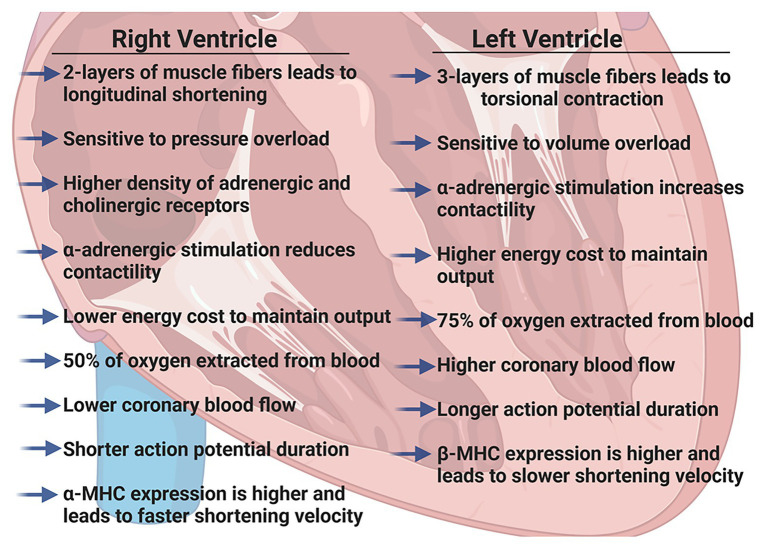
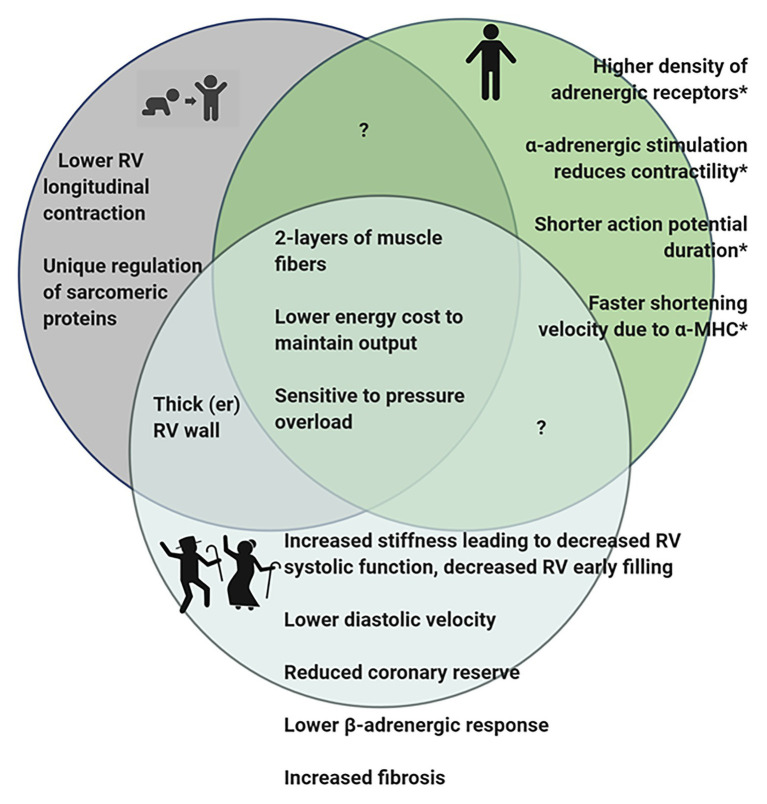
The most common cause of heart failure in the United States is ischemic left heart disease; accordingly, a vast amount of work has been done to elucidate the molecular mechanisms underlying pathologies of the left ventricle (LV) as a general model of heart failure. Until recently, little attention has been paid to the right ventricle (RV) and it has commonly been thought that the mechanical and biochemical properties of the RV are similar to those of the LV. However, therapies used to treat LV failure often fail to improve ventricular function in RV failure underscoring, the need to better understand the unique physiologic and pathophysiologic properties of the RV. Importantly, hemodynamic stresses (such as pressure overload) often underlie right heart failure further differentiating RV failure as unique from LV failure. There are significant structural, mechanical, and biochemical properties distinctive to the RV that influences its function and it is likely that adaptations of the RV occur uniquely across the lifespan. We have previously reviewed the adult RV compared to the LV but there is little known about differences in the pediatric or aged RV. Accordingly, in this mini-review, we will examine the subtle distinctions between the RV and LV that are maintained physiologically across the lifespan and will highlight significant knowledge gaps in our understanding of pediatric and aging RV. Consideration of how RV function is altered in different disease states in an age-specific manner may enable us to define RV function in health and importantly, in response to pathology.
在美国,心力衰竭最常见的病因是缺血性左心疾病;因此,为阐明作为心力衰竭一般模型的左心室(LV)病理背后的分子机制,已经开展了大量工作。直到最近,右心室(RV)很少受到关注,人们普遍认为右心室的机械和生化特性与左心室相似。然而,用于治疗左心室衰竭的疗法往往无法改善右心室衰竭时的心室功能,这突出表明需要更好地了解右心室独特的生理和病理生理特性。重要的是,血流动力学应激(如压力过载)往往是右心衰竭的基础,这进一步将右心室衰竭与左心室衰竭区分开来。右心室具有显著的结构、机械和生化特性,这些特性会影响其功能,而且右心室的适应性可能在整个生命周期中独特地发生。我们之前已将成年右心室与左心室进行了比较,但对于小儿或老年右心室的差异知之甚少。因此,在本综述中,我们将探讨右心室和左心室在整个生命周期中生理上保持的细微差别,并强调我们在理解小儿和老年右心室方面存在的重大知识空白。考虑右心室功能如何以特定年龄的方式在不同疾病状态下发生改变,可能使我们能够界定健康状态下以及重要的是对病理状态作出反应时的右心室功能。