Nouri Barkestani Mahsa, Naserian Sina, Uzan Georges, Shamdani Sara
INSERM UMR-S-MD 1197, Hôpital Paul Brousse, Villejuif, France.
Université Paris-Saclay, CNRS, Centre de Nanosciences et Nanotechnologies C2N, UMR9001, Palaiseau, France.
J Tissue Eng. 2021 Feb 26;12:2041731420983562. doi: 10.1177/2041731420983562. eCollection 2021 Jan-Dec.
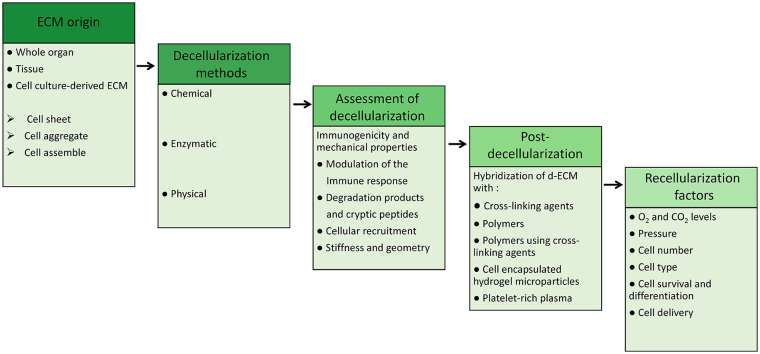
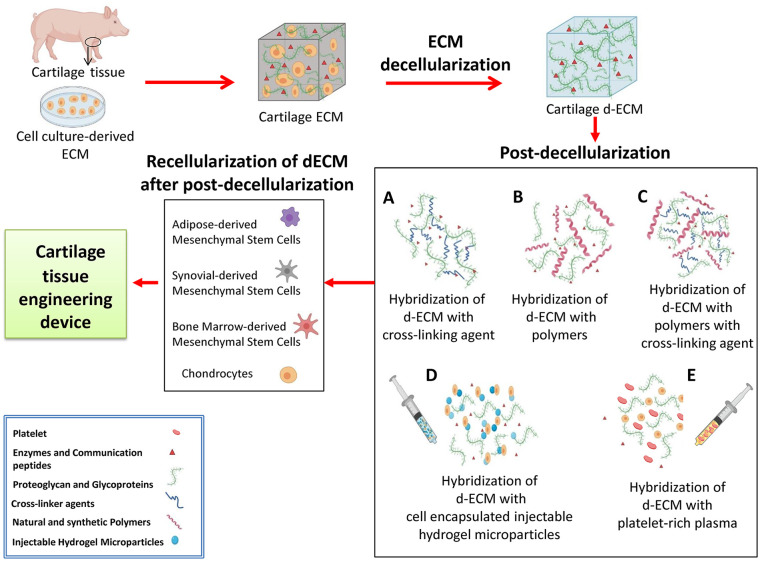
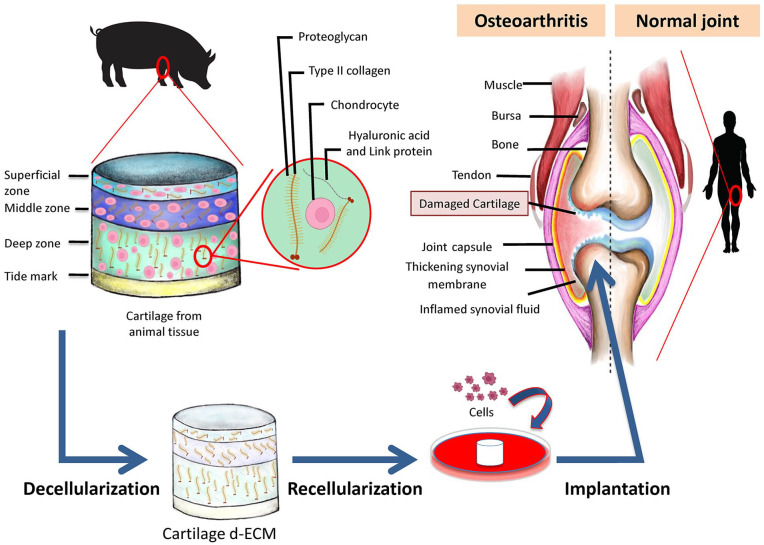
Due to the current lack of innovative and effective therapeutic approaches, tissue engineering (TE) has attracted much attention during the last decades providing new hopes for the treatment of several degenerative disorders. Tissue engineering is a complex procedure, which includes processes of decellularization and recellularization of biological tissues or functionalization of artificial scaffolds by active cells. In this review, we have first discussed those conventional steps, which have led to great advancements during the last several years. Moreover, we have paid special attention to the new methods of post-decellularization that can significantly ameliorate the efficiency of decellularized cartilage extracellular matrix (ECM) for the treatment of osteoarthritis (OA). We propose a series of post-decellularization procedures to overcome the current shortcomings such as low mechanical strength and poor bioactivity to improve decellularized ECM scaffold towards much more efficient and higher integration.
由于目前缺乏创新且有效的治疗方法,在过去几十年中,组织工程(TE)备受关注,为多种退行性疾病的治疗带来了新希望。组织工程是一个复杂的过程,包括生物组织的去细胞化和再细胞化过程,或通过活性细胞对人工支架进行功能化。在本综述中,我们首先讨论了那些在过去几年中取得重大进展的传统步骤。此外,我们特别关注了去细胞化后的新方法,这些方法可以显著提高去细胞化软骨细胞外基质(ECM)治疗骨关节炎(OA)的效率。我们提出了一系列去细胞化后处理程序,以克服当前诸如机械强度低和生物活性差等缺点,从而改进去细胞化ECM支架,使其更高效且具有更高的整合性。