Leng Yi, Ren Guangkai, Cui Yutao, Peng Chuangang, Wang Jincheng, Wu Dankai, Liu He
Department of Orthopedics, The Second Hospital of Jilin University, Changchun 130041, China.
Ann Transl Med. 2020 Mar;8(5):198. doi: 10.21037/atm.2020.01.53.
Bone defects represent a common orthopedic condition. With its vast array of donor sources, xenogeneic bone shows considerable potential as a bone defect repair material but may also be associated with immune rejection and reduced osteogenic capacity. Thus, reducing the risks for immune rejection of xenogeneic bone, while improving its osseointegration, are key technical challenges.
Decellularized bone matrix scaffolds (DBMs) were fabricated by thorough ultrasonic vibration and subjection to chemical biological agents to remove cells and proteins. The DBMs were then mixed with platelet-rich plasma (PRP) under negative pressure. Growth factor concentrations of PRP, as well as the microstructures and biomechanical properties of the system, were examined. Furthermore, osseointegration capacities in the critical-size radial defect rabbit model were verified.
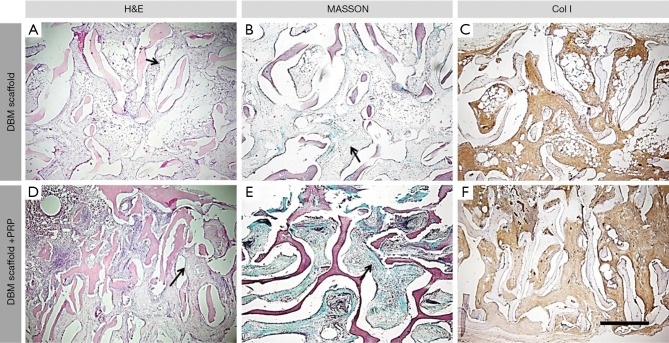
Complete decellularization of the scaffold and limited reductions in mechanical strength were observed. Moreover, the obtained PRP demonstrated various growth factors. Radiographic evaluation and histological analysis verified that more new bone formation occurred in the DBM mixed with PRP group at 6 and 12 weeks after implantation compared with both the blank group and the DBM without PRP group.
Thorough physical and chemical treatments can reduce the probability of immune rejection of DBMs. The novel composite of DBMs mixed with PRP can serve as a promising bone regeneration material.
骨缺损是一种常见的骨科病症。异种骨拥有大量的供体来源,作为骨缺损修复材料具有相当大的潜力,但也可能与免疫排斥反应及成骨能力降低有关。因此,降低异种骨免疫排斥风险并提高其骨整合能力是关键技术挑战。
通过充分的超声振动和使用化学生物制剂去除细胞和蛋白质来制备脱细胞骨基质支架(DBM)。然后在负压条件下将DBM与富血小板血浆(PRP)混合。检测PRP的生长因子浓度以及该系统的微观结构和生物力学性能。此外,在临界尺寸桡骨缺损兔模型中验证骨整合能力。
观察到支架完全脱细胞且机械强度仅有有限降低。此外,所获得的PRP显示出多种生长因子。影像学评估和组织学分析证实,与空白组和不含PRP的DBM组相比,植入后6周和12周时,DBM与PRP混合组有更多新骨形成。
彻底的物理和化学处理可降低DBM免疫排斥的可能性。DBM与PRP混合的新型复合材料可作为一种有前景的骨再生材料。