Neishabouri Afarin, Soltani Khaboushan Alireza, Daghigh Faezeh, Kajbafzadeh Abdol-Mohammad, Majidi Zolbin Masoumeh
Pediatric Urology and Regenerative Medicine Research Center, Children's Medical Center, Pediatric Center of Excellence, Tehran University of Medical Science, Tehran, Iran.
Students' Scientific Research Center, Tehran University of Medical Sciences, Tehran, Iran.
Front Bioeng Biotechnol. 2022 Apr 25;10:805299. doi: 10.3389/fbioe.2022.805299. eCollection 2022.
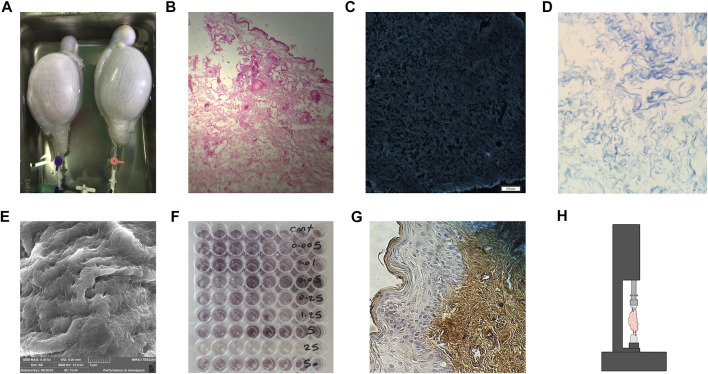
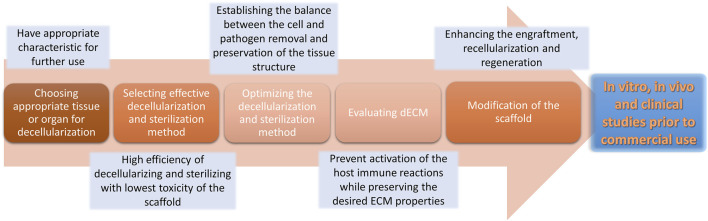
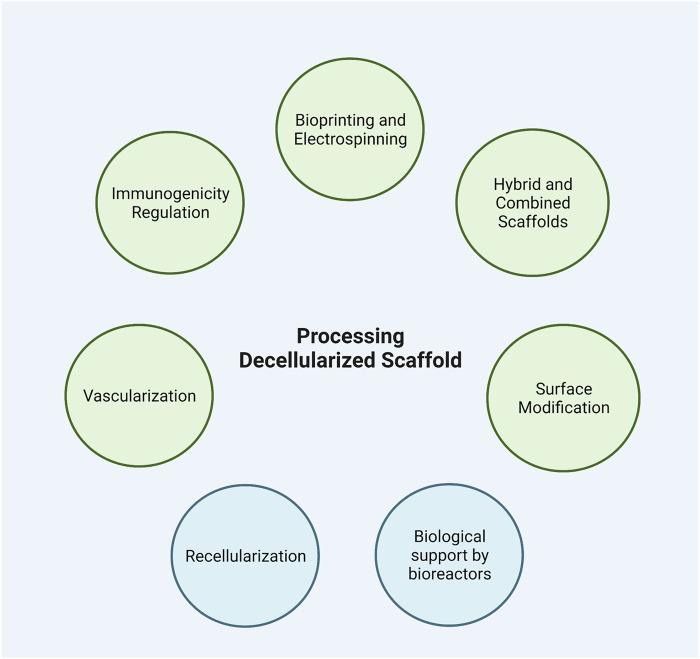
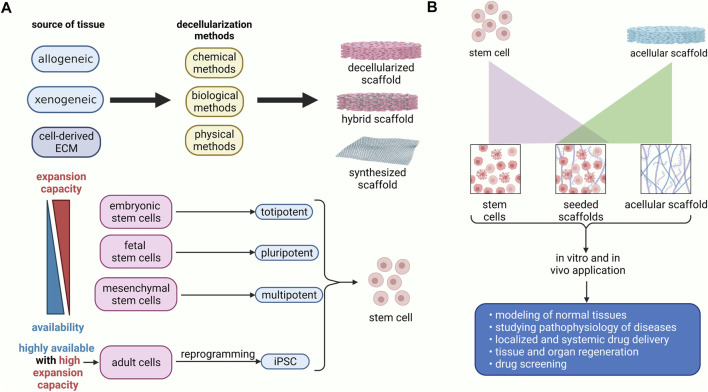
Reproduction of different tissues using scaffolds and materials is a major element in regenerative medicine. The regeneration of whole organs with decellularized extracellular matrix (dECM) has remained a goal despite the use of these materials for different purposes. Recently, decellularization techniques have been widely used in producing scaffolds that are appropriate for regenerating damaged organs and may be able to overcome the shortage of donor organs. Decellularized ECM offers several advantages over synthetic compounds, including the preserved natural microenvironment features. Different decellularization methods have been developed, each of which is appropriate for removing cells from specific tissues under certain conditions. A variety of methods have been advanced for evaluating the decellularization process in terms of cell removal efficiency, tissue ultrastructure preservation, toxicity, biocompatibility, biodegradability, and mechanical resistance in order to enhance the efficacy of decellularization methods. Modification techniques improve the characteristics of decellularized scaffolds, making them available for the regeneration of damaged tissues. Moreover, modification of scaffolds makes them appropriate options for drug delivery, disease modeling, and improving stem cells growth and proliferation. However, considering different challenges in the way of decellularization methods and application of decellularized scaffolds, this field is constantly developing and progressively moving forward. This review has outlined recent decellularization and sterilization strategies, evaluation tests for efficient decellularization, materials processing, application, and challenges and future outlooks of decellularization in regenerative medicine and tissue engineering.
利用支架和材料来复制不同组织是再生医学的一个主要要素。尽管这些材料被用于不同目的,但利用脱细胞细胞外基质(dECM)实现整个器官的再生仍然是一个目标。最近,脱细胞技术已被广泛用于生产适合再生受损器官的支架,并且可能能够克服供体器官短缺的问题。与合成化合物相比,脱细胞ECM具有多个优势,包括保留了天然微环境特征。已经开发出不同的脱细胞方法,每种方法都适用于在特定条件下从特定组织中去除细胞。为了提高脱细胞方法的效果,已经提出了多种方法来评估脱细胞过程,包括细胞去除效率、组织超微结构保留、毒性、生物相容性、生物降解性和机械抗性。修饰技术改善了脱细胞支架的特性,使其可用于受损组织的再生。此外,对支架的修饰使其成为药物递送、疾病建模以及改善干细胞生长和增殖的合适选择。然而,考虑到脱细胞方法和脱细胞支架应用方面的不同挑战,该领域正在不断发展并逐步向前推进。这篇综述概述了再生医学和组织工程中最近的脱细胞和灭菌策略、高效脱细胞的评估测试、材料加工、应用以及脱细胞的挑战和未来展望。