Department of Psychiatry and Behavioral Sciences, University of Washington, Seattle, WA, United States.
Department of Psychiatry and Behavioral Sciences, University of Washington, Seattle, WA, United States.
Vaccine. 2021 Apr 8;39(15):2060-2067. doi: 10.1016/j.vaccine.2021.03.018. Epub 2021 Mar 17.
Vaccination may be critical to curtailing the spread of the SARS-CoV-2 virus responsible for the COVID-19 pandemic, but herd immunity can only be realized with high vaccination coverage. There is a need to identify empirically supported strategies to increase uptake, especially among young adults as this subpopulation has shown relatively poor adherence to physical distancing guidelines. Social norms - estimates of peers' behavior and attitudes - are robust predictors of health behaviors and norms-based intervention strategies may increase COVID vaccine uptake, once available. This study examined the extent that vaccination intentions and attitudes were associated with estimated social norms as an initial proof-of-concept test.
In November of 2020, 647 undergraduate students (46.21% response rate) completed online surveys in which they reported intentions to get COVID and influenza vaccines, perceived importance of these vaccines for young adults, and estimated social norms regarding peers' vaccination behaviors and attitudes.
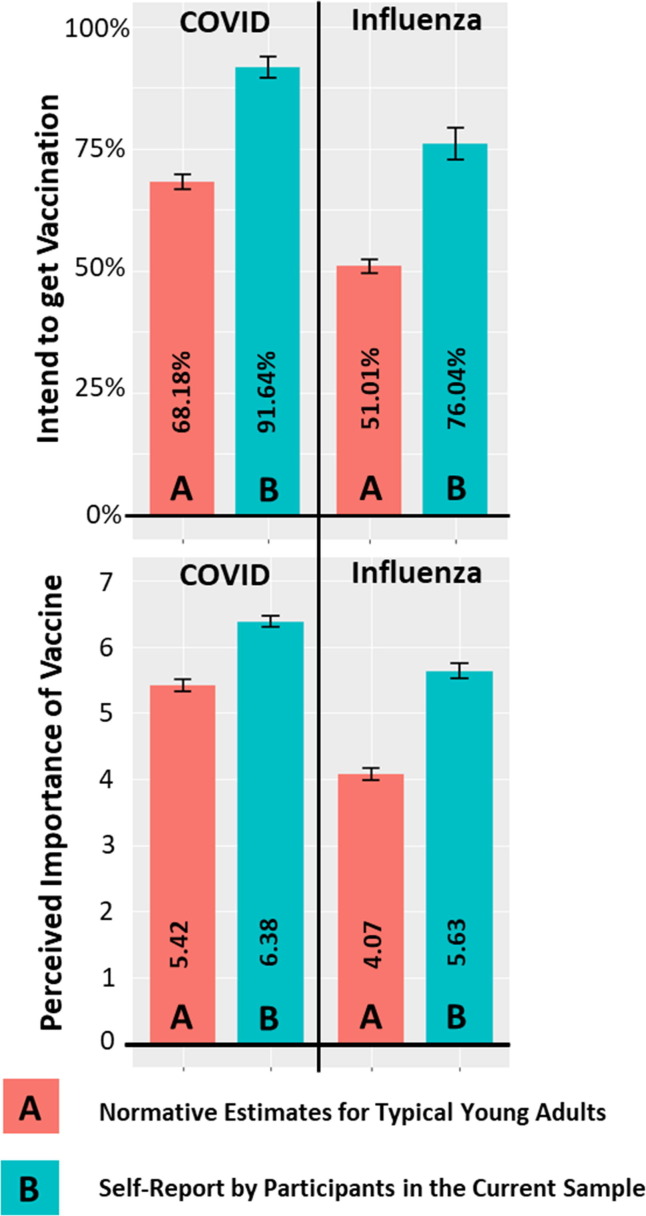
Students reported significantly greater intentions to get a COVID vaccine (91.64%) than an influenza vaccine (76.04%), and perceived COVID vaccination as significantly more important than influenza vaccination. The sample generally held strong intentions to receive a COVID vaccine and thought that doing so was of high importance, but participants, on average, perceived that other young adults would be less likely to be vaccinated and would not think vaccination was as important. Multiple regression models indicated that estimated social norms were positively associated with participants' own intentions and perceived importance of getting a COVID vaccine.
These significant associations highlight the potential value in developing and testing norms-based intervention strategies, such as personalized normative feedback, to improve uptake of forthcoming COVID vaccines among young adults.
接种疫苗对于遏制导致 COVID-19 大流行的 SARS-CoV-2 病毒的传播可能至关重要,但只有在高疫苗接种率的情况下才能实现群体免疫。有必要确定经验支持的策略来提高接种率,特别是在年轻人中,因为这一人群对保持社交距离的指导方针的依从性相对较差。社会规范——对同龄人行为和态度的估计——是健康行为的有力预测因素,基于规范的干预策略可能会增加 COVID 疫苗的接种率,一旦疫苗可用。本研究考察了疫苗接种意愿和态度与估计的社会规范之间的关联程度,作为初步的概念验证测试。
2020 年 11 月,647 名本科生(46.21%的回复率)完成了在线调查,报告了他们接种 COVID 和流感疫苗的意愿、对这些疫苗对年轻人的重要性的看法,以及对同龄人接种疫苗行为和态度的估计社会规范。
学生报告接种 COVID 疫苗的意愿(91.64%)明显高于流感疫苗(76.04%),并认为 COVID 疫苗接种比流感疫苗接种更重要。样本普遍对接种 COVID 疫苗有强烈的意愿,并认为这非常重要,但参与者平均认为其他年轻人不太可能接种疫苗,也不会认为接种疫苗很重要。多元回归模型表明,估计的社会规范与参与者自己接种 COVID 疫苗的意愿和重要性感知呈正相关。
这些显著的关联突显了开发和测试基于规范的干预策略的潜在价值,例如个性化规范反馈,以提高年轻人对即将推出的 COVID 疫苗的接种率。