Bates David W, Levine David, Syrowatka Ania, Kuznetsova Masha, Craig Kelly Jean Thomas, Rui Angela, Jackson Gretchen Purcell, Rhee Kyu
Division of General Internal Medicine, Brigham and Women's Hospital, Boston, MA, USA.
Harvard Medical School, Boston, MA, USA.
NPJ Digit Med. 2021 Mar 19;4(1):54. doi: 10.1038/s41746-021-00423-6.
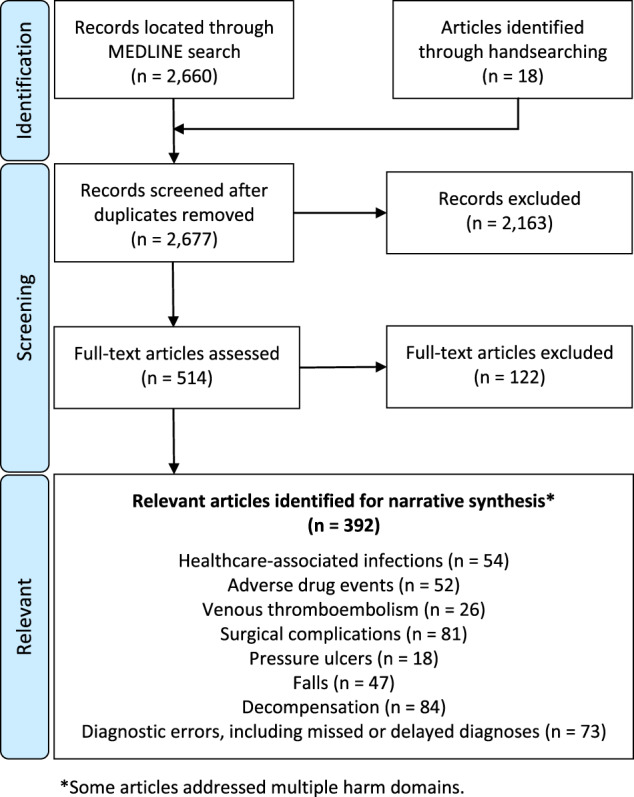
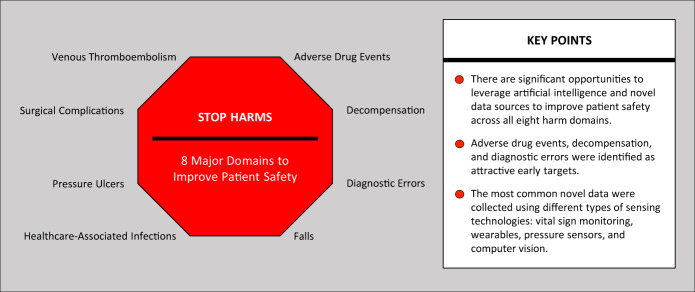
Artificial intelligence (AI) represents a valuable tool that could be used to improve the safety of care. Major adverse events in healthcare include: healthcare-associated infections, adverse drug events, venous thromboembolism, surgical complications, pressure ulcers, falls, decompensation, and diagnostic errors. The objective of this scoping review was to summarize the relevant literature and evaluate the potential of AI to improve patient safety in these eight harm domains. A structured search was used to query MEDLINE for relevant articles. The scoping review identified studies that described the application of AI for prediction, prevention, or early detection of adverse events in each of the harm domains. The AI literature was narratively synthesized for each domain, and findings were considered in the context of incidence, cost, and preventability to make projections about the likelihood of AI improving safety. Three-hundred and ninety-two studies were included in the scoping review. The literature provided numerous examples of how AI has been applied within each of the eight harm domains using various techniques. The most common novel data were collected using different types of sensing technologies: vital sign monitoring, wearables, pressure sensors, and computer vision. There are significant opportunities to leverage AI and novel data sources to reduce the frequency of harm across all domains. We expect AI to have the greatest impact in areas where current strategies are not effective, and integration and complex analysis of novel, unstructured data are necessary to make accurate predictions; this applies specifically to adverse drug events, decompensation, and diagnostic errors.
人工智能(AI)是一种可用于提高医疗安全的宝贵工具。医疗保健中的主要不良事件包括:医疗相关感染、药物不良事件、静脉血栓栓塞、手术并发症、压疮、跌倒、失代偿和诊断错误。本综述的目的是总结相关文献,并评估人工智能在这八个伤害领域提高患者安全的潜力。使用结构化搜索在MEDLINE中查询相关文章。该综述确定了描述人工智能在每个伤害领域用于预测、预防或早期检测不良事件的应用的研究。针对每个领域对人工智能文献进行了叙述性综合,并在发病率、成本和可预防性的背景下考虑研究结果,以预测人工智能提高安全性的可能性。该综述纳入了392项研究。文献提供了许多关于如何使用各种技术在八个伤害领域中的每个领域应用人工智能的例子。最常见的新数据是使用不同类型的传感技术收集的:生命体征监测、可穿戴设备、压力传感器和计算机视觉。利用人工智能和新数据源来减少所有领域伤害发生频率的机会很大。我们预计人工智能将在当前策略无效的领域产生最大影响,并且需要对新的非结构化数据进行整合和复杂分析才能做出准确预测;这尤其适用于药物不良事件、失代偿和诊断错误。