Department of Psychology, Health, and Technology, Center for eHealth and Well-being Research, University of Twente, Enschede, Netherlands.
Psychiatry, Amsterdam Public Health Research Institute, Vrije Universiteit, Amsterdam UMC, The Netherlands.
Psychol Psychother. 2021 Sep;94(3):667-685. doi: 10.1111/papt.12339. Epub 2021 Mar 19.
Personal recovery is increasingly recognized as important outcome for people with bipolar disorder (BD), but research addressing associated factors of personal recovery in this group remains scarce. This study aimed to explore the association of sociodemographic variables, social participation, psychopathology, and positive emotion regulation with personal recovery in BD.
Baseline data from a randomized controlled trial and survey data were combined (N = 209) and split into a training (n = 149) and test sample (n = 60). Block-wise regression analyses and model training were used to determine the most relevant predictors. The final parsimonious model was cross-validated in the test sample.
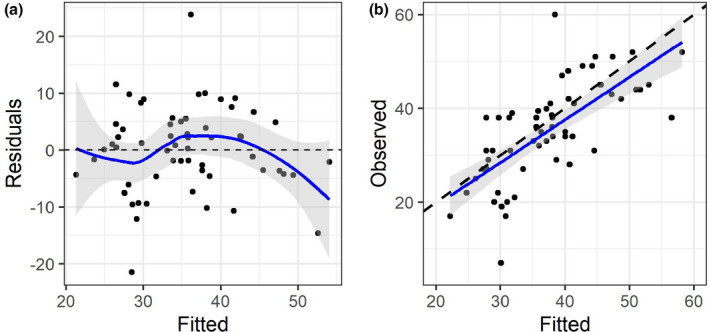
In the final parsimonious model, satisfaction with social roles (β = .442, p < .001), anxiety symptoms (β = -.328, p < .001), manic symptoms (β = .276, p < .001), and emotion-focused positive rumination (β = .258, p < .001) were independently associated with personal recovery. The model explained 57.3% variance in personal recovery (adjusted R = .561) and performed well in predicting personal recovery in the independent test sample (adjusted R = .491).
Our findings suggest that especially social participation, anxiety and positive rumination might be relevant treatment targets when aiming to improve personal recovery.
Personal recovery is considered an increasingly important outcome for people with chronic mental health conditions, including bipolar disorder. We found that anxiety and manic symptoms as well as positive rumination and social participation were independently associated with personal recovery in bipolar disorder. Therefore, these outcomes might be relevant treatment targets when aiming to improve personal recovery in bipolar disorder. Possible interventions to improve these outcomes are discussed, including supported employment and vocational rehabilitation for social participation and exercising with savoring strategies to increase positive rumination.
个人康复越来越被认为是双相情感障碍(BD)患者的重要结果,但针对该人群个人康复相关因素的研究仍然很少。本研究旨在探讨社会人口统计学变量、社会参与、精神病理学和积极情绪调节与 BD 患者个人康复的关系。
将一项随机对照试验的基线数据和调查数据相结合(N=209),并将其分为训练样本(n=149)和测试样本(n=60)。使用分块回归分析和模型训练来确定最相关的预测因子。最终简约模型在测试样本中进行了交叉验证。
在最终简约模型中,对社会角色的满意度(β=0.442,p<0.001)、焦虑症状(β=-.328,p<0.001)、躁狂症状(β=0.276,p<0.001)和情绪焦点积极反刍(β=0.258,p<0.001)与个人康复独立相关。该模型解释了个人康复 57.3%的方差(调整 R ²=0.561),在独立的测试样本中预测个人康复的效果良好(调整 R ²=0.491)。
我们的研究结果表明,特别是社会参与、焦虑和积极反刍可能是改善个人康复的重要治疗目标。
个人康复被认为是包括双相情感障碍在内的慢性精神健康状况患者的一个越来越重要的结果。我们发现,焦虑和躁狂症状以及积极反刍和社会参与与双相情感障碍患者的个人康复独立相关。因此,当旨在改善双相情感障碍患者的个人康复时,这些结果可能是相关的治疗目标。讨论了可能改善这些结果的干预措施,包括支持性就业和职业康复以促进社会参与,以及运用享受策略来增加积极反刍以进行锻炼。