Chirio-Espitalier Marion, Schreck Benoit, Duval Melanie, Hardouin Jean-Benoit, Moret Leila, Bronnec Marie Grall
Nantes University, CHU Nantes, UIC Psychiatrie et Santé Mentale, Nantes, France.
Nantes University, Univ Tours, CHU Nantes, INSERM, MethodS in Patients Centered Outcomes and HEalth ResEarch, SPHERE, Nantes, France.
Front Psychiatry. 2022 Jun 23;13:876761. doi: 10.3389/fpsyt.2022.876761. eCollection 2022.
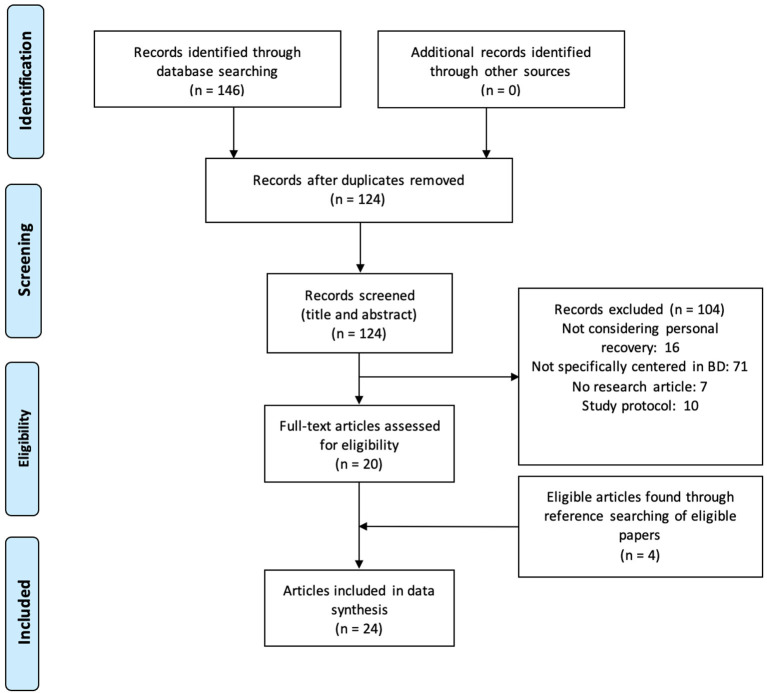
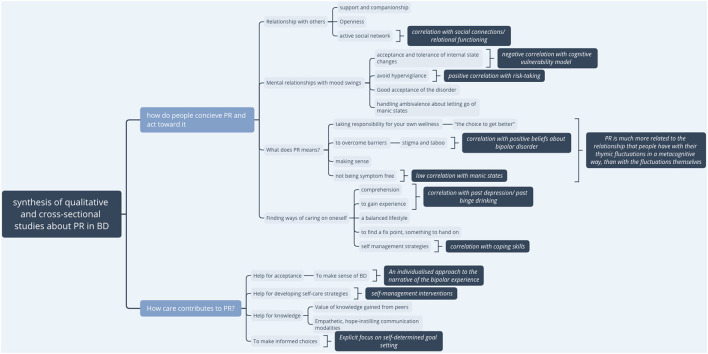
Personal recovery from psychiatric disorders is a journey toward a satisfying and hopeful life despite the possible persistence of symptoms. This concept has gained interest and become an increasingly important goal in mental health care programmes. Personal Recovery is well described in the context of severe mental illnesses in general, but little is known about this journey in bipolar disorders and the factors underlying it. A systematic review was conducted according to the PRISMA recommendations, focusing on studies exploring personal recovery in bipolar disorder specifically. The latter have integrated a comprehensive approach to the concept, the existing means of measurement or have explored the levers of recovery in care. Twenty-four articles were selected, including seven qualitative, 12 observational, and five interventional studies. The Bipolar Recovery Questionnaire was the only scale developed from qualitative work with bipolar people. Personal recovery did not correlate very closely with symptomatology. Some elements of personal recovery in bipolar disorder were similar to those in other severe mental illnesses: meaning in life, self-determination, hope, and low self-stigma. Specific levers differed: mental relationships with mood swings, including acceptance and decrease in hypervigilance, and openness to others, including trust and closeness. The studies highlighted the role of caregiver posture and the quality of communication within care, as well as the knowledge gained from peers. The choice to exclude articles not focused on bipolar disorder resulted in the provision of very specific information, and the small number of articles to date may limit the scope of the evidence. New components of personal recovery in bipolar disorder emerged from this review; these components could be taken into account in the construction of care tools, as well as in the caregiving posture. Strengthening skills of openness to others could also be a central target of recovery-focused care.
尽管精神症状可能持续存在,但从精神疾病中实现个人康复是一段通向满意和充满希望生活的旅程。这一概念已引起关注,并在精神卫生保健项目中日益成为重要目标。总体而言,在严重精神疾病背景下对个人康复已有充分描述,但对于双相情感障碍患者的这一康复历程及其潜在因素却知之甚少。根据PRISMA建议进行了一项系统综述,特别聚焦于探索双相情感障碍患者个人康复的研究。后者对这一概念采用了综合方法、现有的测量手段,或探索了护理中的康复促进因素。共筛选出24篇文章,包括7篇定性研究、12篇观察性研究和5篇干预性研究。双相康复问卷是唯一基于对双相情感障碍患者的定性研究而开发的量表。个人康复与症状学之间的关联并不十分紧密。双相情感障碍患者个人康复的一些要素与其他严重精神疾病相似:生活意义、自我决定、希望和低自我污名感。具体的康复促进因素有所不同:与情绪波动的心理关系,包括接受和降低过度警觉,以及对他人的开放性,包括信任和亲密感。这些研究强调了护理人员态度以及护理中沟通质量的作用,以及从同伴那里获得的知识。选择排除非聚焦于双相情感障碍的文章导致提供了非常具体的信息,而且目前文章数量较少可能限制了证据的范围。本次综述揭示了双相情感障碍患者个人康复的新要素;这些要素可在护理工具的构建以及护理人员态度方面加以考虑。增强对他人开放性的技能也可能是以康复为重点的护理的核心目标。