Jia Cunling, Bai Ying, Liu Jianan, Cai Wentao, Liu Lei, He Yanghua, Song Jiuzhou
College of Animal Science and Technology, Northwest A&F University, Yangling, China.
Department of Animal & Avian Science, University of Maryland, College Park, MD, United States.
Front Genet. 2021 Mar 4;12:579393. doi: 10.3389/fgene.2021.579393. eCollection 2021.
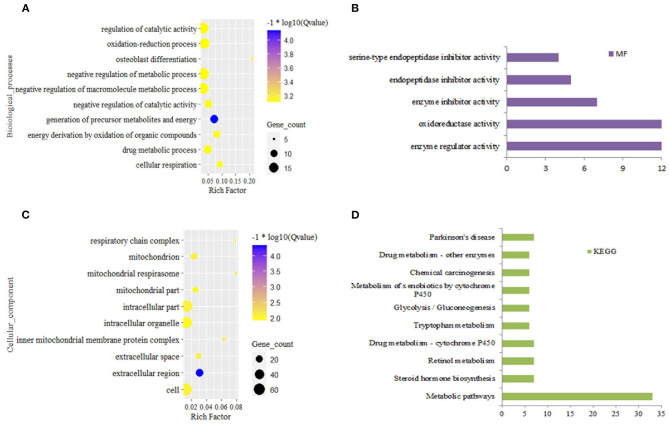
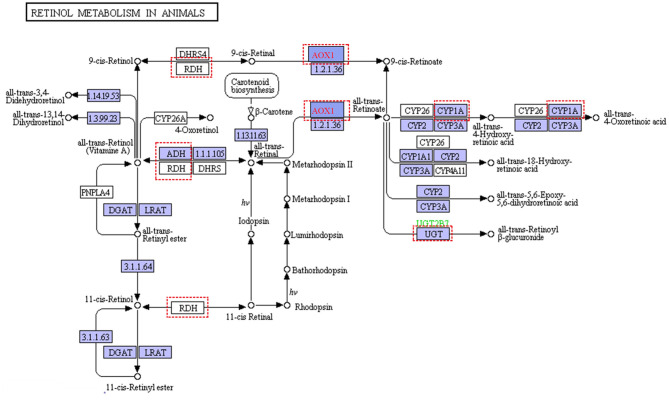
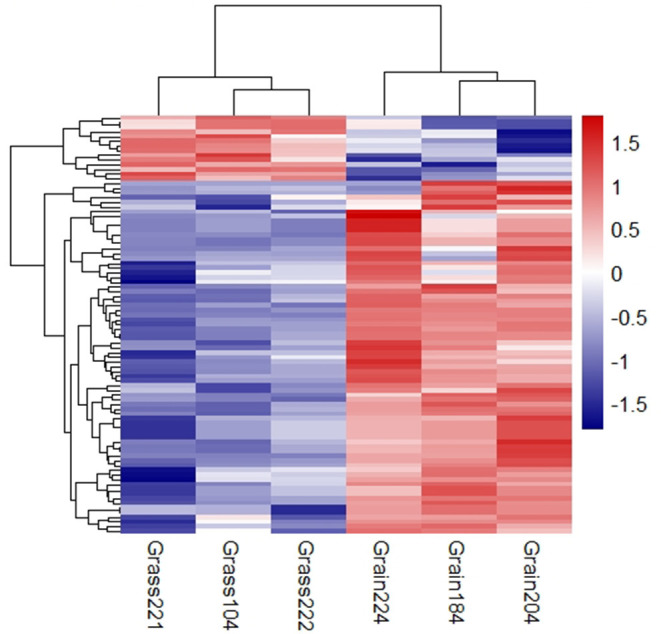
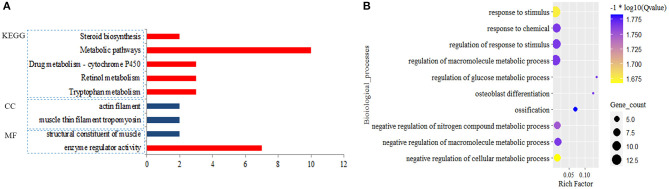
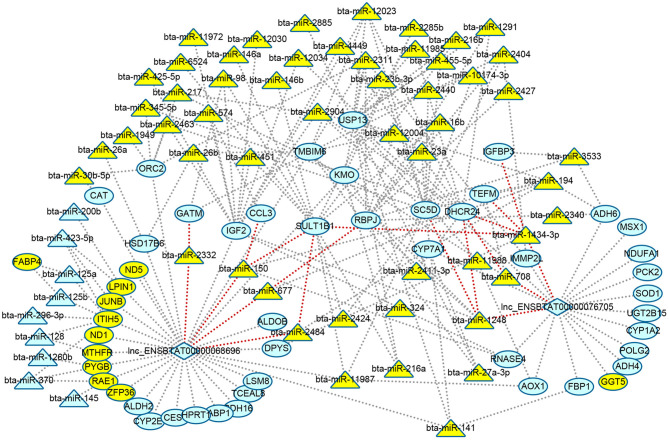
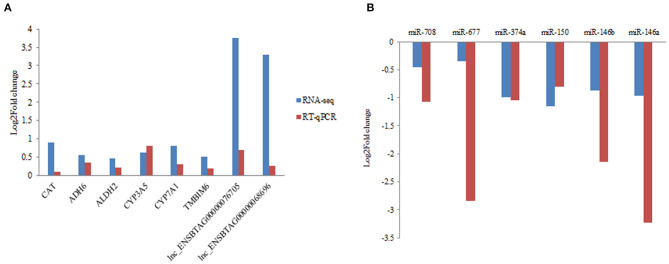
Beef cattle raised under grass-fed and grain-fed have many differences, including metabolic efficiency and meat quality. To investigate these two regimens' intrinsic influence on beef cattle, we used high-throughput sequencing and metabolomics analyses to explore differentially expressed genes (DEGs) and metabolimic networks in the liver. A total of 200 DEGs, 76 differentially expressed miRNAs (DEmiRNAs), and two differentially expressed lncRNAs (DElncRNAs) were detected between regimen groups. Metabolic processes and pathways enriched functional genes including target genes of miRNAs and lncRNAs. We found that many genes were involved in energy, retinol and cholesterol metabolism, and bile acid synthesis. Combined with metabolites such as low glucose concentration, high cholesterol concentration, and increased primary bile acid concentration, these genes were mainly responsible for lowering intramuscular fat, low cholesterol, and yellow meat in grass-fed cattle. Additionally, we identified two lncRNAs and eight DEGs as potential competing endogenous RNAs (ceRNAs) to bind miRNAs by the interaction network analysis. These results revealed that the effects of two feeding regimens on beef cattle were mainly induced by gene expression changes in metabolic pathways mediated via lncRNAs, miRNAs, and ceRNAs, and contents of metabolites in the liver. It may provide a clue on feeding regimens inducing the metabolic regulations.
草饲和谷饲育肥牛存在许多差异,包括代谢效率和肉质。为研究这两种饲养方式对肉牛的内在影响,我们采用高通量测序和代谢组学分析来探究肝脏中差异表达基因(DEGs)和代谢网络。在不同饲养方式组之间共检测到200个DEGs、76个差异表达的miRNA(DEmiRNAs)和2个差异表达的lncRNA(DElncRNAs)。代谢过程和途径富集了包括miRNA和lncRNA靶基因在内的功能基因。我们发现许多基因参与能量、视黄醇和胆固醇代谢以及胆汁酸合成。结合低葡萄糖浓度、高胆固醇浓度和初级胆汁酸浓度增加等代谢产物,这些基因主要导致草饲牛肌肉内脂肪降低、胆固醇含量低和肉色发黄。此外,通过相互作用网络分析,我们鉴定出2个lncRNA和8个DEGs作为潜在的竞争性内源RNA(ceRNAs)与miRNA结合。这些结果表明,两种饲养方式对肉牛的影响主要是由lncRNA、miRNA和ceRNA介导的代谢途径中的基因表达变化以及肝脏中代谢产物的含量引起的。这可能为饲养方式诱导代谢调控提供线索。