Skrzypczak-Zielinska Marzena, Gabryel Marcin, Marszalek Daria, Dobrowolska Agnieszka, Slomski Ryszard
Institute of Human Genetics, Polish Academy of Sciences, Poznan, Poland.
Department of Gastroenterology, Dietetics and Internal Diseases, Poznan University of Medical Sciences, Poznan, Poland.
Arch Med Sci. 2019 May 5;17(2):417-433. doi: 10.5114/aoms.2019.84470. eCollection 2021.
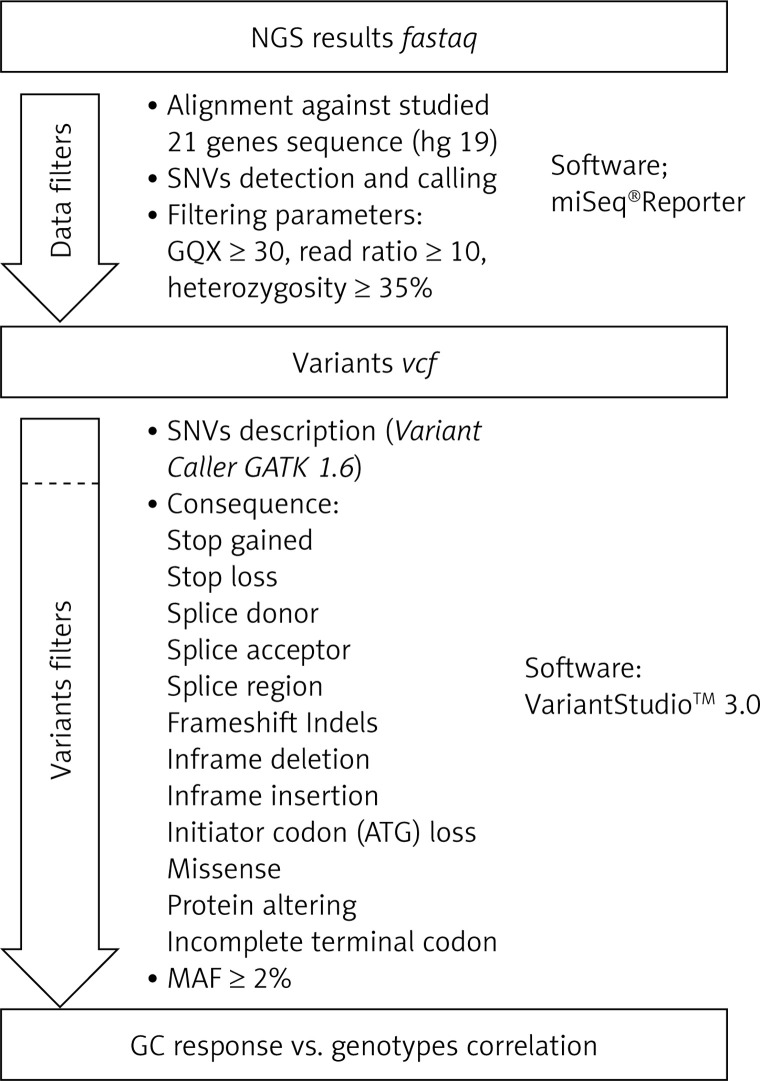
Despite intensive research and a long history of glucocorticoids being applied in various clinical areas, they still generate a challenge for personalized medicine by causing resistance or dependence in nearly 50% of patients treated. The objective of the present study was to determine the genetic predictors of variable reactions in inflammatory bowel disease patients to glucocorticoid therapy. Therefore, based on the current knowledge on how glucocorticoids act, we have compiled a panel of 21 genes for variant analysis: , , , , , , , , , , , , , , , , , , , , and .
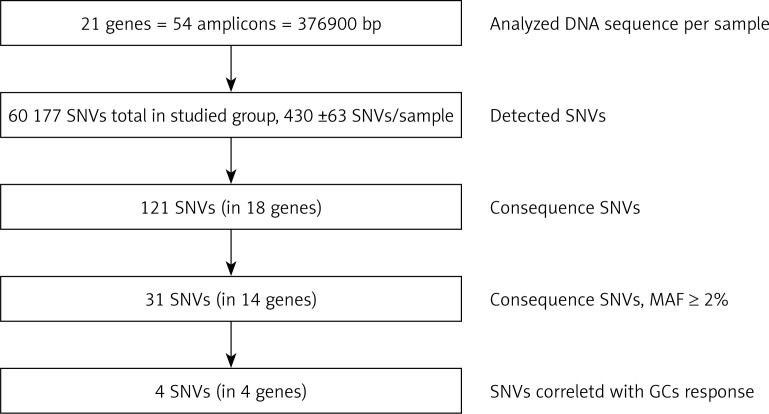
These genes were analyzed using the amplicon next-generation sequencing method in a group of 139 diagnosed and clinically characterized inflammatory bowel disease patients with a confirmed glucocorticoid response.
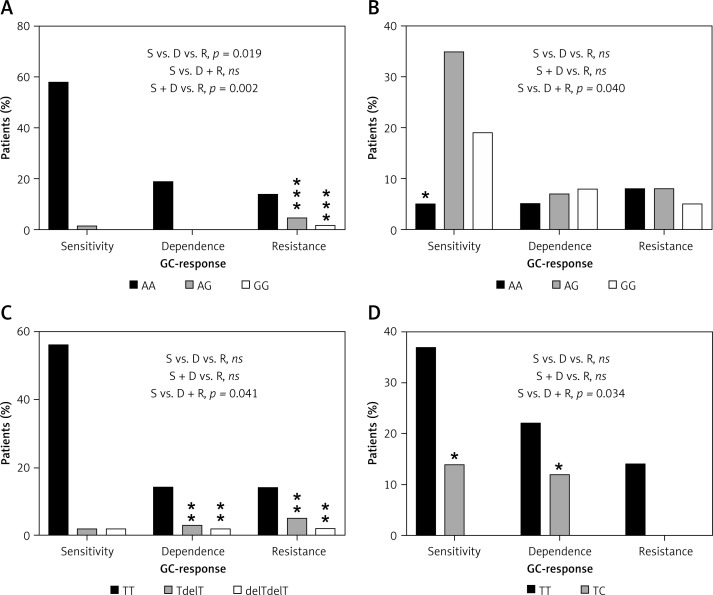
Analysis of all the targeted DNA sequences for the whole patient group indicated 121 different functional variants. After association analyses of 31 selected variants, the polymorphism c.1088A>G in the gene was linked with glucocorticoid resistance ( = 0.002), variant c.241+6A>G of the gene with glucocorticoid sensitivity ( = 0.040), and deletion c.306-7delT in the gene with an adverse therapeutic effect (dependency and resistance, = 0.041) in ulcerative colitis patients. In Crohn's disease, the change c.2685+49T>C of the gene related to glucocorticoid resistance ( = 0.034).
Among the 21 analyzed genes, four (, , , and ) revealed a significant impact on the glucocorticoid treatment response, which could result in valuable pharmacogenetic biomarkers after being confirmed in other populations and in functional studies.
尽管进行了深入研究,且糖皮质激素在各个临床领域应用历史悠久,但它们在近50%接受治疗的患者中仍会导致耐药或依赖,这对个性化医疗构成了挑战。本研究的目的是确定炎症性肠病患者对糖皮质激素治疗反应差异的遗传预测因子。因此,基于目前对糖皮质激素作用机制的了解,我们编制了一个包含21个基因的面板用于变异分析: , , , , , , , , , , , , , , , , , , , , , , , , , , , , , , , , , , , , , , , , , , , , , , , , , , , , , , , , , , , , , , , , , , , , , , , , , , , , , , , , , , , , , , , , , , , , , , , , , , , , , , , , , , , , , , , , , , , , , , , , , , , , , , , , , , , , , , , , , , , , , ; ; ; ; ; ; ; ; ; ; ; ; ; ; ; ; ; ; ; ; ; ; ; ; ; ; ; ; ; ; ; ; ; ; ; ; ; ; ; ; ; ; ; ; ; ; ; ; ; ; ; ; ; ; ; ; ; ; ; ; ; ; ; ; ; ; ; ; ; ; ; ; ; ; ; ; ; ; ; ; ; ; ; ; ; ; ; ; ; ; ; ; ; ; ; ; ; ; ;
采用扩增子二代测序方法对139例确诊且具有临床特征、已证实对糖皮质激素有反应的炎症性肠病患者进行了这些基因的分析。
对整个患者组所有靶向DNA序列的分析表明有121种不同的功能变异。在对31个选定变异进行关联分析后,基因中的多态性c.1088A>G与糖皮质激素耐药相关( = 0.002),基因的变异c.241+6A>G与糖皮质激素敏感性相关( = 0.040),基因中的缺失c.306-7delT在溃疡性结肠炎患者中与不良治疗效果(依赖和耐药, = = 0.041)相关。在克罗恩病中,基因的变化c.2685+49T>C与糖皮质激素耐药相关( = 0.034)。
在分析的21个基因中,四个( , , ,和 )对糖皮质激素治疗反应有显著影响,在其他人群中得到证实并经过功能研究后,可能会产生有价值的药物遗传学生物标志物。