Pancreas Center, The First Affiliated Hospital of Nanjing Medical University, Nanjing 210029, China.
Department of General Surgery, Nanjing Drum Tower Hospital, The Affiliated Hospital of Nanjing University Medical School, Nanjing 210008, China.
Biomed Res Int. 2021 Mar 2;2021:6530298. doi: 10.1155/2021/6530298. eCollection 2021.
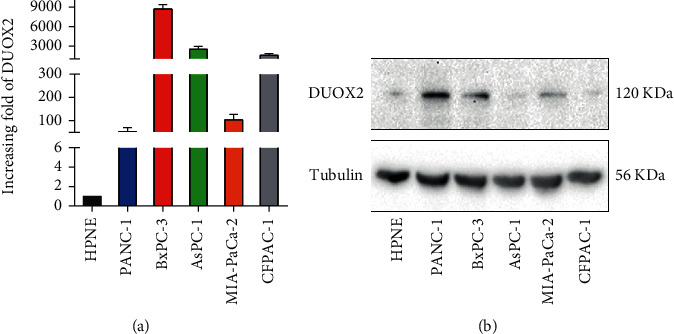
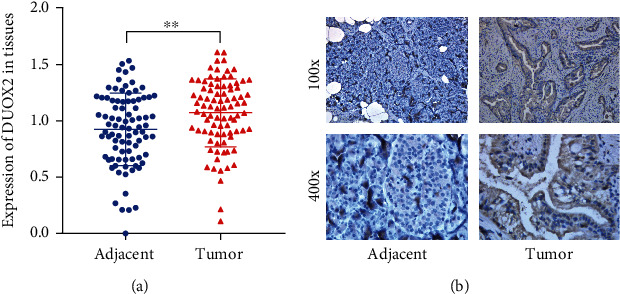
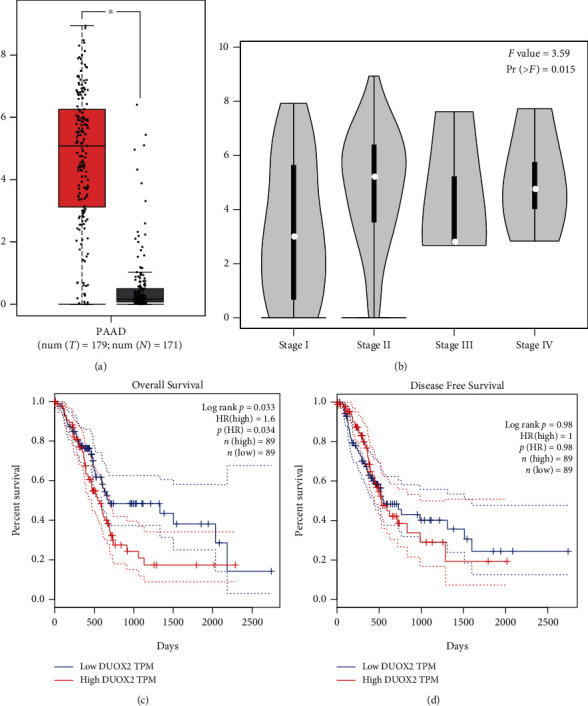
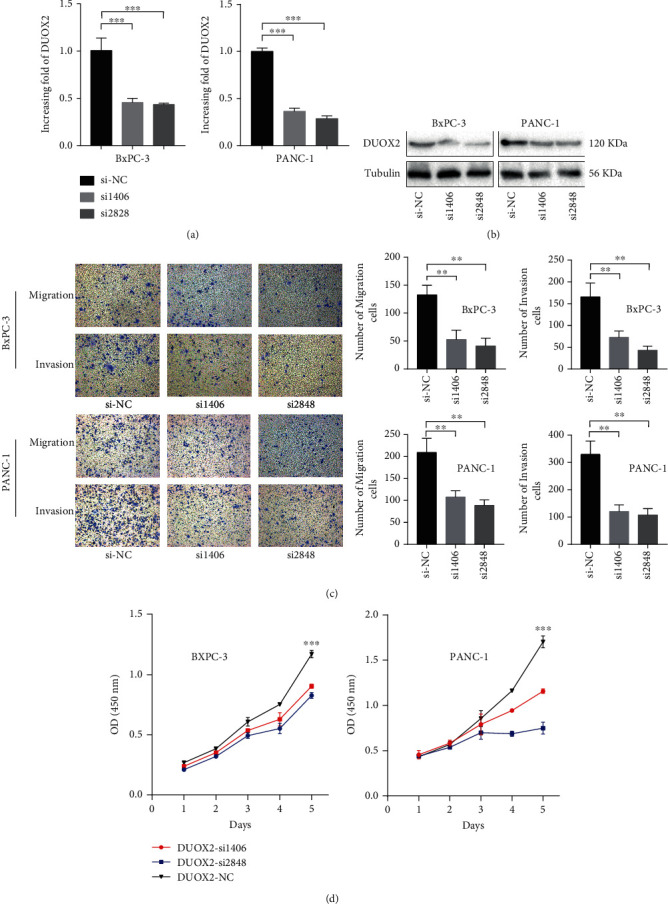
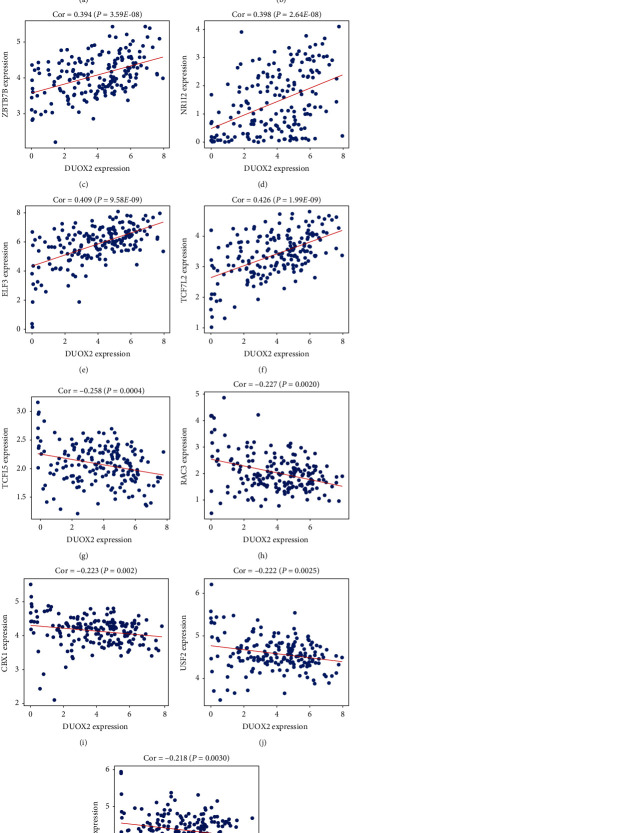
DUOX2 has been reported to highly express in several types of cancers. However, the prognostic significance and the biological function of DUOX2 expression with pancreatic cancer (PC) still remain unclear. The present study is aimed at investigating whether DUOX2 could act as a novel biomarker of prognosis and evaluating its effect on PC cell progression. The mRNA and protein expression of DUOX2 in PC cells and tissues were assessed by quantitative real-time PCR (RT-qPCR) and immunohistochemistry. The effect of DUOX2 expression on PC cell motility and proliferation was evaluated . The correlation between DUOX2 mRNA expression and clinicopathological features and its prognostic significance were analyzed according to the Gene Expression Profiling Interactive Analysis (GEPIA) website based on The Cancer Genome Atlas (TCGA) and the GTEx databases combined with our clinical information. According to bioinformatics analysis, we forecasted the upstream transcription factors (TFs) and microRNA (miRNA) regulatory mechanism of DUOX2 in PC. The expression of DUOX2 at transcriptional and protein level was dramatically increased in PC specimens when compared to adjacent nontumor specimens. Functionally, DUOX2 knockdown inhibited cell motility and proliferation activities. Our clinical data revealed that the patients had better postoperative overall survival (OS) with lower expression of DUOX2, which is consistent with GEPIA data. Multivariate analysis revealed that high DUOX2 expression was considered as an independent prognostic indicator for OS ( = 0.031). Based on Cistrome database, the top 5 TFs of each positively and negatively association with DUOX2 were predicted. hsa-miR-5193 and hsa-miR-1343-3p targeting DUOX2 were forecasted from TargetScan, miRDB, and DIANA-TarBase databases, which were negatively correlated with OS ( = 0.043 and = 0.0088, respectively) and DUOX2 expression ( = 0.0093 and = 0.0032, respectively) in PC from TCGA data. These findings suggest that DUOX2 acts as a promising predictive biomarker and an oncogene in PC, which could be a therapeutic target for PC.
DUOX2 在多种类型的癌症中高度表达。然而,DUOX2 表达与胰腺癌(PC)的预后意义和生物学功能仍不清楚。本研究旨在探讨 DUOX2 是否可以作为一种新的预后标志物,并评估其对 PC 细胞进展的影响。通过实时定量 PCR(RT-qPCR)和免疫组织化学评估 DUOX2 在 PC 细胞和组织中的 mRNA 和蛋白表达。评估 DUOX2 表达对 PC 细胞迁移和增殖的影响。根据基因表达谱交互式分析(GEPIA)网站,结合我们的临床信息,分析 DUOX2 mRNA 表达与临床病理特征的相关性及其预后意义,该网站基于癌症基因组图谱(TCGA)和 GTEx 数据库。根据生物信息学分析,我们预测了 DUOX2 在 PC 中的上游转录因子(TFs)和微小 RNA(miRNA)调控机制。与相邻非肿瘤标本相比,PC 标本中 DUOX2 的转录和蛋白水平表达明显增加。功能上,DUOX2 敲低抑制细胞迁移和增殖活性。我们的临床数据显示,DUOX2 表达较低的患者术后总体生存率(OS)更好,与 GEPIA 数据一致。多变量分析显示,高 DUOX2 表达是 OS 的独立预后指标(=0.031)。基于 Cistrome 数据库,预测了与 DUOX2 呈正相关和负相关的每个 TF 的前 5 个。从 TargetScan、miRDB 和 DIANA-TarBase 数据库预测靶向 DUOX2 的 hsa-miR-5193 和 hsa-miR-1343-3p,它们与 PC 中的 OS(=0.043 和=0.0088,分别)和 DUOX2 表达(=0.0093 和=0.0032,分别)呈负相关从 TCGA 数据。这些发现表明,DUOX2 作为一种有前途的预测生物标志物和 PC 中的癌基因,可能成为 PC 的治疗靶点。