Aparicio Manuela, Costa Carlos J, Moises Rafael
NOVA Information Management School (NOVA IMS), Universidade Nova de Lisboa, Portugal.
ADVANCE/CSG, ISEG (Lisbon School of Economics & Management), Universidade de Lisboa.
Heliyon. 2021 Mar 11;7(3):e06383. doi: 10.1016/j.heliyon.2021.e06383. eCollection 2021 Mar.
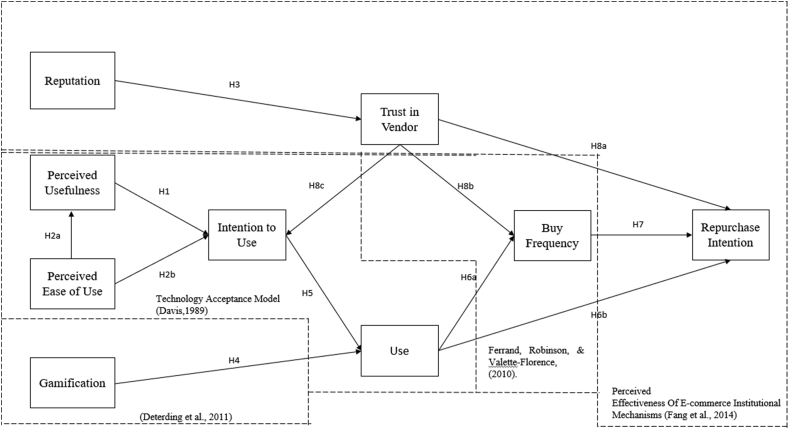
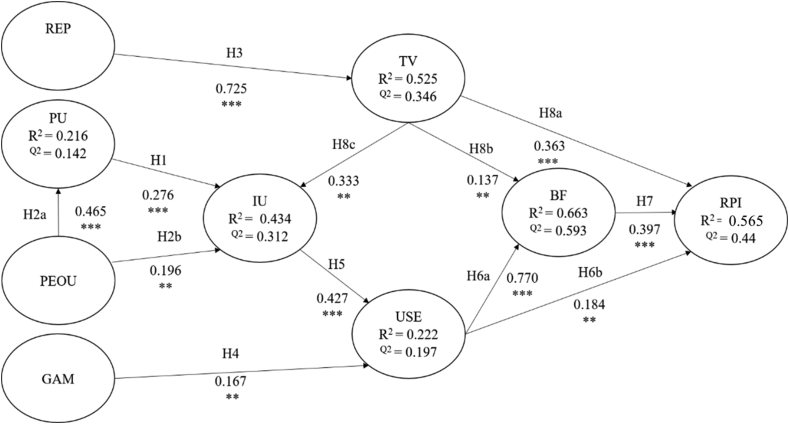
Nowadays, companies know that keeping customers engaged is essential to increase their loyalty. The main goal of this study is to understand the impact of gamification and reputation on the intention of repurchase in e-commerce. Gamification corresponds to the regular usage of game elements in non-game context. This study purposes a theoretical model indicating the determinants of repurchase intention. Here we present an empirical study (survey collected data) within a real e-commerce usage context. Data were analysed with SEM/PLS method. Results indicate a positive impact of trust on the intention to use of e-commerce, on buy frequency and on repurchase intention. Ease of use, usefulness of e-commerce platforms affect intension to use. We verified the impact of reputation on trust, as well as the impact of gamification on the effective use of the e-commerce platforms. Results indicate that gamified e-commerce websites determine usage and use positively influences repurchase intention in e-commerce context.
如今,企业深知保持客户参与度对于提高客户忠诚度至关重要。本研究的主要目的是了解游戏化和声誉对电子商务中重复购买意愿的影响。游戏化是指在非游戏环境中定期使用游戏元素。本研究提出了一个理论模型,指出了重复购买意愿的决定因素。在此,我们展示了一项在真实电子商务使用环境中的实证研究(通过调查收集数据)。数据采用结构方程模型/偏最小二乘法进行分析。结果表明,信任对电子商务使用意愿、购买频率和重复购买意愿有积极影响。电子商务平台的易用性、有用性会影响使用意愿。我们验证了声誉对信任的影响,以及游戏化对电子商务平台有效使用的影响。结果表明,游戏化的电子商务网站决定了使用情况,且使用对电子商务环境中的重复购买意愿有积极影响。