Division of Orthodontics, Faculty of Dentistry, Federal University of Rio Grande do Sul, Rua Ramiro Barcelos 2492, Porto Alegre, RS, 90035-003, Brazil.
Department of Orthodontics, Bauru Dental School, University of São Paulo, Alameda Octávio Pinheiro Brisolla 9-75, Bauru, SP, 17012-901, Brazil.
Prog Orthod. 2021 Mar 22;22(1):9. doi: 10.1186/s40510-021-00352-w.
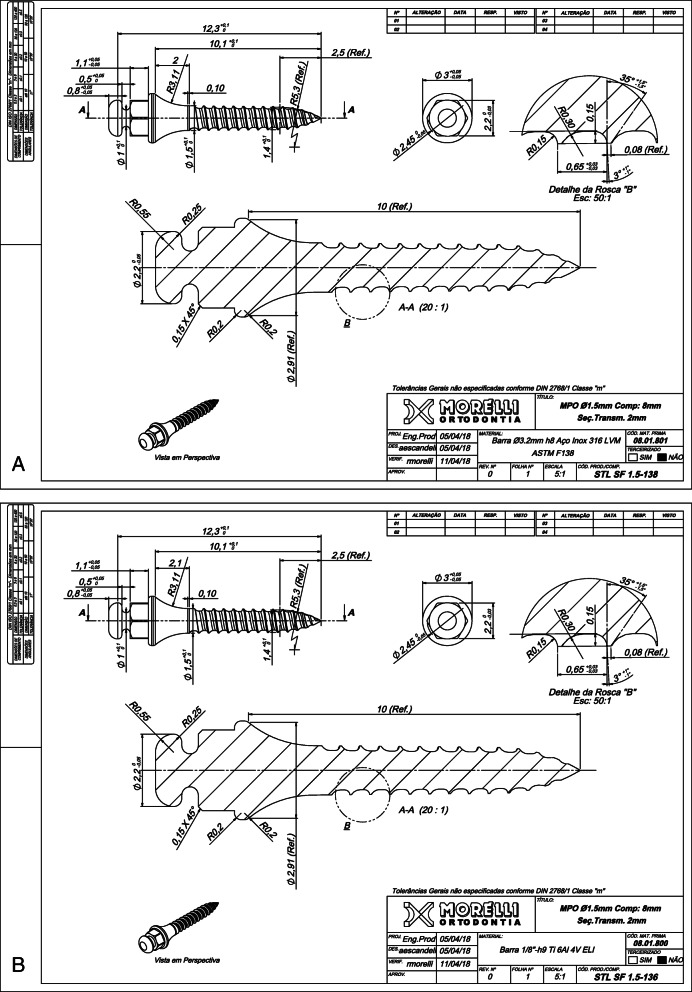
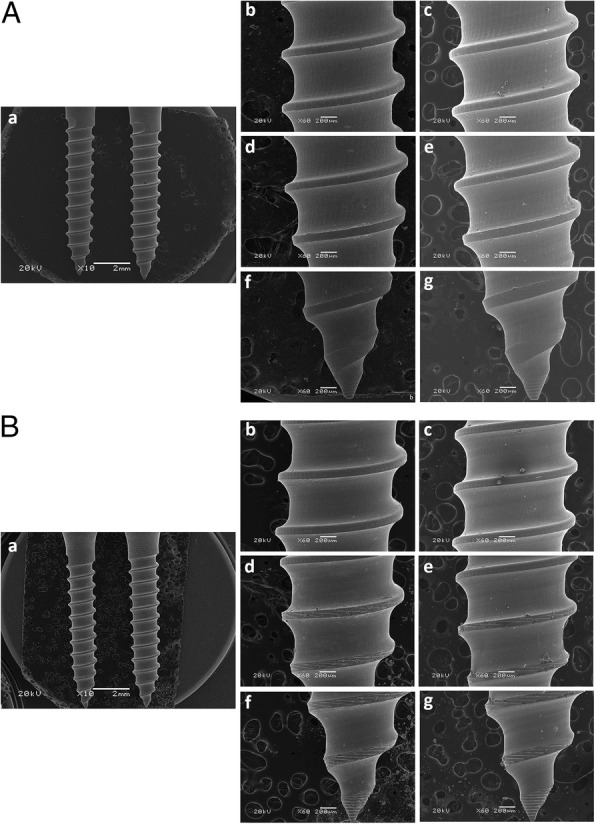
The mechanical strength of mini-implants is a critical factor due to their small diameters. Currently, it is not possible to state whether there is a relevant difference between the mechanical properties of stainless steel (SS-MIs) and titanium alloy mini-implants (TA-MIs). The objective of this study was to test the null hypothesis that there is no difference in the mechanical strength of SS-MIs and TA-MIs, and to analyze, by scanning electron microscopy (SEM), the SS-MI, and TA-MI threads resistance to morphological damage after insertion.
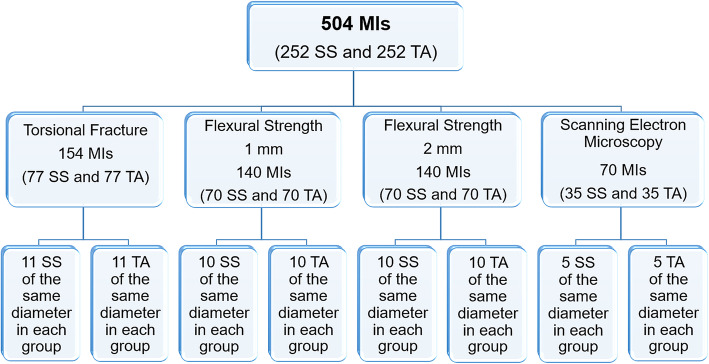
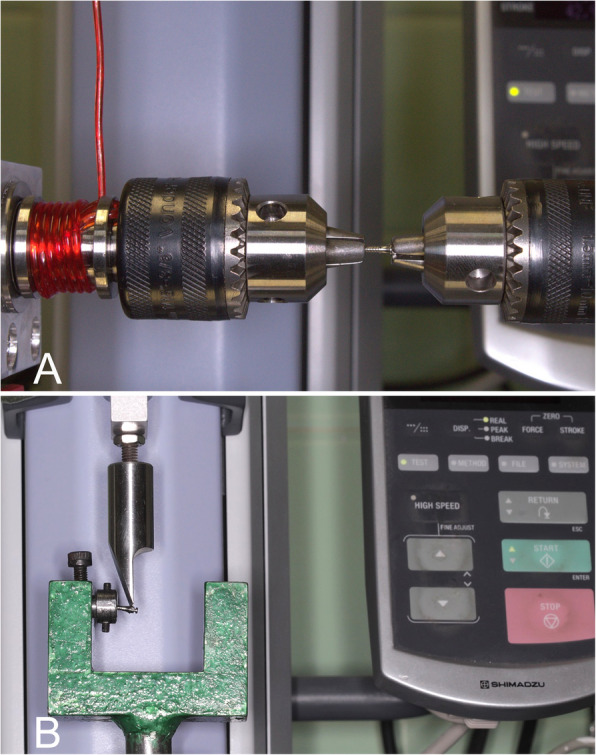
A standardized sample of 504 SS-MIs and TA-MIs with diameters ranging from 1.2 mm to 1.8 mm was used. Torsional fracture was performed in 154 MIs. Flexural strength of 280 MIs was evaluated at 1 mm and 2 mm-deflection. The threads of 70 MIs were morphologically analyzed by scanning electron microscopy (SEM), before and after their insertion in high-density artificial bone blocks. Comparisons between SS-MIs and TA-MIs were performed with t tests or Mann-Whitney U tests. A multiple linear regression analysis was used to evaluate the influence of variables on the ranging of MI mechanical strength.
SS-MIs had higher fracture torque. The mean difference between the SS-MIs and TA-MIs fracture torque was of 4.09 Ncm. The MI diameter explained 90.3% of the total variation in fracture torque, while only 2.2% was explained by the metallic alloy. The SS-MI group presented a higher deformation force during the 1mm and 2mm-deflection. The mean difference between the flexural strength of SS and TA-MIs at 1 mm and 2 mm-deflection was of 18.21 N and 17.55 N, respectively. There was no noticeable morphological damage to the threads of SS-MIs and TA-MIs.
The null hypothesis was rejected. SS-MIs were 13.2% and 20.2% more resistant to torsional fracture and deflection, respectively. The threads of the SS-MIs and TA-MIs were not damaged during the insertion and removal process. Thus, the use of SS-MI can reduce the fracture risk without increasing the MI diameter.
由于迷你种植体的直径较小,其机械强度是一个关键因素。目前,尚无法确定不锈钢(SS-MI)和钛合金迷你种植体(TA-MI)的机械性能是否存在相关差异。本研究的目的是检验 SS-MI 和 TA-MI 的机械强度无差异这一零假设,并通过扫描电子显微镜(SEM)分析 SS-MI 和 TA-MI 植入后螺纹抗形态损伤的能力。
使用直径为 1.2 毫米至 1.8 毫米的标准化 SS-MI 和 TA-MI 样本 504 个。对 154 个 MI 进行扭转断裂试验。对 280 个 MI 的弯曲强度在 1 毫米和 2 毫米挠度下进行评估。对 70 个 MI 的螺纹进行扫描电子显微镜(SEM)形态分析,在将其插入高密度人工骨块之前和之后进行。通过 t 检验或曼-惠特尼 U 检验比较 SS-MI 和 TA-MI。使用多元线性回归分析评估变量对 MI 机械强度范围的影响。
SS-MI 具有更高的断裂扭矩。SS-MI 和 TA-MI 断裂扭矩的平均差异为 4.09 Ncm。MI 直径解释了扭转断裂扭矩总变异的 90.3%,而金属合金仅解释了 2.2%。在 1 毫米和 2 毫米挠度下,SS-MI 组的变形力更高。在 1 毫米和 2 毫米挠度下 SS 和 TA-MI 的弯曲强度平均差异分别为 18.21 N 和 17.55 N。SS-MI 和 TA-MI 的螺纹在插入和取出过程中没有明显的形态损伤。
零假设被拒绝。SS-MI 分别抵抗扭转断裂和挠度的能力提高了 13.2%和 20.2%。SS-MI 和 TA-MI 的螺纹在插入和取出过程中没有损坏。因此,使用 SS-MI 可以降低断裂风险,而不会增加 MI 直径。