Department of Surgery and Cancer, Imperial College London, Hammersmith Hospital, London, UK.
Medical Oncology, Guy's and St Thomas' NHS Foundation Trust (GSTT), London, UK.
J Immunother Cancer. 2021 Mar;9(3). doi: 10.1136/jitc-2020-002277.
Patients with cancer are particularly susceptible to SARS-CoV-2 infection. The systemic inflammatory response is a pathogenic mechanism shared by cancer progression and COVID-19. We investigated systemic inflammation as a driver of severity and mortality from COVID-19, evaluating the prognostic role of commonly used inflammatory indices in SARS-CoV-2-infected patients with cancer accrued to the OnCovid study.
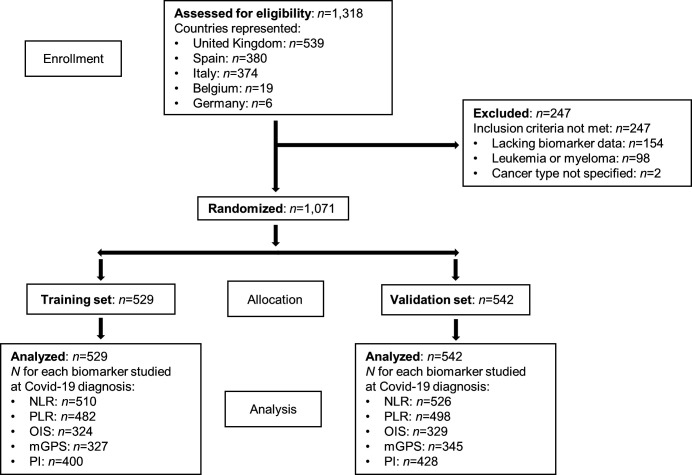
In a multicenter cohort of SARS-CoV-2-infected patients with cancer in Europe, we evaluated dynamic changes in neutrophil:lymphocyte ratio (NLR); platelet:lymphocyte ratio (PLR); Prognostic Nutritional Index (PNI), renamed the OnCovid Inflammatory Score (OIS); modified Glasgow Prognostic Score (mGPS); and Prognostic Index (PI) in relation to oncological and COVID-19 infection features, testing their prognostic potential in independent training (n=529) and validation (n=542) sets.
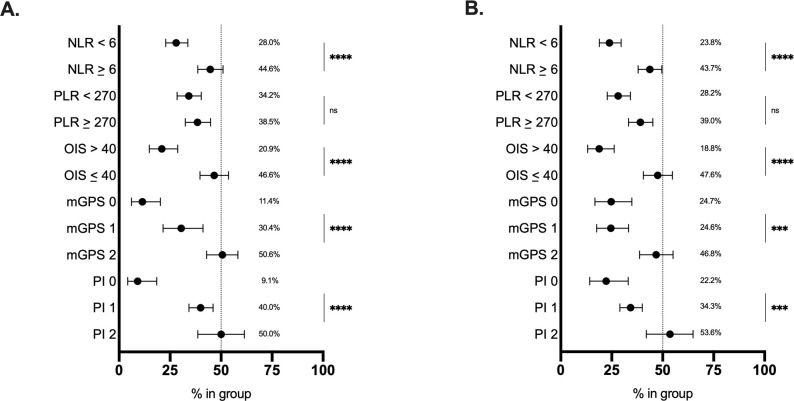
We evaluated 1071 eligible patients, of which 625 (58.3%) were men, and 420 were patients with malignancy in advanced stage (39.2%), most commonly genitourinary (n=216, 20.2%). 844 (78.8%) had ≥1 comorbidity and 754 (70.4%) had ≥1 COVID-19 complication. NLR, OIS, and mGPS worsened at COVID-19 diagnosis compared with pre-COVID-19 measurement (p<0.01), recovering in survivors to pre-COVID-19 levels. Patients in poorer risk categories for each index except the PLR exhibited higher mortality rates (p<0.001) and shorter median overall survival in the training and validation sets (p<0.01). Multivariable analyses revealed the OIS to be most independently predictive of survival (validation set HR 2.48, 95% CI 1.47 to 4.20, p=0.001; adjusted concordance index score 0.611).
Systemic inflammation is a validated prognostic domain in SARS-CoV-2-infected patients with cancer and can be used as a bedside predictor of adverse outcome. Lymphocytopenia and hypoalbuminemia as computed by the OIS are independently predictive of severe COVID-19, supporting their use for risk stratification. Reversal of the COVID-19-induced proinflammatory state is a putative therapeutic strategy in patients with cancer.
癌症患者尤其容易感染 SARS-CoV-2。全身性炎症反应是癌症进展和 COVID-19 的共同致病机制。我们研究了全身性炎症作为 COVID-19 严重程度和死亡率的驱动因素,评估了常用炎症指标在纳入 OnCovid 研究的癌症合并 SARS-CoV-2 感染患者中的预后作用。
在欧洲的一项多中心 SARS-CoV-2 感染癌症患者队列中,我们评估了中性粒细胞与淋巴细胞比值(NLR);血小板与淋巴细胞比值(PLR);预后营养指数(PNI),更名为 OnCovid 炎症评分(OIS);改良格拉斯哥预后评分(mGPS);和预后指数(PI)与肿瘤学和 COVID-19 感染特征的动态变化,在独立的训练(n=529)和验证(n=542)组中检验其预后潜力。
我们评估了 1071 名合格患者,其中 625 名(58.3%)为男性,420 名患者患有晚期恶性肿瘤(39.2%),最常见的是泌尿生殖系统(n=216,20.2%)。844 名(78.8%)有≥1 种合并症,754 名(70.4%)有≥1 种 COVID-19 并发症。与 COVID-19 前测量相比,NLR、OIS 和 mGPS 在 COVID-19 诊断时恶化(p<0.01),但幸存者恢复到 COVID-19 前水平。除 PLR 外,每个指数的风险类别较差的患者死亡率更高(p<0.001),在训练和验证组中的中位总生存期更短(p<0.01)。多变量分析显示 OIS 是最能独立预测生存的指标(验证集 HR 2.48,95%CI 1.47 至 4.20,p=0.001;调整后的一致性指数评分 0.611)。
全身性炎症是 SARS-CoV-2 感染癌症患者中经过验证的预后指标,可用作不良预后的床边预测指标。OIS 计算的淋巴细胞减少和低白蛋白血症是 COVID-19 严重程度的独立预测因素,支持将其用于风险分层。逆转 COVID-19 诱导的促炎状态可能是癌症患者的一种治疗策略。