Liu Yan, Li Hui, Zhu Jing, Zhang Yang, Liu Xianhong, Li Rixin, Zhang Qiang, Cheng Ying
Medical Oncology Translational Research Lab, Jilin Provincial Key Laboratory of Molecular Diagnostics for Lung Cancer, Jilin Cancer Hospital, Changchun, 130012, People's Republic of China.
Department of Medical Thoracic Oncology, Jilin Cancer Hospital, Changchun, 130012, People's Republic of China.
Cancer Manag Res. 2021 Mar 15;13:2447-2454. doi: 10.2147/CMAR.S282617. eCollection 2021.
mutation is one of important driver genes in non-small-cell lung cancer (NSCLC) and the patients with mutations benefit from the inhibitor AMG510. However, the frequency, concurrent pathogenic mutations, and clinical characteristic of is unknown in the NSCLC population of Northeast China.
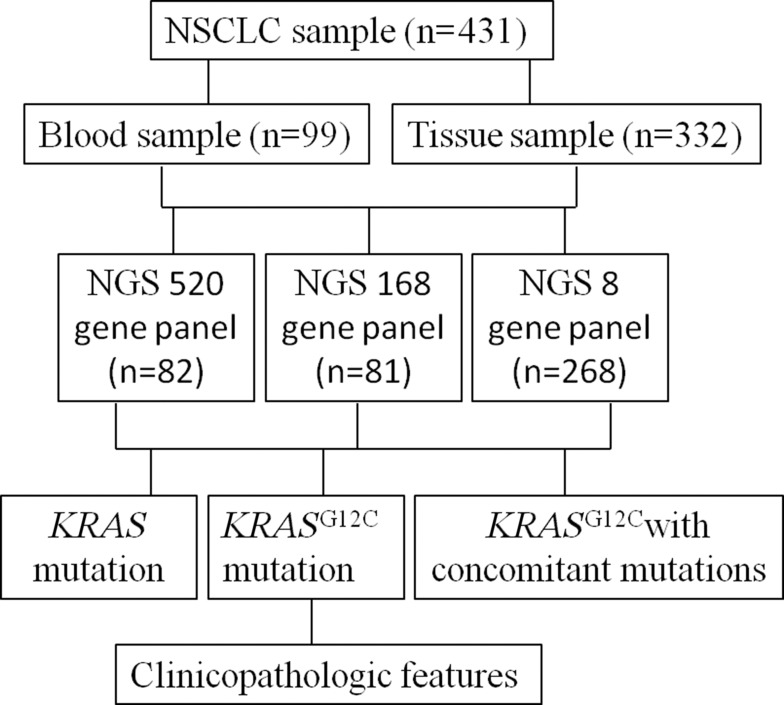
The retrospective analysis was derived from 431 NSCLC patients in Jilin Cancer Hospital between January 2018 and June 2019. The mutation frequency and concurrent mutations of in tumor or peripheral blood was detected by next-generation sequencing (NGS).
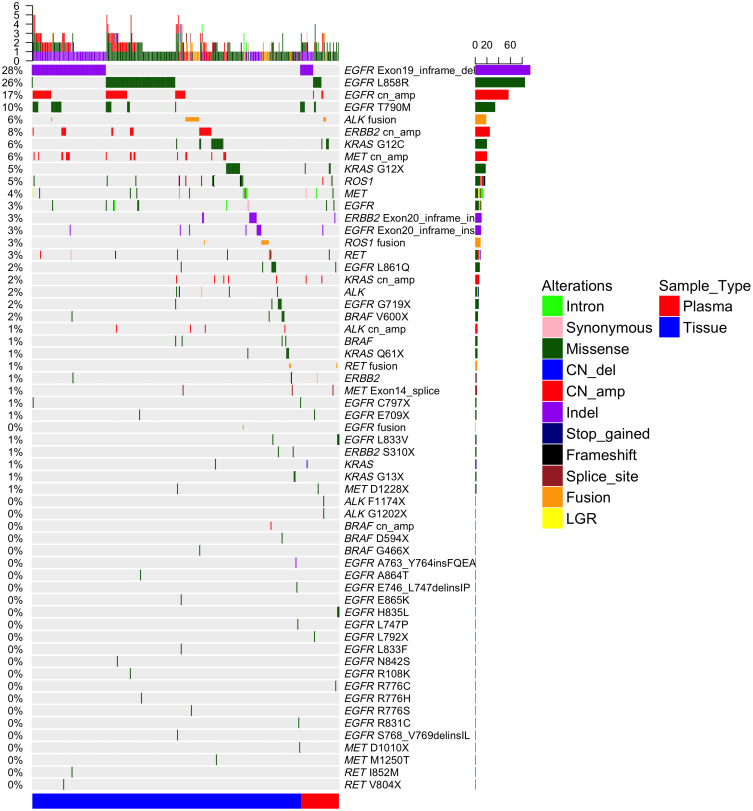
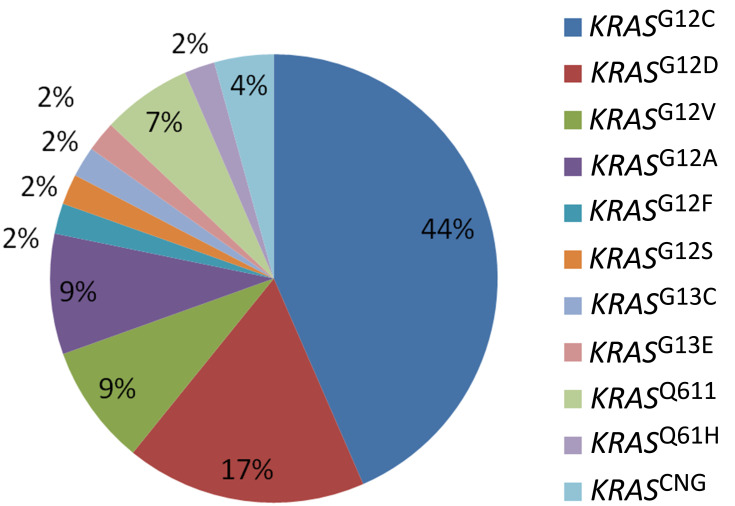
The mutant rate was observed in 10.7% (46/431) of this cohort. All -driver cancers are caused by mutations in the isoform, while the and isoforms were not detected. Among mutant patients, 42 (91.3%) showed exon 2 mutation in 12 codon and 13 codon. showed a 4.6% (20/431) mutation rate in this cohort and the highest frequency (43.5%, 20/46) in -mutant-positive patients. There was no difference between tumor tissue and plasma in terms of either or mutation. The most frequent co-occurrence mutations with were , followed by . Furthermore, was exclusive with mutation. mutation was associated with age, disease stage, and smoking status (=0.024; =0.02; =0.006), smoking remained an independent factor for mutation (=0.037), and higher mutation frequency in patients older than 60, stage I-III, or smoking in NSCLC (=0.0151, =0.0343, =0.0046, respectively).
mutation was the only isoforms of family, of these 43.5% harbored the subtype in northeastern Chinese NSCLC patients. is associated with age, pathological stage and smoking status, more commonly harbored / mutations, and providing more genome profile for targeted therapy in local clinical practice.
突变是非小细胞肺癌(NSCLC)的重要驱动基因之一,携带 突变的患者可从抑制剂AMG510中获益。然而,在中国东北地区的NSCLC人群中, 突变的频率、并发致病突变及临床特征尚不清楚。
本回顾性分析来源于2018年1月至2019年6月期间吉林肿瘤医院的431例NSCLC患者。采用二代测序(NGS)检测肿瘤组织或外周血中 突变频率及并发突变情况。
该队列中10.7%(46/431)的患者检测到 突变。所有 驱动的癌症均由 亚型的突变引起,未检测到 和 亚型。在突变患者中,42例(91.3%)在第12和13密码子处出现外显子2突变。该队列中 突变率为4.6%(20/431),在 突变阳性患者中频率最高(43.5%,20/46)。肿瘤组织和血浆在 或 突变方面无差异。与 最常见的共发突变是 ,其次是 。此外, 与 突变互斥。 突变与年龄、疾病分期和吸烟状态相关(P = = = ),吸烟仍是 突变的独立因素(P = ),且在NSCLC中年龄大于60岁、I-III期或吸烟患者的 突变频率更高(分别为P = ,P = ,P = )。
突变是 家族唯一的亚型,在中国东北NSCLC患者中,43.5%携带 亚型。 与年龄、病理分期和吸烟状态相关,更常见携带 / 突变,为当地临床实践中的靶向治疗提供了更多基因组特征。