Zhang Hui, Zhang Anao, Liu Chengbin, Xiao Jian, Wang Kaipeng
School of Sociology, Huazhong University of Science and Technology, 1037, Luoyu Road, Hongshan District, Wuhan, China.
School of Social Work, University of Michigan, Ann Arbor, MI USA.
Mindfulness (N Y). 2021;12(6):1502-1512. doi: 10.1007/s12671-021-01618-4. Epub 2021 Mar 18.
The coronavirus (COVID-19) global pandemic has increased psychological distress among the general population. The objective of this study is to evaluate a mindfulness-based intervention for psychological distress among Chinese residents during COVID-19.
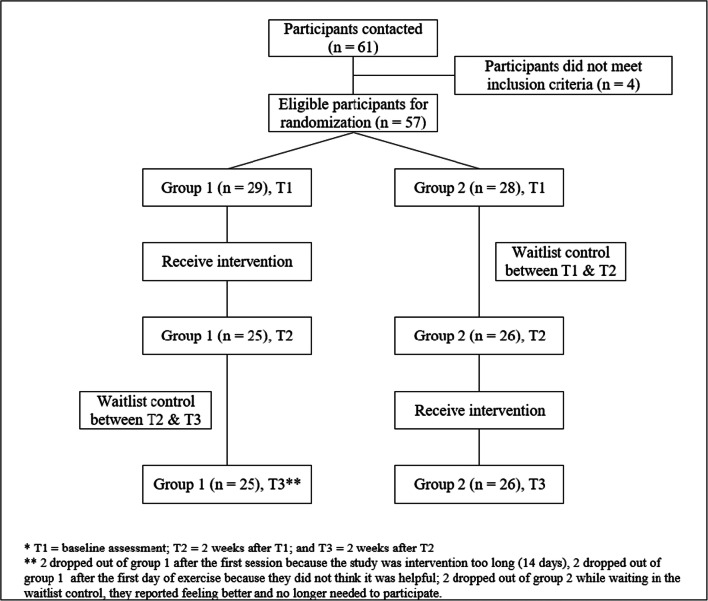
This study used a switching replications design to test the feasibility and efficacy of a brief online mindfulness-based intervention for Chinese residents' psychological distress. Fifty-one residents in the Hubei province were randomly allocated to two groups (experimental group and waitlist control group) with three waves of measurement at time 1, time 2, and time 3 for changes in mindfulness and psychological distress.
In addition to significant within-group improvements over time for both groups, OLS linear regression with full information likelihood estimation revealed statistically significant between-group treatment effects across outcome domains, including mindfulness awareness, = 2.84, < 0.001, = 6.92, psychological distress, = -21.33, < 0.001, = 6.62, somatic symptoms, = -6.22, < 0.001, = 4.42, depressive symptoms, = -7.16, < 0.001, = 5.07, and anxiety symptoms, = -8.09, < 0.001, = 6.84.
Results suggest that a brief online mindfulness-based intervention can be a feasible and promising intervention for improving mindfulness and decreasing psychological distress among Chinese residents staying at home during the COVID-19 outbreak. The study used a small convenience sample which led to a concern of external generalizability and with limited evaluation of long-term change.
新型冠状病毒(COVID-19)全球大流行加剧了普通人群的心理困扰。本研究的目的是评估一种基于正念的干预措施对COVID-19期间中国居民心理困扰的影响。
本研究采用切换复制设计,以测试一种简短的基于网络的正念干预措施对中国居民心理困扰的可行性和有效性。湖北省的51名居民被随机分为两组(实验组和候补对照组),在第1、第2和第3时间点进行三轮测量,以观察正念和心理困扰的变化。
除两组随时间均有显著的组内改善外,采用全信息似然估计的OLS线性回归显示,各结果领域在组间治疗效果上具有统计学意义,包括正念觉察,β = 2.84,p < 0.001,R² = 6.92;心理困扰,β = -21.33,p < 0.001,R² = 6.62;躯体症状,β = -6.22,p < 0.001,R² = 4.42;抑郁症状,β = -7.16,p < 0.001,R² = 5.07;以及焦虑症状,β = -8.09,p < 0.001,R² = 6.84。
结果表明,一种简短的基于网络的正念干预措施对于改善COVID-19疫情期间居家的中国居民的正念水平和减轻心理困扰可能是一种可行且有前景的干预措施。本研究使用了一个小的便利样本,这引发了对外部普遍性的担忧,并且对长期变化的评估有限。