State Key Laboratory for Conservation and Utilization of Subtropical Agro-Bioresources, College of Agriculture, Guangxi University, 100 Daxue Rd., Nanning, Guangxi, China.
College of Plant Science and Technology & Biomass and Bioenergy Research Center, Huazhong Agricultural University, Wuhan, 430070, China.
Sci Rep. 2021 Mar 24;11(1):6767. doi: 10.1038/s41598-021-86127-z.
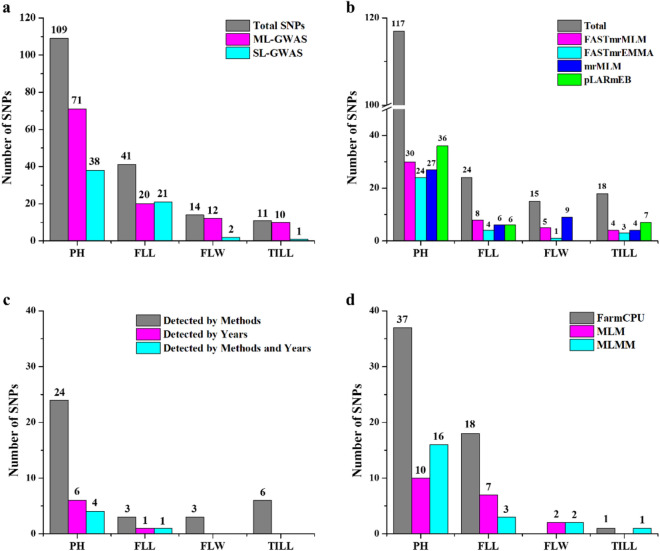
Wheat is a major food crop worldwide. The plant architecture is a complex trait mostly influenced by plant height, tiller number, and leaf morphology. Plant height plays a crucial role in lodging and thus affects yield and grain quality. In this study, a wheat population was genotyped by using Illumina iSelect 90K single nucleotide polymorphism (SNP) assay and finally 22,905 high-quality SNPs were used to perform a genome-wide association study (GWAS) for plant architectural traits employing four multi-locus GWAS (ML-GWAS) and three single-locus GWAS (SL-GWAS) models. As a result, 174 and 97 significant SNPs controlling plant architectural traits were detected by ML-GWAS and SL-GWAS methods, respectively. Among these SNP makers, 43 SNPs were consistently detected, including seven across multiple environments and 36 across multiple methods. Interestingly, five SNPs (Kukri_c34553_89, RAC875_c8121_1490, wsnp_Ex_rep_c66315_64480362, Ku_c5191_340, and tplb0049a09_1302) consistently detected across multiple environments and methods, played a role in modulating both plant height and flag leaf length. Furthermore, candidate SNPs (BS00068592_51, Kukri_c4750_452 and BS00022127_51) constantly repeated in different years and methods associated with flag leaf width and number of tillers. We also detected several SNPs (Jagger_c6772_80, RAC875_c8121_1490, BS00089954_51, Excalibur_01167_1207, and Ku_c5191_340) having common associations with more than one trait across multiple environments. By further appraising these GWAS methods, the pLARmEB and FarmCPU models outperformed in SNP detection compared to the other ML-GWAS and SL-GWAS methods, respectively. Totally, 152 candidate genes were found to be likely involved in plant growth and development. These finding will be helpful for better understanding of the genetic mechanism of architectural traits in wheat.
小麦是世界范围内的主要粮食作物。植物的结构是一个复杂的特征,主要受株高、分蘖数和叶片形态的影响。株高在倒伏中起着关键作用,因此影响产量和籽粒品质。在这项研究中,使用 Illumina iSelect 90K 单核苷酸多态性(SNP)检测对小麦群体进行了基因分型,最终使用 22905 个高质量 SNP 进行了全基因组关联研究(GWAS),采用了四种多基因 GWAS(ML-GWAS)和三种单基因 GWAS(SL-GWAS)模型,用于植物结构性状。结果,通过 ML-GWAS 和 SL-GWAS 方法分别检测到 174 个和 97 个控制植物结构性状的显著 SNP。在这些 SNP 标记中,有 43 个 SNP 是一致检测到的,包括 7 个在多个环境中,36 个在多个方法中。有趣的是,有 5 个 SNP(Kukri_c34553_89、RAC875_c8121_1490、wsnp_Ex_rep_c66315_64480362、Ku_c5191_340 和 tplb0049a09_1302)在多个环境和方法中一致检测到,它们在调节株高和旗叶长度方面都发挥了作用。此外,候选 SNP(BS00068592_51、Kukri_c4750_452 和 BS00022127_51)在不同年份和方法中不断重复,与旗叶宽度和分蘖数有关。我们还检测到一些 SNP(Jagger_c6772_80、RAC875_c8121_1490、BS00089954_51、Excalibur_01167_1207 和 Ku_c5191_340)与多个环境中的多个性状具有共同的关联。通过进一步评估这些 GWAS 方法,pLARmEB 和 FarmCPU 模型在 SNP 检测方面优于其他 ML-GWAS 和 SL-GWAS 方法。总共发现了 152 个候选基因可能参与植物的生长和发育。这些发现将有助于更好地理解小麦结构性状的遗传机制。