Donati Valentina Laura, Dalsgaard Inger, Sundell Krister, Castillo Daniel, Er-Rafik Mériem, Clark Jason, Wiklund Tom, Middelboe Mathias, Madsen Lone
Unit for Fish and Shellfish Diseases, National Institute of Aquatic Resources, Technical University of Denmark, Kgs. Lyngby, Denmark.
Laboratory of Aquatic Pathobiology, Environmental and Marine Biology, Åbo Akademi University, Turku, Finland.
Front Microbiol. 2021 Mar 8;12:628309. doi: 10.3389/fmicb.2021.628309. eCollection 2021.
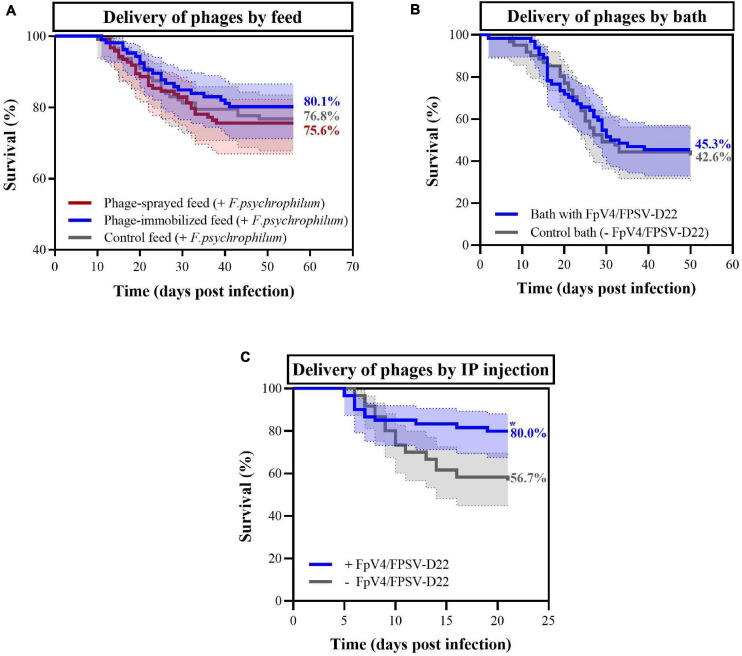
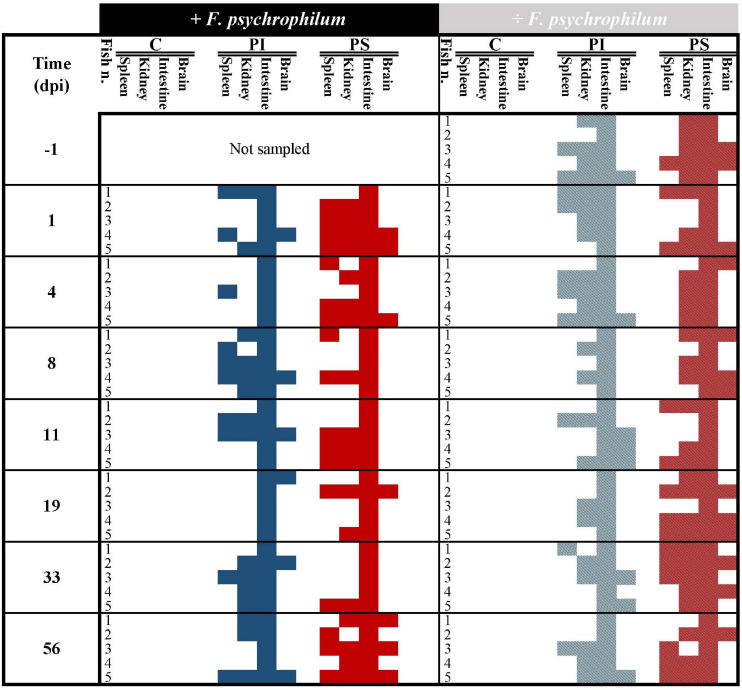
Phage-based approaches have gained increasing interest as sustainable alternative strategies to antibiotic treatment or as prophylactic measures against disease outbreaks in aquaculture. The potential of three methods (oral, bath, and injection) for delivering a two-component phage mixture to rainbow trout fry for controlling infections and reduce fish mortality was investigated using bacteriophages FpV4 and FPSV-D22. For the oral administration experiment, bacteriophages were applied on feed pellets by spraying (1.6 × 10 PFU g) or by irreversible immobilization (8.3 × 10 PFU g), using the corona discharge technology (Fixed Phage Ltd.). The fish showed normal growth for every group and no mortality was observed prior to infection as well as in control groups during the infection. Constant detection of phages in the intestine (∼10 PFU mg) and more sporadic occurrence in kidney, spleen, and brain was observed. When fish were exposed to , no significant effect on fish survival, nor a direct impact on the number of phages in the sampled organs, were detected. Similarly, no significant increase in fish survival was detected when phages were delivered by bath (1 and 2 bath: ∼10 PFU ml; 3 bath: ∼10 PFU ml). However, when phages FpV4 and FPSV-D22 (1.7 × 10 PFU fish) were administered by intraperitoneal injection 3 days after the bacterial challenge, the final percent survival observed in the group injected with bacteriophages FpV4 and FPSV-D22 (80.0%) was significantly higher than in the control group (56.7%). The work demonstrates the delivery of phages to fish organs by oral administration, but also suggests that higher phage dosages than the tested ones may be needed on feed pellets to offer fish an adequate protection against infections.
基于噬菌体的方法作为抗生素治疗的可持续替代策略或水产养殖中疾病爆发的预防措施,已越来越受到关注。使用噬菌体FpV4和FPSV-D22研究了三种方法(口服、浸浴和注射)将双组分噬菌体混合物递送至虹鳟鱼苗以控制感染并降低鱼类死亡率的潜力。在口服给药实验中,通过喷雾(1.6×10 PFU/g)或使用电晕放电技术(Fixed Phage Ltd.)进行不可逆固定(8.3×10 PFU/g)将噬菌体应用于饲料颗粒上。每组鱼生长正常,在感染前以及感染期间的对照组中均未观察到死亡。观察到肠道中持续检测到噬菌体(约10 PFU/mg),而在肾脏、脾脏和大脑中出现的频率较低。当鱼暴露于 时,未检测到对鱼类存活的显著影响,也未检测到对采样器官中噬菌体数量的直接影响。同样,通过浸浴(1次和2次浸浴:约10 PFU/ml;3次浸浴:约10 PFU/ml)递送噬菌体时,未检测到鱼类存活率的显著增加。然而,在细菌攻击后3天通过腹腔注射施用噬菌体FpV4和FPSV-D22(1.7×10 PFU/鱼)时,注射噬菌体FpV4和FPSV-D22的组中观察到的最终存活百分比(80.0%)显著高于对照组(56.7%)。这项工作证明了通过口服给药将噬菌体递送至鱼类器官,但也表明可能需要在饲料颗粒上使用比测试剂量更高的噬菌体剂量,以使鱼类获得足够的保护以抵御 感染。