Department of International Health, the Johns Hopkins University Bloomberg School of Public Health, Baltimore, Maryland, USA.
Population Council, Nairobi, Kenya.
J Glob Health. 2021 Mar 10;11:07005. doi: 10.7189/jogh.11.07005.
Community health workers (CHWs) play a critical role in supporting health systems, and in improving the availability and accessibility to health care. However, CHW programs globally continue to face challenges with poor performance and high levels of CHW attrition. CHW programs are often underfunded and poorly planned, which can lead to loss of motivation by CHWs. The study aims to determine preferences of CHWs for job incentives with the goal of furthering their motivation and success.
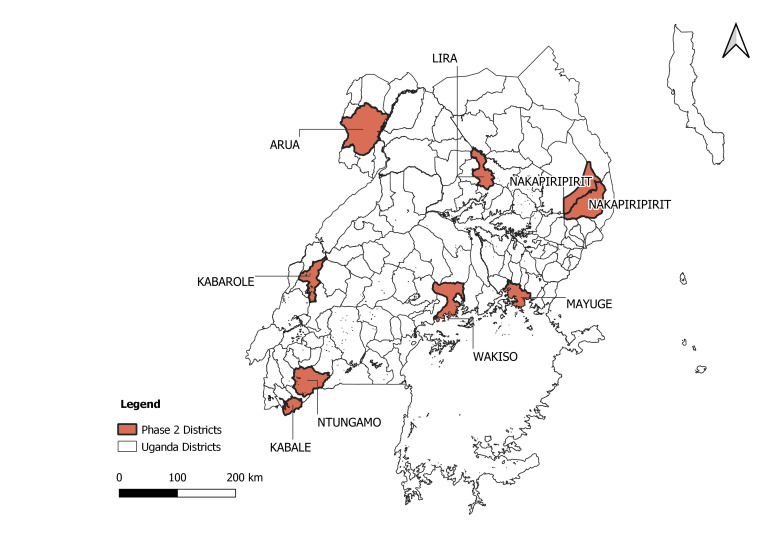
Relevant incentive attributes were identified through focus group discussions and in-depth interviews with CHWs, non-governmental organization CHWs, CHW supervisors, and policy-level stakeholders. Based on seven attributes (eg, training, workload, stipend) we developed a discrete choice experiment (DCE) that was administered to 399 CHWs across eight districts in Uganda. We used conditional and mixed multinomial logit models to estimate the utility of each job attribute. We calculated the marginal willingness to accept as the trade-off the CHWs were willing to make for a change in salary.
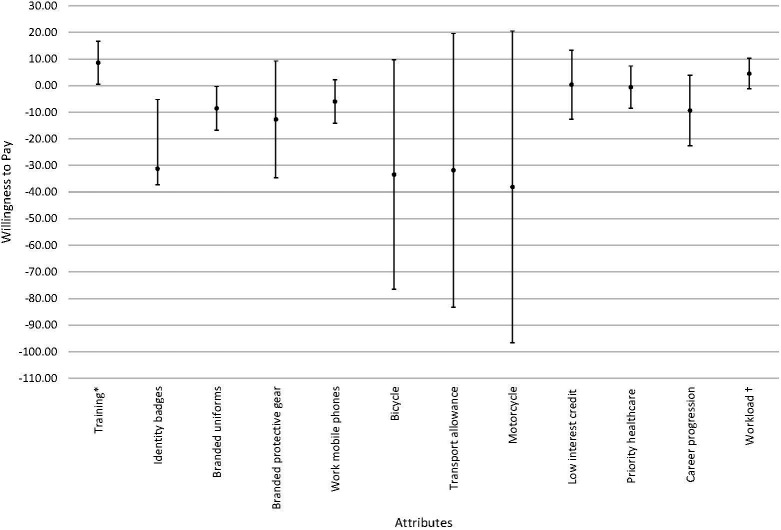
CHWs preferred higher salaries, though salary was not the most important attribute. There was a preference for reliable transportation, such as a bicycle (β = 1.86, 95% CI = 1.06, 2.67), motorcycle (β = 1.81, 95% CI = 1.27, 2.34) or transport allowance (β = 1.37, 95% CI = 0.65, 2.10) to no transport. Formal identification including identity badges (β = 1.61, 95% CI = 0.72, 2.49), branded uniforms (β = 1.04, 95% CI = 0.45, 1.63) and protective branded gear (β = 0.76, 95% CI = 0.32, 1.21) were preferred compared to no identification. CHWs also preferred more regular refresher trainings, the use of mobile phones as job-aids and a lesser workload. The relative importance estimates suggested that transport was the most important attribute, followed by identification, refresher training, salary, workload, recognition, and availability of tools. CHWs were willing to accept a decrease in salary of USH 31 240 (US$8.5) for identity badges, and a decrease of USH85 300 (US$23) for branded uniforms to no identification.
This study utilized CHW and policymaker perspectives to identify realistic and pragmatic incentives to improve CHW working conditions, which is instrumental in improving their retention. Non-monetary incentives (eg, identification, transportation) are crucial motivators for CHWs and should be considered as part of the compensation package to facilitate improved performance of CHW programs.
社区卫生工作者(CHWs)在支持卫生系统和提高卫生保健的可及性方面发挥着关键作用。然而,全球的 CHW 项目仍然面临着绩效不佳和 CHW 大量流失的挑战。CHW 项目往往资金不足且规划不善,这可能导致 CHW 失去动力。本研究旨在确定 CHW 对工作激励措施的偏好,以进一步激发他们的积极性和成功。
通过对 CHW、非政府组织 CHW、CHW 主管和政策制定者进行焦点小组讨论和深入访谈,确定了相关激励属性。基于七个属性(例如,培训、工作量、津贴),我们开发了一个离散选择实验(DCE),并在乌干达八个地区的 399 名 CHW 中进行了测试。我们使用条件和混合多项逻辑回归模型来估计每个工作属性的效用。我们计算了边际意愿接受程度,即 CHW 愿意为工资变化做出的权衡。
CHW 更喜欢更高的工资,尽管工资并不是最重要的属性。他们更喜欢可靠的交通工具,例如自行车(β=1.86,95%置信区间=1.06,2.67)、摩托车(β=1.81,95%置信区间=1.27,2.34)或交通补贴(β=1.37,95%置信区间=0.65,2.10),而不是没有交通工具。与没有身份证明相比,正式身份识别(包括身份证、品牌制服和防护品牌装备)(β=1.61,95%置信区间=0.72,2.49)、品牌制服(β=1.04,95%置信区间=0.45,1.63)和防护装备(β=0.76,95%置信区间=0.32,1.21)受到偏爱。CHW 还更喜欢更定期的进修培训、使用手机作为工作辅助工具和更少的工作量。相对重要性估计表明,交通是最重要的属性,其次是身份识别、进修培训、工资、工作量、认可和工具的可用性。CHW 愿意接受减少 31240 乌干达先令(8.5 美元)的身份证费用,以及减少 85300 乌干达先令(23 美元)的品牌制服费用,以换取无身份证明。
本研究利用 CHW 和政策制定者的观点,确定了切实可行的激励措施,以改善 CHW 的工作条件,这对于提高他们的留用率至关重要。非货币激励措施(例如,身份证明、交通)是 CHW 的重要激励因素,应作为薪酬方案的一部分加以考虑,以促进 CHW 项目绩效的提高。