Department of Neurology, Shengjing Hospital of China Medical University, No. 36 Sanhao Street, Heping District, Shenyang, Liaoning, 110004, China.
J Transl Med. 2021 Mar 25;19(1):125. doi: 10.1186/s12967-021-02804-7.
Multiple Sclerosis (MS) is a potentially devastating autoimmune neurological disorder, which characteristically induces demyelination of white matter in the brain and spinal cord.
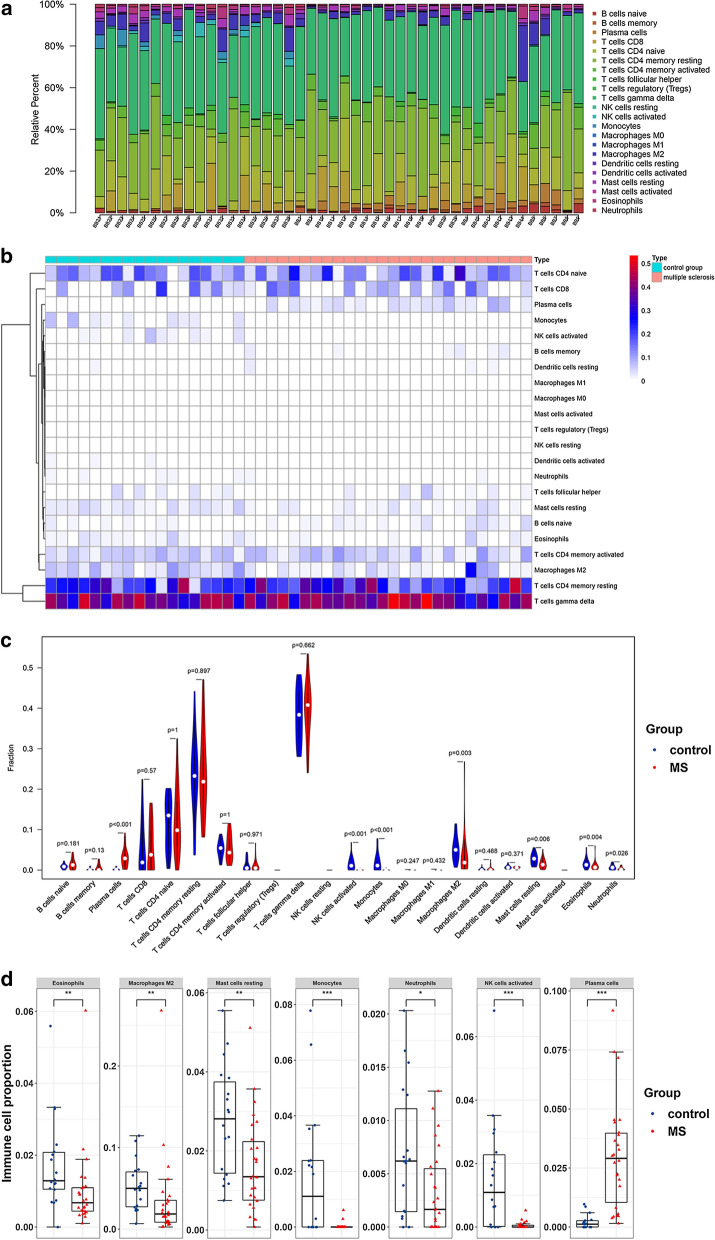
In this study, three characteristics of the central nervous system (CNS) immune microenvironment occurring during MS onset were explored; immune cell proportion alteration, differential gene expression profile, and related pathways. The raw data of two independent datasets were obtained from the ArrayExpress database; E-MTAB-69, which was used as a derivation cohort, and E-MTAB-2374 which was used as a validation cohort. Differentially expressed genes (DEGs) were identified by the false discovery rate (FDR) value of < 0.05 and |log2 (Fold Change)|> 1, for further analysis. Then, functional enrichment analyses were performed to explore the pathways associated with MS onset. The gene expression profiles were analyzed using CIBERSORT to identify the immune type alterations involved in MS disease.
After verification, the proportion of five types of immune cells (plasma cells, monocytes, macrophage M2, neutrophils and eosinophils) in cerebrospinal fluid (CSF) were revealed to be significantly altered in MS cases compared to the control group. Thus, the complement and coagulation cascades and the systemic lupus erythematosus (SLE) pathways may play critical roles in MS. We identified NLRP3, LILRB2, C1QB, CD86, C1QA, CSF1R, IL1B and TLR2 as eight core genes correlated with MS.
Our study identified the change in the CNS immune microenvironment of MS cases by analysis of the in silico data using CIBERSORT. Our data may assist in providing directions for further research as to the molecular mechanisms of MS and provide future potential therapeutic targets in treatment.
多发性硬化症(MS)是一种潜在的破坏性自身免疫性神经系统疾病,其特征在于诱导大脑和脊髓的白质脱髓鞘。
在这项研究中,探索了 MS 发病过程中中枢神经系统(CNS)免疫微环境的三个特征;免疫细胞比例改变、差异基因表达谱和相关途径。从 ArrayExpress 数据库中获得了两个独立数据集的原始数据;E-MTAB-69 用作推导队列,E-MTAB-2374 用作验证队列。通过假发现率(FDR)值<0.05 和 |log2(倍数变化)|>1 确定差异表达基因(DEGs),用于进一步分析。然后,进行功能富集分析以探索与 MS 发病相关的途径。使用 CIBERSORT 分析基因表达谱,以确定与 MS 疾病相关的免疫类型改变。
验证后,与对照组相比,MS 病例脑脊液(CSF)中五种免疫细胞(浆细胞、单核细胞、M2 巨噬细胞、中性粒细胞和嗜酸性粒细胞)的比例明显改变。因此,补体和凝血级联反应以及系统性红斑狼疮(SLE)途径可能在 MS 中发挥关键作用。我们确定了 NLRP3、LILRB2、C1QB、CD86、C1QA、CSF1R、IL1B 和 TLR2 作为与 MS 相关的八个核心基因。
我们通过使用 CIBERSORT 对基于计算机的数据分析,鉴定了 MS 病例 CNS 免疫微环境的变化。我们的数据可能有助于为 MS 的分子机制研究提供方向,并为未来的治疗提供潜在的治疗靶点。