Department of Psychology & Center for Translational Neuroscience, University of Oregon, Eugene, OR, USA.
Counseling Psychology and Human Services, University of Oregon, Eugene, OR, USA.
Dev Psychopathol. 2022 Oct;34(4):1618-1635. doi: 10.1017/S0954579421000031. Epub 2021 Mar 26.
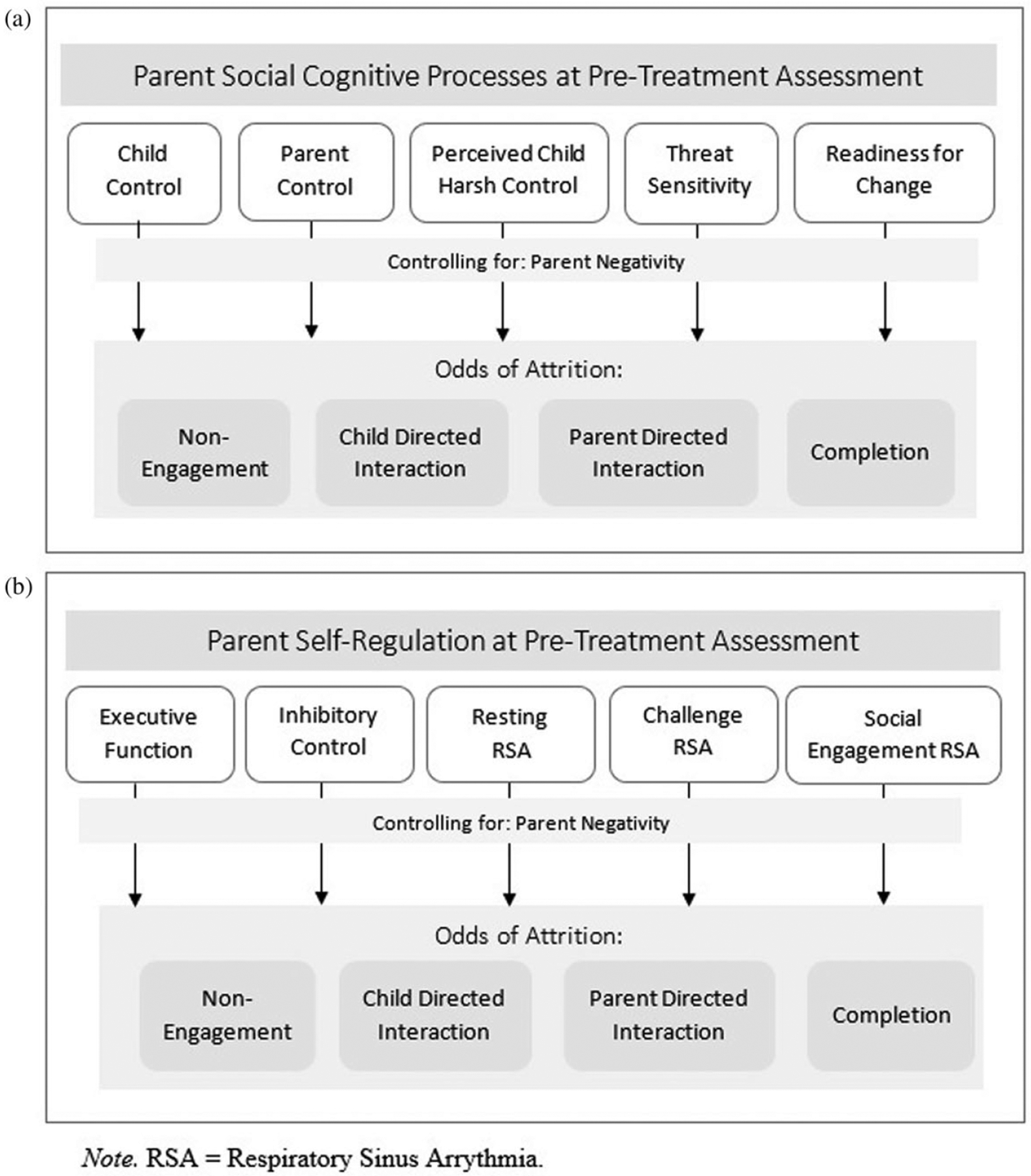
Parent-Child interaction therapy (PCIT) has been shown to improve positive, responsive parenting and lower risk for child maltreatment (CM), including among families who are already involved in the child welfare system. However, higher risk families show higher rates of treatment attrition, limiting effectiveness. In = 120 child welfare families randomized to PCIT, we tested behavioral and physiological markers of parent self-regulation and socio-cognitive processes assessed at pre-intervention as predictors of retention in PCIT. Results of multinomial logistic regressions indicate that parents who declined treatment displayed more negative parenting, greater perceptions of child responsibility and control in adult-child transactions, respiratory sinus arrhythmia (RSA) increases to a positive dyadic interaction task, and RSA withdrawal to a challenging, dyadic toy clean-up task. Increased odds of dropout during PCIT's child-directed interaction phase were associated with greater parent attentional bias to angry facial cues on an emotional go/no-go task. Hostile attributions about one's child predicted risk for dropout during the parent-directed interaction phase, and readiness for change scores predicted higher odds of treatment completion. Implications for intervening with child welfare-involved families are discussed along with study limitations.
亲子互动治疗(PCIT)已被证明可以改善积极、响应式的育儿方式,并降低儿童虐待(CM)的风险,包括已经参与儿童福利系统的家庭。然而,高风险家庭的治疗脱落率更高,限制了其效果。在随机分配到 PCIT 的 120 个儿童福利家庭中,我们测试了父母自我调节的行为和生理标记物,以及在干预前评估的社会认知过程,作为 PCIT 保留的预测指标。多项逻辑回归的结果表明,拒绝治疗的父母表现出更多的消极育儿方式,在成人-儿童交易中对儿童的责任感和控制感更强,呼吸窦性心律失常(RSA)在积极的二元互动任务中增加,而在具有挑战性的二元玩具清理任务中 RSA 减少。在 PCIT 的儿童导向互动阶段,更多的父母注意力偏向于情绪 Go/No-Go 任务中的愤怒面部线索,与更高的脱落几率相关。对孩子的敌意归因预测了父母导向互动阶段的脱落风险,而改变准备分数则预测了更高的治疗完成几率。讨论了与儿童福利相关的家庭干预的意义,同时也讨论了研究的局限性。