Zou Jing, Xie Xuping, Fontes-Garfias Camila R, Swanson Kena A, Kanevsky Isis, Tompkins Kristin, Cutler Mark, Cooper David, Dormitzer Philip R, Shi Pei-Yong
Department of Biochemistry and Molecular Biology, University of Texas Medical Branch, Galveston, TX, USA.
Pfizer, Pearl River, NY, USA.
NPJ Vaccines. 2021 Mar 25;6(1):44. doi: 10.1038/s41541-021-00313-8.
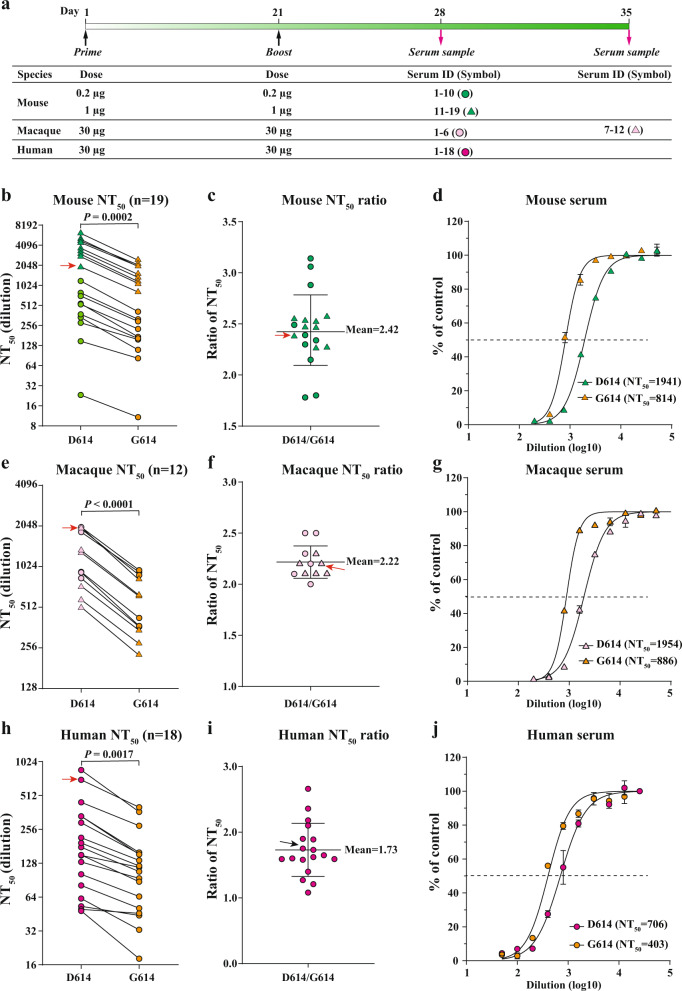
Initial COVID-19 vaccine candidates were based on the original sequence of SARS-CoV-2. However, the virus has since accumulated mutations, among which the spike D614G is dominant in circulating virus, raising questions about potential virus escape from vaccine-elicited immunity. Here, we report that the D614G mutation modestly reduced (1.7-2.4-fold) SARS-CoV-2 neutralization by BNT162b2 vaccine-elicited mouse, rhesus, and human sera, concurring with the 95% vaccine efficacy observed in clinical trial.
最初的新冠病毒疫苗候选品种是基于严重急性呼吸综合征冠状病毒2(SARS-CoV-2)的原始序列。然而,自那时起该病毒已积累了突变,其中刺突蛋白D614G在传播的病毒中占主导地位,这引发了关于病毒可能逃避疫苗诱导免疫的问题。在此,我们报告,D614G突变使BNT162b2疫苗诱导的小鼠、恒河猴和人血清对SARS-CoV-2的中和作用适度降低(1.7至2.4倍),这与临床试验中观察到的95%的疫苗效力相符。