Waltz James A, Wilson Robert C, Albrecht Matthew A, Frank Michael J, Gold James M
Maryland Psychiatric Research Center, University of Maryland School of Medicine, Baltimore, Maryland, USA.
Department of Psychology and Cognitive Science Program, University of Arizona, Tucson, Arizona, USA.
Comput Psychiatr. 2020;4:18-39. doi: 10.1162/cpsy_a_00027. Epub 2020 Aug 1.
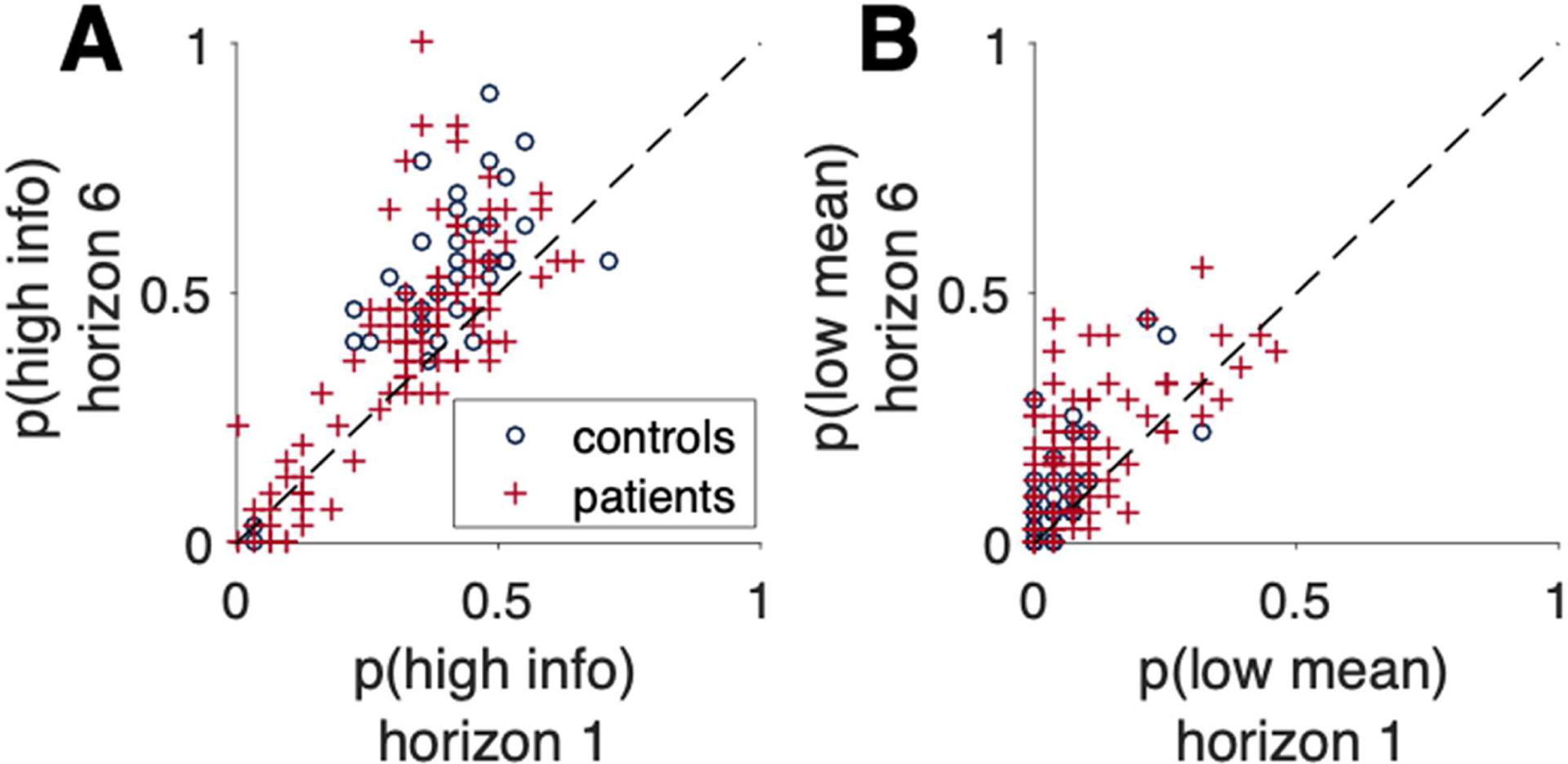
Schizophrenia is associated with a number of deficits in decision-making, but the scope, nature, and cause of these deficits are not completely understood. Here we focus on a particular type of decision, known as the dilemma, in which people must choose between exploiting options that yield relatively known rewards and exploring more ambiguous options of uncertain reward probability or magnitude. Previous work has shown that healthy people use two distinct strategies to decide when to explore: directed exploration, which involves choosing options that would reduce uncertainty about the reward values (information seeking), and random exploration (exploring by chance), which describes behavioral variability that is not goal directed. We administered a recently developed gambling task designed to quantify both directed and random exploration to 108 patients with schizophrenia (PSZ) and 33 healthy volunteers (HVs). We found that PSZ patients show reduced directed exploration relative to HVs, but no difference in random exploration. Moreover, patients' directed exploration behavior clusters into two qualitatively different behavioral phenotypes. In the first phenotype, which accounts for the majority of the patients (79%) and is consistent with previously reported behavior, directed exploration is only marginally (but significantly) reduced, suggesting that these patients can use directed exploration, but at a slightly lower level than community controls. In contrast, the second phenotype, comprising 21% of patients, exhibit a form of "extreme ambiguity aversion," in which they almost never choose more informative options, even when they are clearly of higher value. Moreover, in PSZ, deficits in directed exploration were related to measures of intellectual function, whereas random exploration was related to positive symptoms. Taken together, our results suggest that schizophrenia has differential effects on directed and random exploration and that investigating the explore/exploit dilemma in psychosis patients may reveal subgroups of patients with qualitatively different patterns of exploration.
精神分裂症与决策方面的多种缺陷相关,但这些缺陷的范围、性质和成因尚未完全明确。在此,我们聚焦于一种特定类型的决策,即两难抉择,在此情境中人们必须在利用能带来相对已知回报的选项与探索回报概率或量级更模糊的选项之间做出选择。先前的研究表明,健康人会运用两种不同策略来决定何时进行探索:定向探索,即选择能降低回报价值不确定性的选项(信息寻求),以及随机探索(偶然探索),它描述的是无目标导向的行为变异性。我们对108名精神分裂症患者(PSZ)和33名健康志愿者(HVs)进行了一项最近开发的赌博任务,该任务旨在量化定向探索和随机探索。我们发现,与健康志愿者相比,精神分裂症患者的定向探索减少,但随机探索无差异。此外,患者的定向探索行为可分为两种性质不同的行为表型。在第一种表型中,占大多数患者(79%),且与先前报道的行为一致,定向探索仅略有(但显著)减少,这表明这些患者能够运用定向探索,但水平略低于社区对照组。相比之下,第二种表型占患者的21%,表现出一种“极端模糊厌恶”形式,即他们几乎从不选择信息更多的选项,即使这些选项明显价值更高。此外,在精神分裂症患者中,定向探索缺陷与智力功能指标相关,而随机探索与阳性症状相关。综合来看,我们的结果表明,精神分裂症对定向探索和随机探索有不同影响,并且研究精神病患者的探索/利用两难困境可能会揭示出具有性质不同探索模式的患者亚组。