Department of Pharmacy and Pharmacology, University of Bath.
Royal National Hospital for Rheumatic Diseases, NHS Foundation Trust.
Rheumatology (Oxford). 2022 Feb 2;61(2):581-590. doi: 10.1093/rheumatology/keab310.
The aim of this study was to explore the use of Bayesian networks (BNs) to understand the relationships between musculoskeletal symptoms and the development of PsA in people with psoriasis.
Incident cases of psoriasis were identified for 1998 to 2015 from the UK Clinical Research Practice Datalink. Musculoskeletal symptoms (identified by Medcodes) were concatenated into primary groups, each made up of several subgroups. Baseline demographics for gender, age, BMI, psoriasis severity, alcohol use and smoking status were also extracted. Several BN structures were composed using a combination of expert knowledge and data-oriented modelling based on: (i) primary musculoskeletal symptom groups; (ii) musculoskeletal symptom subgroups and (iii) demographic variables. Predictive ability of the networks using the area under the receiver operating characteristic curve was calculated.
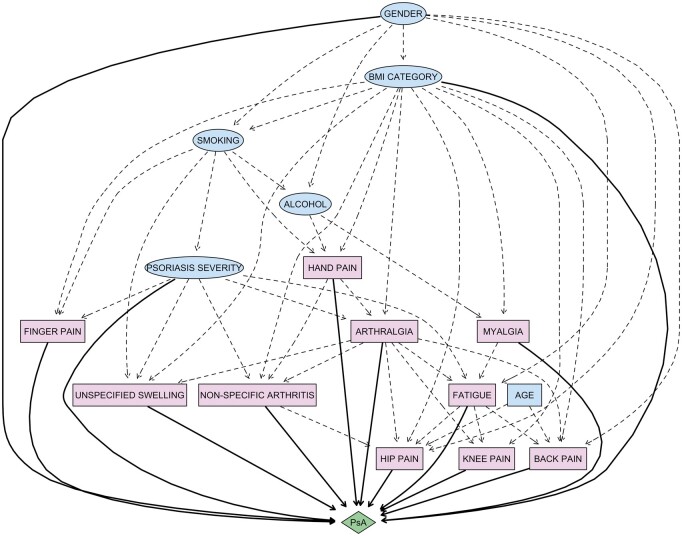
Over one million musculoskeletal symptoms were extracted for the 90 189 incident cases of psoriasis identified, of which 1409 developed PsA. The BN analysis yielded direct relationships between gender, BMI, arthralgia, finger pain, fatigue, hand pain, hip pain, knee pain, swelling, back pain, myalgia and PsA. The best BN, achieved by using the more site-specific musculoskeletal symptom subgroups, was 76% accurate in predicting the development of PsA in a test set and had an area under the receiver operating characteristic curve of 0.73 (95% CI: 0.70, 0.75).
The presented BN model may be a useful method to identify clusters of symptoms that predict the development of PsA with reasonable accuracy. Using a BN approach, we have shown that there are several symptoms which are predecessors of PsA, including fatigue, specific types of pain and swelling.
本研究旨在探讨贝叶斯网络(BNs)在理解银屑病患者的肌肉骨骼症状与 PsA 发展之间的关系中的应用。
1998 年至 2015 年,从英国临床研究实践数据链接中确定了银屑病的发病病例。肌肉骨骼症状(通过 Medcodes 确定)被串联成主要组,每个主要组由几个亚组组成。还提取了性别、年龄、BMI、银屑病严重程度、酒精使用和吸烟状况等基线人口统计学数据。根据以下内容构建了几个 BN 结构:(i)主要肌肉骨骼症状组;(ii)肌肉骨骼症状亚组和(iii)人口统计学变量。使用基于专家知识和面向数据的建模的组合,计算网络的预测能力,其使用了接收器工作特征曲线下的面积。
为确定的 90189 例银屑病发病病例提取了超过 100 万例肌肉骨骼症状,其中 1409 例发展为 PsA。BN 分析得出了性别、BMI、关节痛、手指疼痛、疲劳、手部疼痛、髋部疼痛、膝部疼痛、肿胀、背部疼痛、肌痛与 PsA 之间的直接关系。通过使用更特定于部位的肌肉骨骼症状亚组,获得的最佳 BN 在测试集中预测 PsA 发展的准确率为 76%,其接收器工作特征曲线下的面积为 0.73(95%CI:0.70,0.75)。
所提出的 BN 模型可能是一种有用的方法,可以识别出具有合理准确性的预测 PsA 发展的症状集群。通过使用 BN 方法,我们已经表明,有几种症状是 PsA 的前兆,包括疲劳、特定类型的疼痛和肿胀。