Frontotemporal Degeneration Center, Perelman School of Medicine, Department of Neurology, Philadelphia, PA, United States.
Frontotemporal Degeneration Center, Perelman School of Medicine, Department of Neurology, Philadelphia, PA, United States; School of Nursing, University of Pennsylvania, Philadelphia, PA, United States.
Neuroimage Clin. 2021;30:102629. doi: 10.1016/j.nicl.2021.102629. Epub 2021 Mar 13.
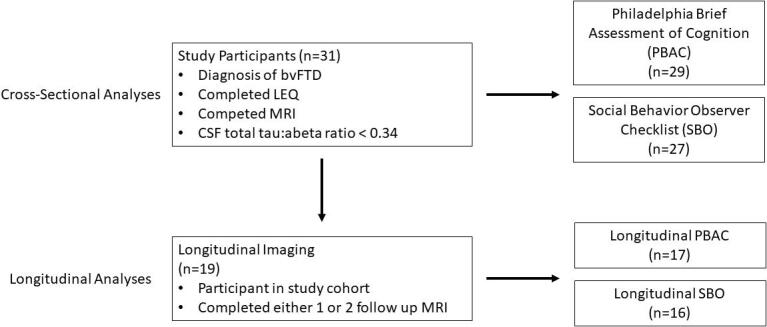
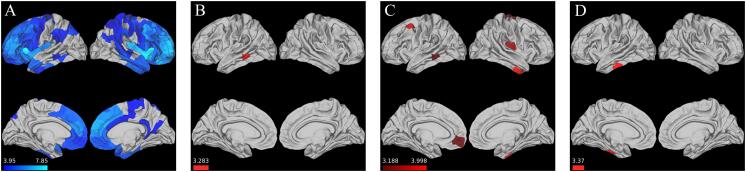
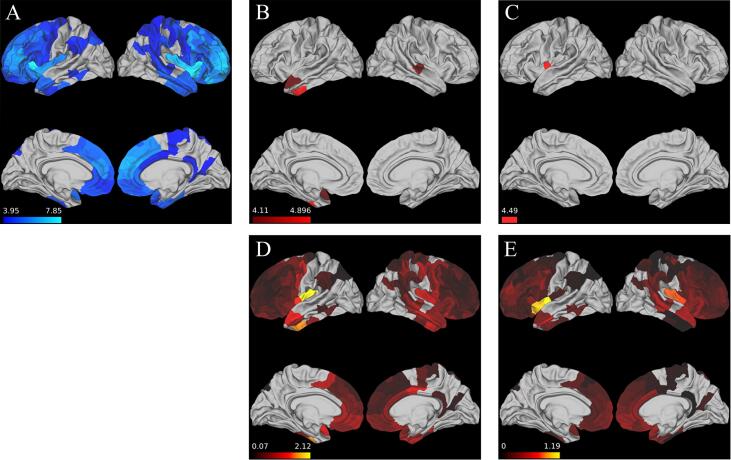
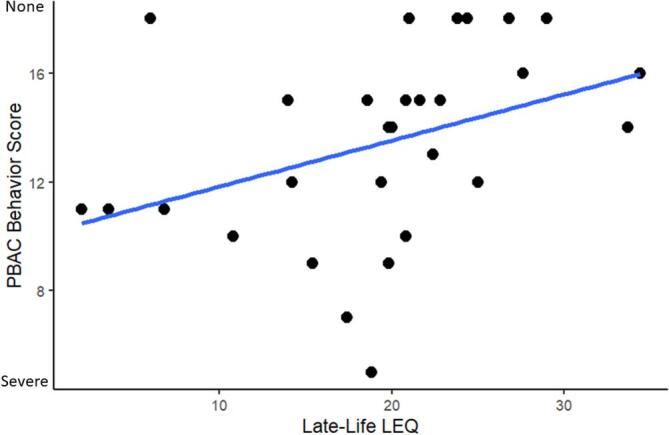
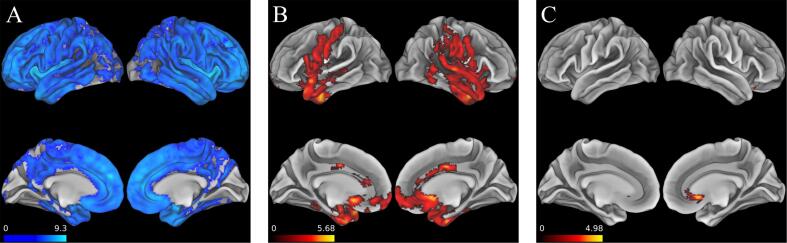
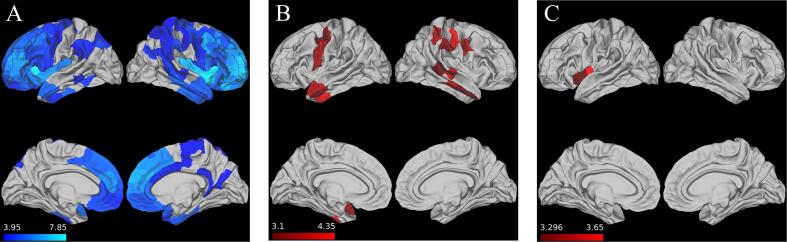
Behavioral variant frontotemporal degeneration (bvFTD) is clinically characterized by progressive decline in social and executive domains. Previous work suggests that early lifestyle factors such as education and occupational attainment may relate to structural integrity and moderate the rate of cognitive decline in bvFTD, but the role of other cognitively stimulating activities is understudied. We sought to investigate the effect of such activities on cortical thickness (CT) in bvFTD. bvFTD patients (n = 31) completed a baseline MRI scan, and informants for the patients completed the Lifetime of Experiences Questionnaire (LEQ), which measures specific activities considered to be undertaken primarily within one particular life phase, such as education (young-life), occupation (mid-life), and social/leisure activity (late-life). At baseline, linear models assessed the effect of LEQ scores from each life phase on regional CT. A subset (n = 19) of patients completed longitudinal MRI, and to evaluate the association of LEQ with longitudinal rates of CT decline, we derived individualized slopes of decline using linear mixed effects models and these were related to LEQ scores from each life phase. At baseline, a higher late-life LEQ score was associated with less atrophy in left superior and inferior anterior temporal regions as well as right middle temporal gyrus. Longitudinally, we observed that higher late-life LEQ scores were associated with an attenuated rate of CT loss in insular cortex. Late-life LEQ score was positively associated with both relatively preserved CT early in bvFTD and a slower rate of cortical loss in regions important for social functioning. These findings suggest that social and leisure activities may contribute to a form of resilience against pathologic effects of disease.
行为变异额颞叶痴呆(bvFTD)的临床特征是社会和执行领域的逐渐衰退。以前的工作表明,早期的生活方式因素,如教育和职业成就,可能与结构完整性有关,并减缓 bvFTD 的认知衰退速度,但其他认知刺激活动的作用仍有待研究。我们试图研究这些活动对 bvFTD 皮质厚度(CT)的影响。bvFTD 患者(n=31)完成了基线 MRI 扫描,患者的知情人完成了生活经历问卷(LEQ),该问卷衡量了被认为主要在特定生命阶段进行的特定活动,如教育(青年期)、职业(中年期)和社会/休闲活动(老年期)。在基线时,线性模型评估了每个生命阶段的 LEQ 分数对区域 CT 的影响。患者的一个亚组(n=19)完成了纵向 MRI,为了评估 LEQ 与 CT 下降的纵向速率的关联,我们使用线性混合效应模型得出了个体下降斜率,并将其与每个生命阶段的 LEQ 分数相关联。在基线时,较高的老年期 LEQ 分数与左侧额下回和上回以及右侧中颞回的萎缩程度较低有关。纵向观察发现,较高的老年期 LEQ 分数与岛叶皮质 CT 丢失率的降低有关。老年期 LEQ 得分与 bvFTD 早期相对保留的 CT 和对社会功能重要的区域皮质丢失率较慢呈正相关。这些发现表明,社会和休闲活动可能有助于对疾病的病理影响产生一种弹性。