Australian Research Council Centre of Excellence for Translational Photosynthesis, Division of Plant Science, Research School of Biology, The Australian National University, Acton, Australian Capital Territory, 2601, Australia.
University of the Balearic Islands, Palma, Illes Balears, 07122, Spain.
Plant J. 2021 Jun;106(5):1443-1454. doi: 10.1111/tpj.15247. Epub 2021 May 7.
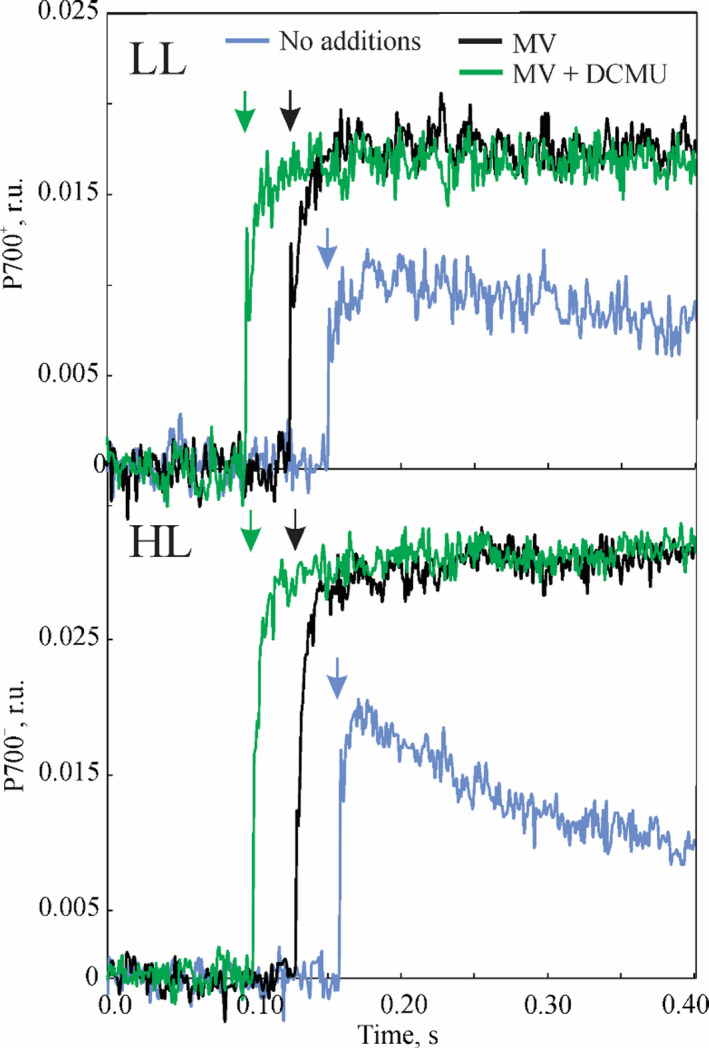
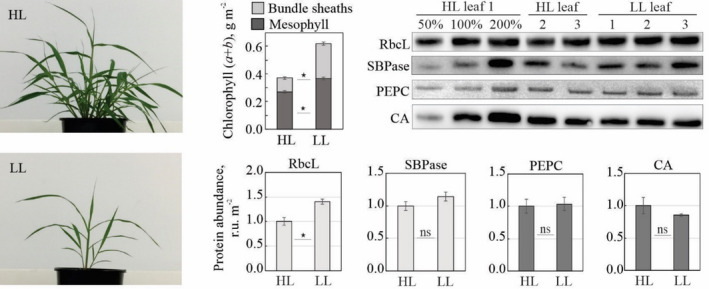
C photosynthesis is a biochemical pathway that operates across mesophyll and bundle sheath (BS) cells to increase CO concentration at the site of CO fixation. C plants benefit from high irradiance but their efficiency decreases under shade, causing a loss of productivity in crop canopies. We investigated shade acclimation responses of Setaria viridis, a model monocot of NADP-dependent malic enzyme subtype, focussing on cell-specific electron transport capacity. Plants grown under low light (LL) maintained CO assimilation rates similar to high light plants but had an increased chlorophyll and light-harvesting-protein content, predominantly in BS cells. Photosystem II (PSII) protein abundance, oxygen-evolving activity and the PSII/PSI ratio were enhanced in LL BS cells, indicating a higher capacity for linear electron flow. Abundances of PSI, ATP synthase, Cytochrome b f and the chloroplast NAD(P)H dehydrogenase complex, which constitute the BS cyclic electron flow machinery, were also increased in LL plants. A decline in PEP carboxylase activity in mesophyll cells and a consequent shortage of reducing power in BS chloroplasts were associated with a more oxidised plastoquinone pool in LL plants and the formation of PSII - light-harvesting complex II supercomplexes with an increased oxygen evolution rate. Our results suggest that the supramolecular composition of PSII in BS cells is adjusted according to the redox state of the plastoquinone pool. This discovery contributes to the understanding of the acclimation of PSII activity in C plants and will support the development of strategies for crop improvement, including the engineering of C photosynthesis into C plants.
C 光合作用是一种横跨叶肉和束鞘(BS)细胞的生化途径,以增加 CO 固定部位的 CO 浓度。C 植物受益于高光强,但在遮荫下效率下降,导致作物冠层生产力下降。我们研究了 NADP 依赖性苹果酸酶亚型的模式单子叶植物柳枝稷对遮荫的适应反应,重点关注细胞特异性电子传递能力。在低光(LL)下生长的植物保持与高光植物相似的 CO 同化速率,但叶绿素和光捕获蛋白含量增加,主要在 BS 细胞中。PSII 蛋白丰度、氧释放活性和 PSII/PSI 比在 LL BS 细胞中增强,表明线性电子流能力更高。PSI、ATP 合酶、细胞色素 b f 和质体 NAD(P)H 脱氢酶复合物的丰度也在 LL 植物中增加,这些都是 BS 环式电子流机制的组成部分。PEP 羧化酶活性在叶肉细胞中的下降以及 BS 叶绿体中还原力的相应不足,与 LL 植物中更氧化的质醌库以及 PSII-光捕获复合物 II 超复合物的形成有关,后者具有更高的氧气释放速率。我们的结果表明,BS 细胞中 PSII 的超分子组成根据质醌库的氧化还原状态进行调整。这一发现有助于理解 C 植物 PSII 活性的适应,将为作物改良策略的发展提供支持,包括将 C 光合作用工程化到 C 植物中。